
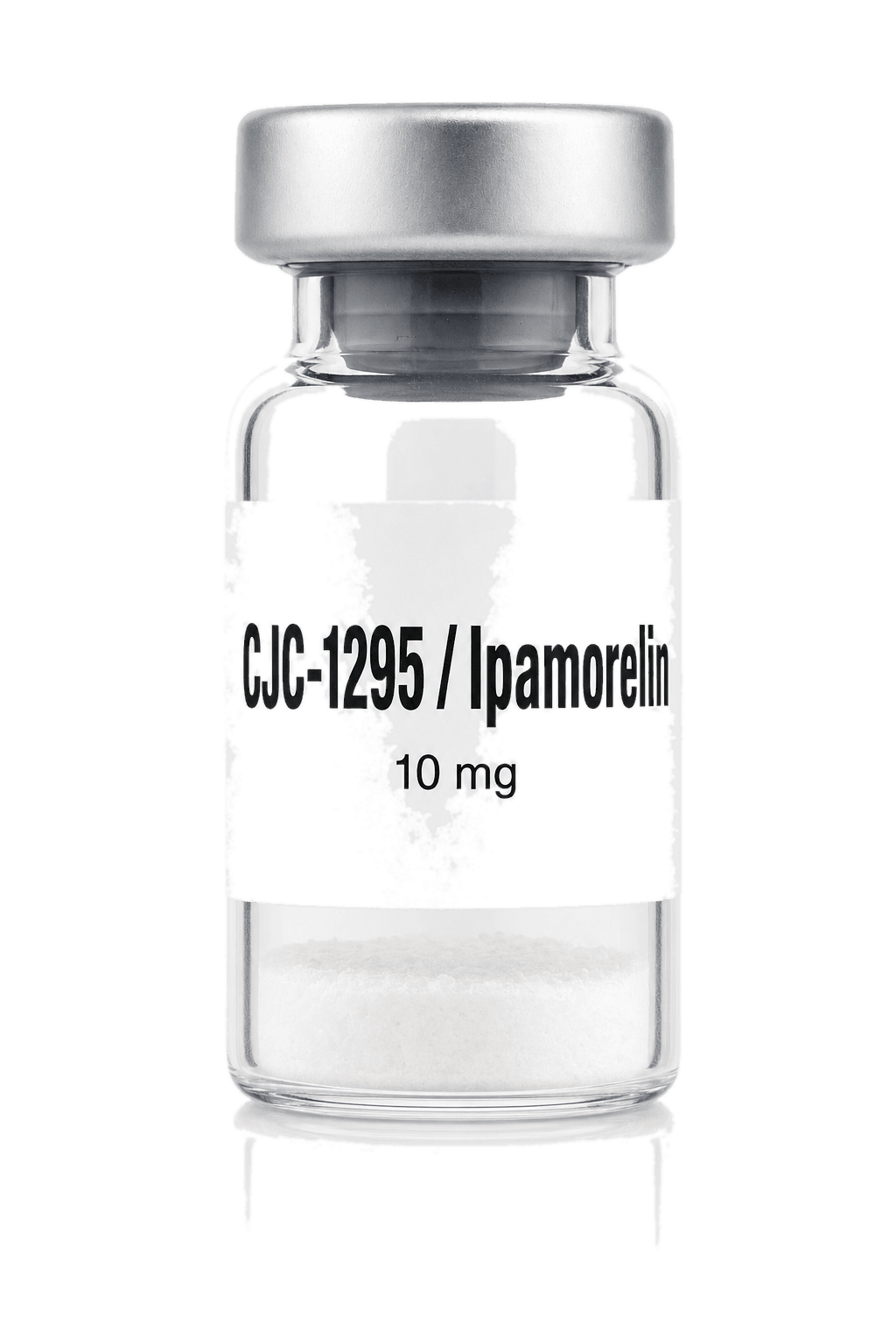
CJC-1295 / Ipamorelin Blend
CJC-1295 / Ipamorelin is a blend of two synthetic research peptides marketed for growth-hormone support. Neither is FDA-approved for any use, human data are limited, and both are banned in sport by WADA. This is education, not medical advice.
In plain words
This is a popular combo of two peptides — CJC-1295 and Ipamorelin — that together push your body to release more of its own growth hormone. People use it hoping for better recovery, muscle, and sleep.
1 person has this in their stack
Key facts
- Category
- Growth hormone peptides
- Legal / FDA status
- Research chemicals (neither FDA-approved). CJC-1295 and ipamorelin are unapproved growth-hormone secretagogues; the FDA has flagged peptide GH secretagogues as unsuitable for compounding, and both are prohibited in sport by WADA.
- Half-life
- Not well characterized in humans. CJC-1295 with DAC is reported to extend to several days; the no-DAC (Modified GRF 1-29) form and ipamorelin are short-acting (minutes to ~2 hours).
- Typical form
- Lyophilized (freeze-dried) powder for reconstitution
- Also known as
- CJC-1295 and Ipamorelin, CJC/Ipa blend, CJC-1295 + Ipamorelin, Modified GRF 1-29 + Ipamorelin
The CJC-1295 / Ipamorelin blend combines two synthetic research peptides that are marketed together for growth-hormone support. Neither component is approved by the FDA for any use, human data are limited, and both are banned in sport by the World Anti-Doping Agency. This page is educational information, not medical advice. It does not endorse using these materials, and any decision about your health should be made with a licensed clinician.
What is CJC-1295 / Ipamorelin Blend?#
This is not a single drug but a mixture of two separate peptides that vendors sell pre-combined:
- CJC-1295 is a synthetic analog of growth-hormone-releasing hormone (GHRH). It is designed to stimulate the pituitary gland to release growth hormone. It comes in two forms: a long-acting version "with DAC" (a Drug Affinity Complex that binds albumin and extends its reported half-life to days), and a short-acting version "without DAC," often called Modified GRF 1-29.
- Ipamorelin is a synthetic pentapeptide (five amino acids) classified as a selective ghrelin/growth-hormone-secretagogue-receptor (GHS-R) agonist. In early studies it stimulated growth hormone release with comparatively little effect on cortisol or prolactin, which is why it is described as relatively "selective."
The two are blended because they act on the growth-hormone axis through different but complementary pathways — a GHRH analog plus a ghrelin-receptor agonist — and sellers suggest the pairing might produce a larger or more sustained GH response. It is important to understand that the blend as a product has not itself been the subject of published human studies; the rationale for combining them is largely a marketing convention rather than an established, evidence-based protocol.
How does CJC-1295 / Ipamorelin Blend work?#
The proposed mechanisms come from the known pharmacology of each peptide individually:
- CJC-1295 mimics GHRH and binds the GHRH receptor on the pituitary, promoting the release of growth hormone (and, downstream, IGF-1). In an early single-dose human pharmacology study, the DAC form raised GH and IGF-1 levels for an extended period (Teichman et al., 2006).
- Ipamorelin acts on a different receptor — the growth-hormone-secretagogue (ghrelin) receptor — to trigger a pulse of growth-hormone release. In its original characterization it was notable for releasing GH with relatively little increase in cortisol and prolactin compared with some other secretagogues (Raun et al., 1998).
These are proposed mechanisms based largely on early pharmacology and animal models. They have not been confirmed to produce safe or meaningful long-term effects in humans, and laboratory mechanisms frequently fail to translate into real-world clinical benefit. The combination specifically has no published human trials.
What is CJC-1295 / Ipamorelin Blend studied for?#
Most claims trace back to early pharmacology research on the two peptides separately. The table below summarizes common research themes and how strong the human evidence is.
| Research theme | Study type | Evidence level in humans |
|---|---|---|
| Sustained GH/IGF-1 elevation (CJC-1295 with DAC) | Early single-dose human pharmacology (Teichman 2006) | Very limited; one early PK/PD study, no long-term trials |
| Selective GH release (ipamorelin) | Early pharmacology and animal studies | Very limited; no robust modern human efficacy trials |
| GH support / "anti-aging" / recovery claims | Mechanism- and animal-based marketing claims | Not established in humans |
| Combined CJC-1295 + ipamorelin blend | No published controlled studies of the combination | None |
A notable limitation: the strongest human data point is a single early single-dose study of CJC-1295 with DAC, and ipamorelin's clinical development was discontinued — neither supports the marketed blend as a proven product.
Is CJC-1295 / Ipamorelin Blend legal and FDA-approved?#
Neither component is FDA-approved.
- FDA status: Neither CJC-1295 nor ipamorelin is an FDA-approved drug, and neither is a lawful dietary supplement ingredient. The FDA has reviewed peptide growth hormone secretagogues as part of its bulk drug substances evaluation for compounding under section 503A and flagged this class as raising safety concerns and unsuitable for compounding. They remain unapproved drugs and are frequently sold labeled "research use only" or "not for human consumption."
- Sport status: Both CJC-1295 and ipamorelin fall under the WADA Prohibited List category S2 (Peptide Hormones, Growth Factors, Related Substances and Mimetics) — growth-hormone-releasing peptides and secretagogues are banned at all times, in and out of competition. Athletes have been sanctioned for their use, and military service members are warned against products containing these peptides.
Selling, marketing, or buying these as human-use products is legally fraught, and the "research chemical" labeling does not make human use safe or lawful.
How is CJC-1295 / Ipamorelin Blend dosed in research?#
There is no validated human dose for CJC-1295, ipamorelin, or the blend. The one human study of CJC-1295 with DAC (Teichman et al., 2006) used single subcutaneous research doses on a per-kilogram basis to characterize pharmacokinetics — not a regimen for the marketed no-DAC blend. Because adequate efficacy and safety trials have not been conducted, no one has established a dose that is known to be safe or effective, and no governing health authority has issued dosing guidance.
WikiPeps does not publish dosing protocols or amounts for these peptides. Any question about whether a peptide could be appropriate, and in what form or amount, should be directed to a licensed clinician who can weigh your individual medical history and the substantial unknowns involved.
How is CJC-1295 / Ipamorelin Blend reconstituted?#
These peptides are typically supplied as a lyophilized (freeze-dried) powder that must be reconstituted with bacteriostatic or sterile water before any handling. The frontmatter on this page includes a generic, education-only overview of the reconstitution steps, with no volumes or concentrations. For a fuller walkthrough of sterile technique, supplies, and storage, see our general guide at /learn/guides/how-to-reconstitute-a-peptide.
Reconstitution instructions describe laboratory handling only. They are not an endorsement of use and do not substitute for guidance from a licensed clinician.
What are the safety considerations?#
- Unknown human safety. With no adequate human trials of the combination, the long-term risks, drug interactions, and safe dose (if any) are unknown for both peptides and especially for the combination.
- Growth-axis effects. Because these peptides are designed to raise growth hormone and IGF-1, there are theoretical concerns about effects on blood sugar (insulin resistance), fluid retention, joint discomfort, and the possibility of supporting the growth of an existing, undetected tumor. These have not been resolved in humans.
- Product quality risk. Material sold as a research chemical is not manufactured to pharmaceutical standards. Purity, sterility, correct identity, and accurate labeling are not guaranteed, and contamination or mislabeling is a real possibility.
- Injection risks. These products are typically injected after reconstitution, which carries risks of infection, injection-site reactions, and harm from non-sterile technique.
- Regulatory and sport consequences. Use can result in anti-doping sanctions for athletes and is incompatible with rules for military service members and many employers.
- Not a substitute for care. Self-treating a perceived deficiency with an unapproved peptide may delay appropriate, evidence-based medical care.
If you are considering anything in this category, talk with a licensed clinician first. If you experience a reaction or adverse event, seek medical attention.
The bottom line#
The CJC-1295 / Ipamorelin blend pairs two synthetic peptides that are both unapproved research chemicals, not medicines. The human evidence is limited to early pharmacology of the individual components, the combination has no published human studies, and both are banned in sport by WADA. Human safety, effectiveness, and dosing are not established. This page is educational only and is not medical advice; decisions about your health should be made with a qualified, licensed clinician.
Side effects & safety
A growth-hormone stack; reported effects relate to raising GH and are usually mild.
Commonly reported
- Water retention / mild puffiness
- Tingling or numbness in the hands
- Head-rush or flushing after a dose
- Hunger
Limited human data; the long-term effects of sustained GH elevation aren't well studied.
Educational only — not medical advice. Everyone responds differently; talk to a licensed clinician before starting CJC-1295 / Ipamorelin Blend, and stop and seek medical care for any severe or unusual reaction.
Tried CJC-1295 / Ipamorelin Blend, or have a question about it?
Ask the community or share what you noticed — real people doing this carefully. Takes 30 seconds.
How to reconstitute lyophilized CJC-1295 / Ipamorelin Blend (educational overview)
What you'll need
- Vial of lyophilized CJC-1295 / Ipamorelin Blend
- Bacteriostatic water (or sterile water per product labeling)
- Sterile syringe for reconstitution
- Alcohol prep pads
- Clean, flat work surface
Wash hands and prepare the area
Wash your hands thoroughly and clear a clean, flat surface. Gather all supplies so you do not have to handle the vial repeatedly. This overview describes laboratory handling only and is not a recommendation to use this material in or on the body.
Inspect and warm the vial
Let a refrigerated vial come to room temperature. Inspect the powder and the diluent; do not use anything that looks discolored, cloudy, cracked, or otherwise compromised. Discard damaged vials.
Sanitize both stoppers
Wipe the rubber stopper of the peptide vial and the diluent vial each with a fresh alcohol prep pad and let them air-dry. This reduces the chance of contaminating the contents.
Draw the diluent
Using a sterile syringe, draw up sterile or bacteriostatic water. WikiPeps does not publish volumes or concentrations; any specific amounts are a dosing decision that belongs to a licensed clinician, not to this overview.
Add the liquid slowly
Insert the needle and let the water run slowly down the inside glass wall of the vial rather than spraying directly onto the powder. Do not shake; gently swirl or let it sit until the powder fully dissolves into a clear solution.
Label, store, and discard safely
Label the vial with the contents and reconstitution date, and store it per the labeling (typically refrigerated). Dispose of needles in a sharps container. Bring any questions about handling or use to a licensed clinician.
Frequently asked questions
What is the CJC-1295 / Ipamorelin blend?
- It is a combination of two separate synthetic peptides sold as research chemicals: CJC-1295, an analog of growth-hormone-releasing hormone (GHRH), and ipamorelin, a selective ghrelin/growth-hormone-secretagogue-receptor (GHS-R) agonist. They are combined by sellers because both have been studied for stimulating growth hormone release, but the blend itself has not been studied or approved as a product.
Is the CJC-1295 / Ipamorelin blend FDA-approved?
- No. Neither CJC-1295 nor ipamorelin is approved by the FDA for any medical use. They are unapproved drugs that cannot be legally marketed as medicines or dietary supplements, and the FDA has flagged peptide growth hormone secretagogues as unsuitable for compounding. They are commonly sold labeled 'for research use only, not for human consumption.'
Does the blend actually work in humans?
- There is little to no published controlled human evidence for the combination. CJC-1295 with DAC was studied in an early single-dose pharmacology trial, and ipamorelin has early pharmacology data, but most modern interest is based on mechanism and animal work. The blend as a product has not been studied, and laboratory or single-dose results do not reliably predict human safety or benefit.
Is it banned in sports?
- Yes. Growth-hormone-releasing peptides and secretagogues, including CJC-1295 and ipamorelin, are on the World Anti-Doping Agency (WADA) Prohibited List under category S2 (Peptide Hormones, Growth Factors, Related Substances and Mimetics), banned at all times, in and out of competition.
Is the blend safe?
- Safety in humans is unknown. Because there are no adequate human trials of the combination, no one has established whether there is a safe dose or what long-term risks exist. Products sold as research chemicals are also not made to pharmaceutical quality standards, so purity and sterility are not guaranteed.
How is the blend dosed?
- There is no validated human dose for either peptide, and WikiPeps does not publish dosing protocols. Any decision about whether and how a peptide might be used belongs to a licensed clinician who knows your medical history.
Why are CJC-1295 and ipamorelin sold together?
- Sellers combine them because each acts on the growth-hormone axis through a different pathway — CJC-1295 mimics GHRH while ipamorelin acts on the ghrelin/GHS receptor — on the theory that the two together might produce a larger or more sustained GH response than either alone. This pairing is a marketing convention, not an evidence-based combination; there are no published human studies of the two used together.
References
- 1.Prolonged stimulation of growth hormone (GH) and insulin-like growth factor I secretion by CJC-1295, a long-acting analog of GH-releasing hormone, in healthy adults — Teichman et al., Journal of Clinical Endocrinology & Metabolism 2006;91(3):799–805 (PubMed PMID 16352683) · 2006
- 2.Ipamorelin, the first selective growth hormone secretagogue — Raun et al., European Journal of Endocrinology 1998;139(5):552–561 (PubMed PMID 9849822) · 1998
- 3.Certain Bulk Drug Substances for Use in Compounding — peptide growth hormone secretagogues — U.S. Food and Drug Administration (FDA.gov) · 2023
- 4.The Prohibited List (S2 Peptide Hormones, Growth Factors, Related Substances and Mimetics) — World Anti-Doping Agency (WADA) · 2026
Improve this page
See something out of date or unclear? Propose an edit — an admin reviews every suggestion before any change is made.
Comments & experiences
What members are saying about CJC-1295 / Ipamorelin Blend — questions, observations, and lived experience. Not medical advice.
Add a comment
Ask a question or share what you've seen — a star rating is optional. Comments post right away once they pass a quick automated check; anything flagged is reviewed first.