
BPC-157
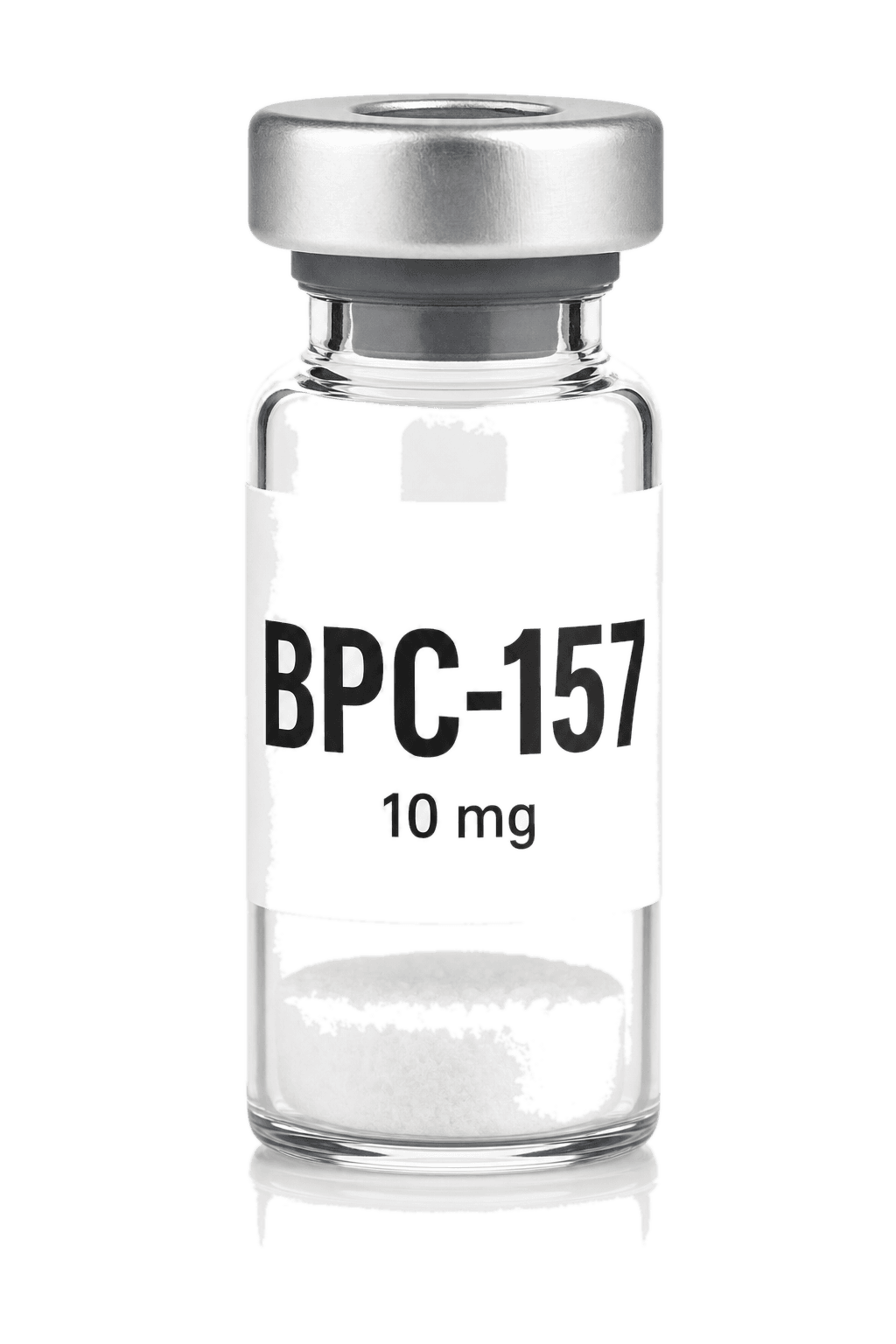
BPC-157 is a synthetic 15-amino-acid peptide derived from a protein found in gastric juice. In animal studies it has been investigated for tendon, muscle, and gut tissue healing. It is a research chemical, not an FDA-approved drug, and is not a proven human therapy.
In plain words
BPC-157 is a lab-made copy of a tiny piece of a protein found in your stomach. People take it hoping to heal injuries — like sore tendons or a troubled gut — faster. It hasn’t been proven in real human studies.
2 people have this in their stack
Key facts
- Category
- Healing & recovery
- Legal / FDA status
- Research chemical (not FDA-approved)
- Half-life
- Reported in minutes for the intact peptide in rodent plasma; not characterized in humans
- Typical form
- Lyophilized (freeze-dried) powder for reconstitution
- Also known as
- Body Protection Compound-157, PL 14736, Bepecin
Subcutaneous injection
Community use of BPC-157 is overwhelmingly subcutaneous, sometimes near the area of concern; oral capsules are also marketed (note that preclinical work used intraperitoneal and oral/intragastric routes in rats). There is no validated human dose or approved route.
Also seen: oral (capsules) · intramuscular (community)
Source: Community-reported practice; preclinical studies (Sikiric group) used IP/oral routes in animals. Not FDA-approved.
BPC-157 is a synthetic 15-amino-acid peptide whose sequence comes from a protein found in human gastric juice. In animal research it has been studied for its effects on tendon, muscle, bone, and gut healing. It is a research chemical, not an approved medicine, and nothing here is medical advice or a recommendation to obtain or use it.
What is BPC-157?#
BPC-157 is a short, stable peptide originally identified within a larger "body protection compound" found in stomach acid. Researchers synthesized the 15-amino-acid fragment to study tissue protection and repair. Because it is a laboratory research chemical, it has not gone through the clinical trials required for a drug to be approved for any medical use.
The peptide is usually sold as a lyophilized (freeze-dried) white powder that must be reconstituted with a sterile diluent before it can be measured in liquid form. It is sometimes labeled "for research use only."
How does BPC-157 work?#
The proposed mechanisms come almost entirely from cell and animal studies, so they should be read as hypotheses rather than established facts. In those models, researchers have reported that BPC-157 may:
- Promote angiogenesis (the growth of new blood vessels) toward injured tissue.
- Interact with the nitric oxide (NO) system, which influences blood flow and healing.
- Influence growth-factor and receptor pathways (such as VEGF and the FAK–paxillin pathway) involved in tendon and fibroblast repair.
- Support the gut lining and modulate the gut–brain axis in rodent models.
None of these mechanisms has been confirmed in adequately powered human trials. A licensed clinician is the right person to interpret what, if anything, this means for an individual.
What is BPC-157 studied for?#
Most BPC-157 literature is preclinical and explores soft-tissue and gastrointestinal healing. The table below summarizes common research themes and their evidence level.
| Research theme | Typical study type | Evidence level in humans |
|---|---|---|
| Tendon and ligament healing | Rodent models, cell culture | No controlled human trials |
| Muscle injury recovery | Rodent models | No controlled human trials |
| Gastrointestinal protection (ulcers, IBD models) | Rodent models | No controlled human trials |
| Bone and wound healing | Rodent models | No controlled human trials |
| Blood-vessel formation (angiogenesis) | Cell and animal studies | No controlled human trials |
The recurring caveat is the same: animal results do not reliably predict human outcomes, and BPC-157 has not been validated as a treatment for any condition.
Is BPC-157 legal and FDA-approved?#
BPC-157 is not FDA-approved and is not a recognized dietary supplement, so it cannot lawfully be sold for human consumption in the United States. In 2023 the FDA included BPC-157 among bulk substances it identified as presenting significant safety risks for pharmacy compounding, citing insufficient safety characterization. The World Anti-Doping Agency prohibits BPC-157 in sport at all times. Regulations differ internationally, so verify local law and consult a licensed professional.
How is BPC-157 dosed in research?#
There is no validated human dose. Published animal studies use doses scaled to body weight that do not translate directly to people, and the route, frequency, and duration vary widely between experiments. WikiPeps does not publish dosing protocols. Any decision about quantity, route, or frequency is a medical decision that belongs with a licensed clinician who knows your history.
How is BPC-157 reconstituted?#
Lyophilized BPC-157 is reconstituted by slowly adding bacteriostatic water to the vial and gently swirling until the powder fully dissolves. The numbered steps in the "How To" section above outline the general, education-only process, and our reconstitution guide and mixing-math guide explain how to choose a diluent volume and convert it to syringe units.
What are the safety considerations?#
Human safety data are sparse because rigorous clinical trials have not been completed. That uncertainty is itself a safety concern: unknown long-term effects, variable product purity in the research-chemical market, and the absence of regulatory oversight all raise risk. Sterility during handling matters, and contamination can cause infection. Because of these unknowns, the only responsible step before considering any peptide is a conversation with a licensed clinician.
The bottom line#
BPC-157 is a synthetic peptide with interesting but almost entirely preclinical evidence for tissue and gut healing. It is not FDA-approved, not proven in humans, and is banned in sport. Treat everything here as education, verify the law where you live, and talk to a licensed clinician before making any health decision.
Side effects & safety
Human side-effect data is limited; commonly-reported effects are usually mild.
Commonly reported
- Injection-site soreness, redness, or bruising
- Occasional fatigue or lightheadedness
- Mild headache or nausea (less common)
Not FDA-approved and with no controlled human safety studies — long-term effects are unknown and most reports are anecdotal.
Educational only — not medical advice. Everyone responds differently; talk to a licensed clinician before starting BPC-157, and stop and seek medical care for any severe or unusual reaction.
Tried BPC-157, or have a question about it?
Ask the community or share what you noticed — real people doing this carefully. Takes 30 seconds.
How to reconstitute lyophilized BPC-157 (educational overview)
What you'll need
- Vial of lyophilized BPC-157
- Bacteriostatic water (or sterile water per product labeling)
- Sterile insulin syringe or reconstitution syringe
- Alcohol prep pads
- Clean, flat work surface
Wash hands and prepare the area
Wash your hands thoroughly and wipe down a clean, flat surface. Let both vials reach room temperature to reduce condensation.
Disinfect the stoppers
Wipe the rubber stopper of both the BPC-157 vial and the bacteriostatic water vial with separate alcohol prep pads and let them air dry.
Draw the diluent
Draw your pre-calculated volume of bacteriostatic water into the syringe. Use our reconstitution math guide to choose a volume that makes measurement easy.
Add water slowly
Insert the needle into the BPC-157 vial and let the water run slowly down the inside glass wall rather than blasting it directly onto the powder, which can damage the peptide.
Dissolve gently
Remove the syringe and gently swirl or roll the vial. Do not shake. Wait until the solution is completely clear with no visible particles.
Label and refrigerate
Label the vial with the concentration and date, then store it in the refrigerator per product guidance. Inspect for cloudiness or particles before any use.
Frequently asked questions
What is BPC-157?
- BPC-157 (Body Protection Compound-157) is a synthetic peptide of 15 amino acids whose sequence is derived from a larger protein found in human gastric juice. It has been studied mainly in rodents for its effects on tissue repair. It is a research chemical and has not been approved as a medicine.
What is BPC-157 studied for?
- Most published BPC-157 research is preclinical (cells and animals) and explores tendon, ligament, muscle, bone, and gastrointestinal healing, plus possible effects on blood-vessel formation. These findings do not establish that BPC-157 is safe or effective in humans.
Is BPC-157 FDA-approved?
- No. BPC-157 is not approved by the U.S. FDA for any use. In 2023 the FDA placed BPC-157 in a category of substances it identified as not suitable for compounding, citing limited safety data. It is sold only as a research chemical.
Is BPC-157 legal?
- BPC-157 is not an approved drug or dietary supplement in the United States, so it cannot legally be marketed for human consumption. The World Anti-Doping Agency (WADA) prohibits BPC-157 in sport. Laws vary by country; check local regulations and consult a licensed professional.
What are the reported side effects of BPC-157?
- Human safety data are very limited because rigorous human trials are lacking. Reported anecdotes mention injection-site reactions, lightheadedness, and changes in heart rate, but these are not well characterized. Anyone considering it should speak with a licensed clinician first.
How is BPC-157 typically dosed in research settings?
- Published animal studies use a wide range of doses normalized to body weight, and these do not translate directly to humans. There is no established, validated human dose. This page does not provide dosing instructions; dosing decisions belong with a licensed clinician.
How is BPC-157 reconstituted?
- Lyophilized BPC-157 powder is typically reconstituted with bacteriostatic water by slowly injecting the water down the inside wall of the vial and gently swirling until dissolved. See the reconstitution steps below and our full reconstitution guide.
References
- 1.Stable gastric pentadecapeptide BPC 157: novel therapy in gastrointestinal tract — Current Pharmaceutical Design (PubMed-indexed) · 2011
- 2.Brain-gut axis and pentadecapeptide BPC 157: theoretical and practical implications — Current Neuropharmacology (PubMed-indexed) · 2016
- 3.FDA list of bulk drug substances that present significant safety risks (503A compounding) — U.S. Food and Drug Administration · 2023
- 4.Prohibited List — Peptides and Growth Factors (S2) — World Anti-Doping Agency (WADA) · 2024
What the research shows
Preclinical (animal/cell) evidenceBPC-157's healing claims rest almost entirely on animal and in-vitro studies, the bulk from a single Croatian research group (Sikiric and colleagues). There are no completed, peer-reviewed randomized human efficacy trials, and it is not FDA-approved.
Gastric pentadecapeptide BPC 157 accelerates healing of transected rat Achilles tendon and in vitro stimulates tendocytes growth
Staresinic M, Sikiric P, et al. · 2003 · J Orthop Res 2003;21(6):976-983
Stable gastric pentadecapeptide BPC 157: Robert's stomach cytoprotection / organoprotection and Selye's stress coping response (review)
Sikiric P, Rucman R, et al. · 2020 · review article (PMC7096228)
Citations are real, published sources, graded conservatively. Educational only — not medical advice, and not an endorsement to use any compound.
Improve this page
See something out of date or unclear? Propose an edit — an admin reviews every suggestion before any change is made.
Comments & experiences
What members are saying about BPC-157 — questions, observations, and lived experience. Not medical advice.
Add a comment
Ask a question or share what you've seen — a star rating is optional. Comments post right away once they pass a quick automated check; anything flagged is reviewed first.