
TB-500 (Thymosin Beta-4)
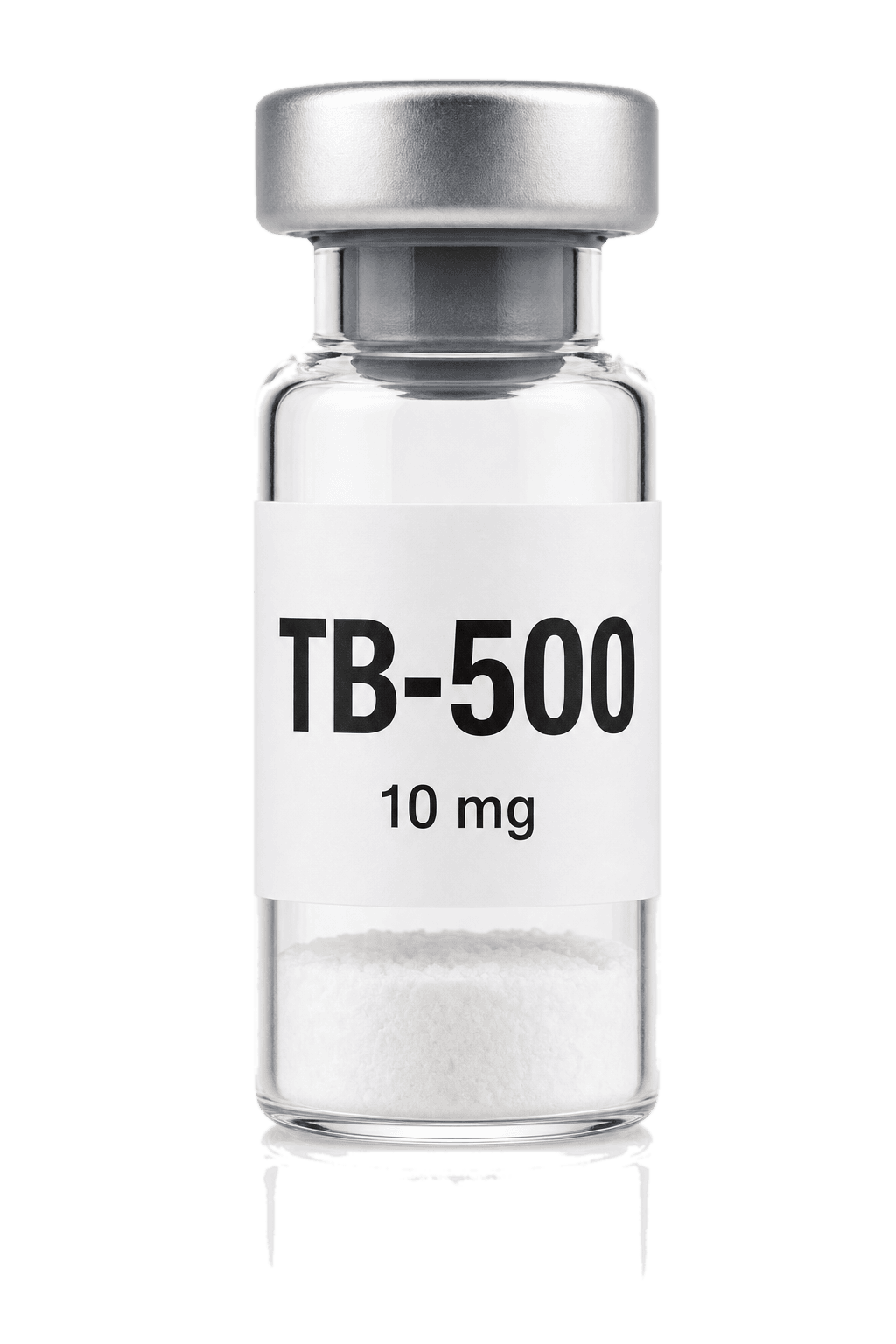
TB-500 is a synthetic peptide related to Thymosin Beta-4, a naturally occurring protein involved in cell migration and tissue repair. It has been studied in animal models for wound, muscle, and cardiac healing. It is a research chemical, not an FDA-approved drug.
In plain words
TB-500 is a lab-made version of a healing protein your body already makes. People take it hoping to recover from injuries faster. There are no real human studies behind it yet.
Key facts
- Category
- Healing & recovery
- Legal / FDA status
- Research chemical (not FDA-approved)
- Half-life
- Not well characterized in humans; thymosin beta-4 is reported to clear over hours in animal studies
- Typical form
- Lyophilized (freeze-dried) powder for reconstitution
- Also known as
- TB-500, Thymosin Beta-4, Tβ4, TB4
Subcutaneous injection
TB-500 is community-administered by subcutaneous injection (sometimes intramuscular). The thymosin beta-4 it derives from has been studied topically (skin/eye) in clinical trials, but the systemic research-chemical form is injected. No validated human dose or approved route exists.
Also seen: intramuscular (community) · topical (thymosin β4 in trials)
Source: Community-reported practice; RegeneRx thymosin β4 trials used topical/ophthalmic delivery. Not FDA-approved.
TB-500 is a synthetic peptide based on a fragment of Thymosin Beta-4, a natural protein involved in cell migration and tissue repair. It has been studied in animals for wound, muscle, tendon, and cardiac healing. It is a research chemical, not an approved drug, and nothing here is medical advice.
What is TB-500?#
TB-500 is a laboratory-synthesized peptide derived from Thymosin Beta-4 (Tβ4), a 43-amino-acid protein present in nearly every cell of the body. Tβ4 helps regulate actin, a protein essential to cell structure and movement, which is why it appears in research on healing and cell migration. TB-500 usually contains the active actin-binding portion of that molecule and is sold as a freeze-dried research chemical, not a medicine.
Is TB-500 the same as Thymosin Beta-4?#
Not exactly, and the distinction matters. Thymosin Beta-4 is the complete natural protein that has been studied in some early human research. TB-500 is a synthetic peptide marketed as containing the key active fragment. Sellers frequently use the two names interchangeably, but the products are not guaranteed to be identical, and purity in the research-chemical market is inconsistent.
How does TB-500 work?#
The proposed mechanisms come from preclinical research and should be treated as hypotheses. In animal and cell studies, Thymosin Beta-4 has been reported to:
- Sequester actin, influencing how cells build and dismantle their internal scaffolding.
- Promote cell migration toward sites of injury, a key step in wound repair.
- Support angiogenesis (new blood-vessel formation) and reduce inflammation in injury models.
- Aid cardiac and corneal repair in specific animal experiments.
These effects have not been confirmed in large human trials, and a licensed clinician is the right person to interpret their relevance.
What is TB-500 studied for?#
| Research theme | Typical study type | Human evidence |
|---|---|---|
| Skin and wound healing | Animal and cell studies; some early Tβ4 trials | Very limited |
| Muscle and tendon repair | Animal models | None controlled |
| Cardiac protection after injury | Animal models | Very limited |
| Corneal / eye injury | Animal models; early Tβ4 research | Very limited |
Most evidence applies to Thymosin Beta-4 broadly, not specifically to research-chemical TB-500, and none establishes that TB-500 is a safe or effective human therapy.
TB-500 vs BPC-157: how do people compare them?#
People often discuss the two together because both appear in healing-focused research, but they are different molecules with different evidence bases.
| TB-500 (Thymosin Beta-4) | BPC-157 | |
|---|---|---|
| Origin | Fragment of a natural cellular protein | Fragment derived from gastric-juice protein |
| Common research focus | Cell migration, wound and cardiac repair | Tendon, gut, and soft-tissue repair |
| Approval status | Not FDA-approved | Not FDA-approved |
| Sport status | Banned by WADA | Banned by WADA |
This comparison is informational only and is not a suggestion to use either substance.
Is TB-500 legal and approved?#
TB-500 is not FDA-approved and is not a recognized supplement, so it cannot lawfully be sold for human consumption in the U.S. It is prohibited in sport by WADA at all times. International rules vary, so confirm local law and consult a licensed professional.
How is TB-500 dosed in research?#
There is no validated human dose. Animal studies use weight-scaled doses that do not translate to people, and protocols differ across experiments. WikiPeps does not provide dosing instructions; that decision belongs with a licensed clinician.
How is TB-500 reconstituted?#
Lyophilized TB-500 is reconstituted by slowly adding bacteriostatic water down the vial wall and swirling gently until clear, as outlined in the steps above. Our reconstitution guide and mixing-math guide cover the process and unit conversions in detail.
What are the safety considerations?#
Human safety information is limited, long-term effects are unknown, and research-chemical purity varies. Sterile technique reduces infection risk, but it cannot substitute for clinical oversight. Anyone considering TB-500 should first speak with a licensed clinician.
The bottom line#
TB-500 is a synthetic Thymosin Beta-4 fragment studied mostly in animals for healing. It is not FDA-approved, not proven in humans, and banned in sport. Use this page for education only, verify your local laws, and consult a licensed clinician before any health decision.
Side effects & safety
Limited human data; reported effects are generally mild.
Commonly reported
- Injection-site reactions
- Occasional fatigue or head-rush
- Mild headache (less common)
No controlled human safety studies of the TB-500 fragment — long-term effects are unknown and reports are anecdotal.
Educational only — not medical advice. Everyone responds differently; talk to a licensed clinician before starting TB-500 (Thymosin Beta-4), and stop and seek medical care for any severe or unusual reaction.
Tried TB-500 (Thymosin Beta-4), or have a question about it?
Ask the community or share what you noticed — real people doing this carefully. Takes 30 seconds.
How to reconstitute lyophilized TB-500 (educational overview)
What you'll need
- Vial of lyophilized TB-500
- Bacteriostatic water (or sterile water per product labeling)
- Sterile insulin or reconstitution syringe
- Alcohol prep pads
- Clean, flat work surface
Prepare your space and hands
Wash your hands and clean a flat surface. Allow both vials to reach room temperature to limit condensation inside the vial.
Disinfect the stoppers
Wipe both rubber stoppers with separate alcohol prep pads and let them air dry fully before inserting any needle.
Measure the diluent
Draw your pre-calculated volume of bacteriostatic water. Choosing a round number simplifies later dose math — see our mixing-math guide.
Add water against the glass
Insert the needle and let the water flow slowly down the inside wall of the vial rather than directly onto the powder, which helps protect the peptide.
Dissolve without shaking
Gently swirl or roll the vial until the solution is completely clear. Never shake vigorously.
Label and store cold
Label with concentration and date and refrigerate per product guidance. Discard if you see cloudiness or particles.
Frequently asked questions
What is TB-500?
- TB-500 is a synthetic peptide based on a fragment of Thymosin Beta-4 (Tβ4), a naturally occurring protein found in nearly all human and animal cells that plays a role in actin regulation, cell migration, and tissue repair. TB-500 is sold as a research chemical and is not an approved medicine.
Is TB-500 the same as Thymosin Beta-4?
- They are closely related but not identical. Thymosin Beta-4 is the full 43-amino-acid natural protein. TB-500 typically refers to a synthetic peptide that contains the active actin-binding region of Tβ4. Marketing often uses the names interchangeably, which can be misleading.
What is TB-500 studied for?
- Preclinical research on Thymosin Beta-4 and TB-500 has explored wound healing, muscle and tendon repair, corneal injury, and cardiac tissue protection after injury. This work is largely in animals and cells and does not establish human safety or efficacy.
Is TB-500 FDA-approved?
- No. TB-500 is not approved by the FDA for any use. Thymosin Beta-4 has been investigated in some early clinical research, but TB-500 itself is sold only as a research chemical and is not a recognized therapy.
Is TB-500 banned in sports?
- Yes. The World Anti-Doping Agency prohibits TB-500 and Thymosin Beta-4 in sport at all times under its growth factors and peptides category. Athletes subject to drug testing should avoid it.
What are the reported side effects of TB-500?
- Human safety data are very limited. Anecdotal reports mention fatigue, lightheadedness, and injection-site reactions, but these are not well studied. Because long-term effects and interactions are unknown, consult a licensed clinician before considering it.
How is TB-500 reconstituted?
- Lyophilized TB-500 powder is typically reconstituted with bacteriostatic water added slowly down the vial wall, then gently swirled until clear. See the steps below and our full reconstitution guide for details.
References
- 1.Thymosin beta4: actin-sequestering protein moonlights to repair injured tissues — Trends in Molecular Medicine (PubMed-indexed) · 2007
- 2.Thymosin beta 4 and cardiac repair — Annals of the New York Academy of Sciences (PubMed-indexed) · 2010
- 3.Prohibited List — Peptides and Growth Factors (S2) — World Anti-Doping Agency (WADA) · 2024
What the research shows
Preclinical / early-clinical (parent protein)TB-500 is a synthetic fragment related to thymosin β4. Thymosin β4 itself reached human trials (RegeneRx) for topical wound healing and dry eye, with no FDA approval; the systemic 'TB-500' research chemical used by the community has no completed human efficacy trials of its own.
Study of Thymosin Beta 4 in Patients With Venous Stasis Ulcers (phase 2)
RegeneRx Biopharmaceuticals (sponsor) · 2009 · ClinicalTrials.gov registration
View source NCT00832091Study of Thymosin Beta 4 in Patients With Pressure Ulcers (phase 2, dose-response)
RegeneRx Biopharmaceuticals (sponsor) · 2008 · ClinicalTrials.gov registration
View source NCT00382174
Citations are real, published sources, graded conservatively. Educational only — not medical advice, and not an endorsement to use any compound.
Improve this page
See something out of date or unclear? Propose an edit — an admin reviews every suggestion before any change is made.
Comments & experiences
What members are saying about TB-500 (Thymosin Beta-4) — questions, observations, and lived experience. Not medical advice.
Add a comment
Ask a question or share what you've seen — a star rating is optional. Comments post right away once they pass a quick automated check; anything flagged is reviewed first.