
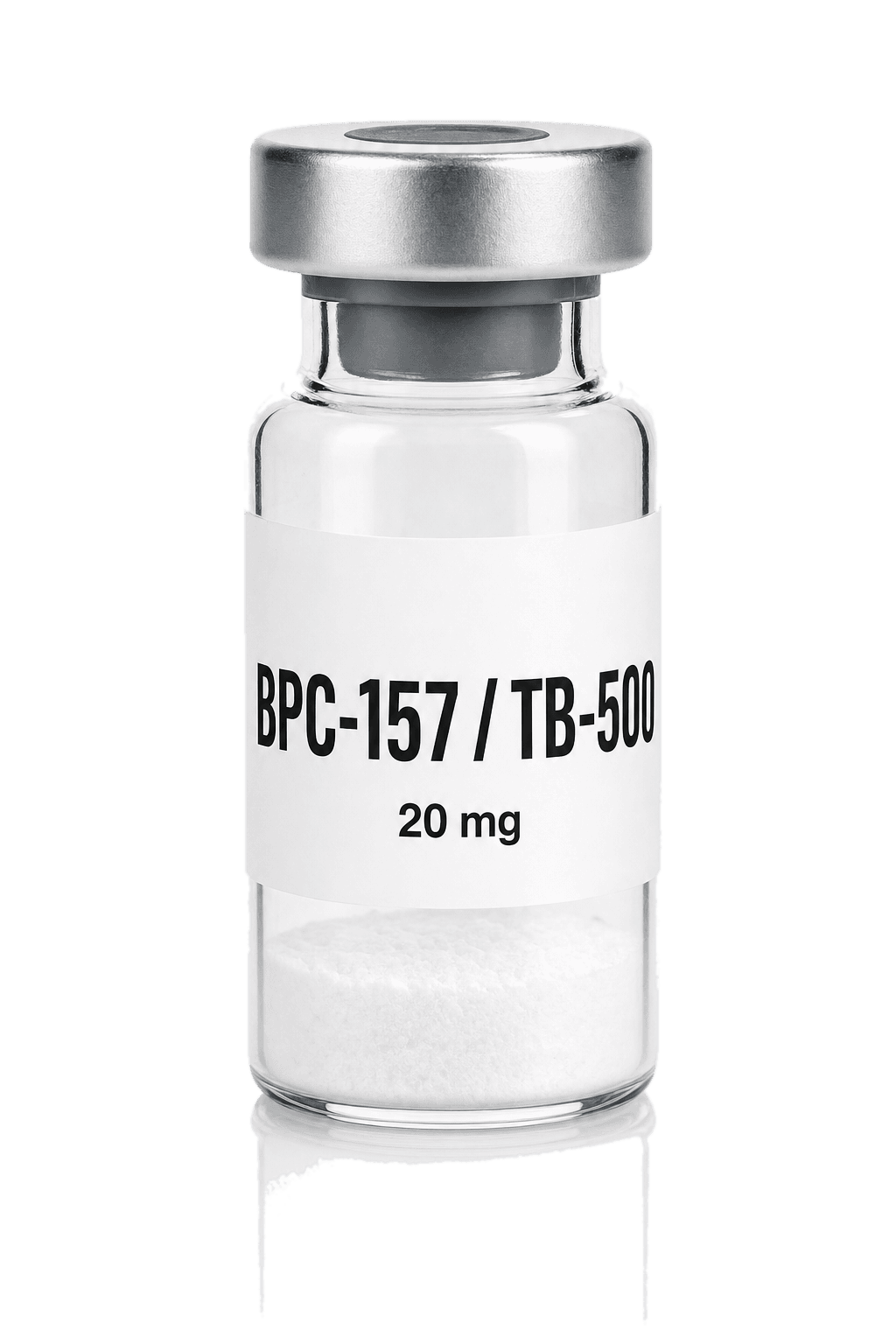
BPC-157 / TB-500 Blend
BPC-157 / TB-500 is a blend of two synthetic research peptides marketed for healing and recovery. Neither is FDA-approved for any use, both are mostly studied in animals, and both are banned in sport by WADA. This is education, not medical advice.
In plain words
This is a blend of two research peptides — BPC-157 and TB-500 — that people stack together hoping to heal injuries faster. Neither one has been proven in real human studies.
Key facts
- Category
- Healing & recovery
- Legal / FDA status
- Research chemicals (neither FDA-approved). BPC-157 and TB-500 are unapproved drugs; both appear in WADA's S0 'Non-approved substances' category.
- Half-life
- Not well characterized in humans for either component.
- Typical form
- Lyophilized (freeze-dried) powder for reconstitution
- Also known as
- BPC-157 and TB-500, BPC/TB blend, BPC 157 + TB 500
The BPC-157 / TB-500 blend combines two synthetic research peptides that are marketed together for healing and recovery. Neither component is approved by the FDA for any use, both are studied almost entirely in animals rather than humans, and both are banned in sport by the World Anti-Doping Agency. This page is educational information, not medical advice. It does not endorse using these materials, and any decision about your health should be made with a licensed clinician.
What is BPC-157 / TB-500 Blend?#
This is not a single drug but a mixture of two separate peptides that vendors sell pre-combined:
- BPC-157 (sometimes called Body Protection Compound-157) is a synthetic chain of 15 amino acids. Its sequence is derived from a fragment of a protein found in gastric juice. It does not exist as a complete, naturally occurring molecule in the body in this form.
- TB-500 is a synthetic peptide related to thymosin beta-4, a naturally occurring protein involved in cell movement and tissue repair. The names "TB-500" and "thymosin beta-4" are often used interchangeably by sellers, though TB-500 typically refers to a synthetic fragment rather than the full natural protein.
The two are blended because each has been promoted for soft-tissue and recovery purposes, and sellers suggest their actions might complement each other. It is important to understand that the blend as a product has not itself been the subject of published human studies; the rationale for combining them is largely a marketing convention rather than an established, evidence-based protocol.
How does BPC-157 / TB-500 Blend work?#
The proposed mechanisms come from preclinical (cell and animal) research on each peptide individually:
- BPC-157 has been reported in animal studies to interact with the nitric oxide (NO) signaling system, to promote the formation of new blood vessels (angiogenesis), and to show antioxidant activity. Reviews describe effects on the healing of skin, muscle, tendon, ligament, and gut tissue in rodents.
- TB-500 / thymosin beta-4 is described as a regulator of the protein actin inside cells, which influences how cells migrate to a wound. Animal and laboratory work links it to angiogenesis, reduced inflammation, and faster re-epithelialization (skin closing over) of wounds.
These are proposed mechanisms based largely on animal models. They have not been confirmed to produce safe or meaningful effects in humans, and laboratory mechanisms frequently fail to translate into real-world clinical benefit.
What is BPC-157 / TB-500 Blend studied for?#
Most claims trace back to preclinical research on the two peptides separately. The table below summarizes common research themes and how strong the human evidence is.
| Research theme | Study type | Evidence level in humans |
|---|---|---|
| Tendon, ligament, and muscle repair (BPC-157) | Mostly rodent/animal studies | Very limited; no robust controlled human trials |
| Gut and tissue protection (BPC-157) | Animal studies, single-group dominated literature | Very limited; not established in humans |
| Wound healing and angiogenesis (TB-500 / thymosin beta-4) | Cell and animal studies | Limited; early or unpublished human data only |
| Combined BPC-157 + TB-500 blend | No published controlled studies of the combination | None |
A notable limitation: a large share of the published BPC-157 literature comes from a single research group, which makes independent confirmation difficult.
Is BPC-157 / TB-500 Blend legal and FDA-approved?#
Neither component is FDA-approved.
- FDA status: Neither BPC-157 nor TB-500 is an FDA-approved drug, and neither is a lawful dietary supplement ingredient. In September 2023 the FDA placed BPC-157 and the thymosin beta-4 fragment (TB-500) in Category 2 of its review of bulk drug substances for compounding under section 503A — substances the agency considered to raise significant safety concerns, citing issues such as immunogenicity and impurities. In April 2026 the FDA announced it was removing these peptides from Category 2, but it has been explicit that removal does not make them FDA-approved or eligible for compounding; they remain unapproved drugs pending further regulatory review. Products are frequently sold labeled "research use only" or "not for human consumption."
- Sport status: Both BPC-157 and TB-500 are on the WADA Prohibited List under category S0 (Non-approved substances), which covers substances not approved by any government regulatory health authority for human therapeutic use. They are banned at all times, in and out of competition, and athletes have received multi-year sanctions for their use. Military service members are also warned against products containing these peptides.
Selling, marketing, or buying these as human-use products is legally fraught, and the "research chemical" labeling does not make human use safe or lawful.
How is BPC-157 / TB-500 Blend dosed in research?#
There is no validated human dose for BPC-157, TB-500, or the blend. Because adequate human trials have not been conducted, no one has established a dose that is known to be safe or effective, and no governing health authority has issued dosing guidance.
WikiPeps does not publish dosing protocols or amounts for these peptides. Any question about whether a peptide could be appropriate, and in what form or amount, should be directed to a licensed clinician who can weigh your individual medical history and the substantial unknowns involved.
How is BPC-157 / TB-500 Blend reconstituted?#
These peptides are typically supplied as a lyophilized (freeze-dried) powder that must be reconstituted with bacteriostatic or sterile water before any handling. The frontmatter on this page includes a generic, education-only overview of the reconstitution steps, with no volumes or concentrations. For a fuller walkthrough of sterile technique, supplies, and storage, see our general guide at /learn/guides/how-to-reconstitute-a-peptide.
Reconstitution instructions describe laboratory handling only. They are not an endorsement of use and do not substitute for guidance from a licensed clinician.
What are the safety considerations?#
- Unknown human safety. With no adequate human trials, the long-term risks, drug interactions, and safe dose (if any) are unknown for both peptides and especially for the combination.
- Possible tumor-growth concern. Because these peptides are reported to promote new blood-vessel growth, regulators and anti-doping bodies have raised the theoretical concern that they could also support the growth of an existing, undetected tumor. This has not been resolved in humans.
- Product quality risk. Material sold as a research chemical is not manufactured to pharmaceutical standards. Purity, sterility, correct identity, and accurate labeling are not guaranteed, and contamination or mislabeling is a real possibility.
- Injection risks. These products are typically injected after reconstitution, which carries risks of infection, injection-site reactions, and harm from non-sterile technique.
- Regulatory and sport consequences. Use can result in anti-doping sanctions for athletes and is incompatible with rules for military service members and many employers.
- Not a substitute for care. Self-treating an injury or medical condition with an unapproved peptide may delay appropriate, evidence-based medical care.
If you are considering anything in this category, talk with a licensed clinician first. If you experience a reaction or adverse event, seek medical attention.
The bottom line#
The BPC-157 / TB-500 blend pairs two synthetic peptides that are both unapproved research chemicals, not medicines. The evidence for either is largely preclinical, the combination has no published human studies, and both are banned in sport by WADA. Human safety, effectiveness, and dosing are not established. This page is educational only and is not medical advice; decisions about your health should be made with a qualified, licensed clinician.
Side effects & safety
A blend of two research peptides; human data is limited and reported effects are usually mild.
Commonly reported
- Injection-site reactions
- Occasional fatigue or headache
Neither component has controlled human safety studies — long-term effects are unknown.
Educational only — not medical advice. Everyone responds differently; talk to a licensed clinician before starting BPC-157 / TB-500 Blend, and stop and seek medical care for any severe or unusual reaction.
Tried BPC-157 / TB-500 Blend, or have a question about it?
Ask the community or share what you noticed — real people doing this carefully. Takes 30 seconds.
How to reconstitute lyophilized BPC-157 / TB-500 Blend (educational overview)
What you'll need
- Vial of lyophilized BPC-157 / TB-500 Blend
- Bacteriostatic water (or sterile water per product labeling)
- Sterile syringe for reconstitution
- Alcohol prep pads
- Clean, flat work surface
Wash hands and prepare the area
Wash your hands thoroughly and clear a clean, flat surface. Gather all supplies so you do not have to handle the vial repeatedly. This overview describes laboratory handling only and is not a recommendation to use this material in or on the body.
Inspect and warm the vial
Let a refrigerated vial come to room temperature. Inspect the powder and the diluent; do not use anything that looks discolored, cloudy, cracked, or otherwise compromised. Discard damaged vials.
Sanitize both stoppers
Wipe the rubber stopper of the peptide vial and the diluent vial each with a fresh alcohol prep pad and let them air-dry. This reduces the chance of contaminating the contents.
Draw the diluent
Using a sterile syringe, draw up sterile or bacteriostatic water. WikiPeps does not publish volumes or concentrations; any specific amounts are a dosing decision that belongs to a licensed clinician, not to this overview.
Add the liquid slowly
Insert the needle and let the water run slowly down the inside glass wall of the vial rather than spraying directly onto the powder. Do not shake; gently swirl or let it sit until the powder fully dissolves into a clear solution.
Label, store, and discard safely
Label the vial with the contents and reconstitution date, and store it per the labeling (typically refrigerated). Dispose of needles in a sharps container. Bring any questions about handling or use to a licensed clinician.
Frequently asked questions
What is the BPC-157 / TB-500 blend?
- It is a combination of two separate synthetic peptides sold as research chemicals: BPC-157, a 15-amino-acid fragment first described from a protein in gastric juice, and TB-500, a synthetic fragment related to the natural protein thymosin beta-4. They are combined by sellers because both have been studied in animals for tissue repair, but the blend itself has not been studied or approved as a product.
Is the BPC-157 / TB-500 blend FDA-approved?
- No. Neither BPC-157 nor TB-500 is approved by the FDA for any medical use. They are unapproved drugs that cannot be legally marketed as medicines or dietary supplements, and are commonly sold labeled 'for research use only, not for human consumption.'
Does the blend actually work in humans?
- There is little to no published controlled human evidence for either peptide. Most data come from cell and animal studies, and much of the BPC-157 literature comes from a single research group. Animal results do not reliably predict human safety or benefit.
Is it banned in sports?
- Yes. Both BPC-157 and TB-500 are on the World Anti-Doping Agency (WADA) Prohibited List under category S0 (Non-approved substances), banned at all times, in and out of competition. Athletes have been sanctioned for their use.
Is the blend safe?
- Safety in humans is unknown. Because there are no adequate human trials, no one has established whether there is a safe dose or what long-term risks exist. Products sold as research chemicals are also not made to pharmaceutical quality standards, so purity and sterility are not guaranteed.
How is the blend dosed?
- There is no validated human dose for either peptide, and WikiPeps does not publish dosing protocols. Any decision about whether and how a peptide might be used belongs to a licensed clinician who knows your medical history.
Why are BPC-157 and TB-500 sold together?
- Sellers combine them because each has been promoted for tissue and soft-tissue recovery, on the theory that the effects might be complementary. This pairing is a marketing convention, not an evidence-based combination; there are no published human studies of the two used together.
References
- 1.Multifunctionality and Possible Medical Application of the BPC 157 Peptide—Literature and Patent Review — Pharmaceuticals (MDPI), 2025, 18, 185 · 2025
- 2.Thymosin beta4 promotes angiogenesis, wound healing, and hair follicle development — Mechanisms of Ageing and Development (PubMed PMID 15037013) · 2004
- 3.BPC-157: Experimental Peptide Creates Risk for Athletes — U.S. Anti-Doping Agency (USADA) · 2023
- 4.Bulk Drug Substances Used in Compounding Under Section 503A of the FD&C Act — U.S. Food and Drug Administration (FDA.gov) · 2026
- 5.The Prohibited List (S0 Non-approved Substances) — World Anti-Doping Agency (WADA) · 2026
Improve this page
See something out of date or unclear? Propose an edit — an admin reviews every suggestion before any change is made.
Comments & experiences
What members are saying about BPC-157 / TB-500 Blend — questions, observations, and lived experience. Not medical advice.
Add a comment
Ask a question or share what you've seen — a star rating is optional. Comments post right away once they pass a quick automated check; anything flagged is reviewed first.