
AOD-9604
AOD-9604 is a synthetic fragment of human growth hormone (residues 176-191) studied as an anti-obesity drug. It showed fat-burning effects in animals but failed to beat placebo in human obesity trials. It is a research chemical, not FDA-approved.
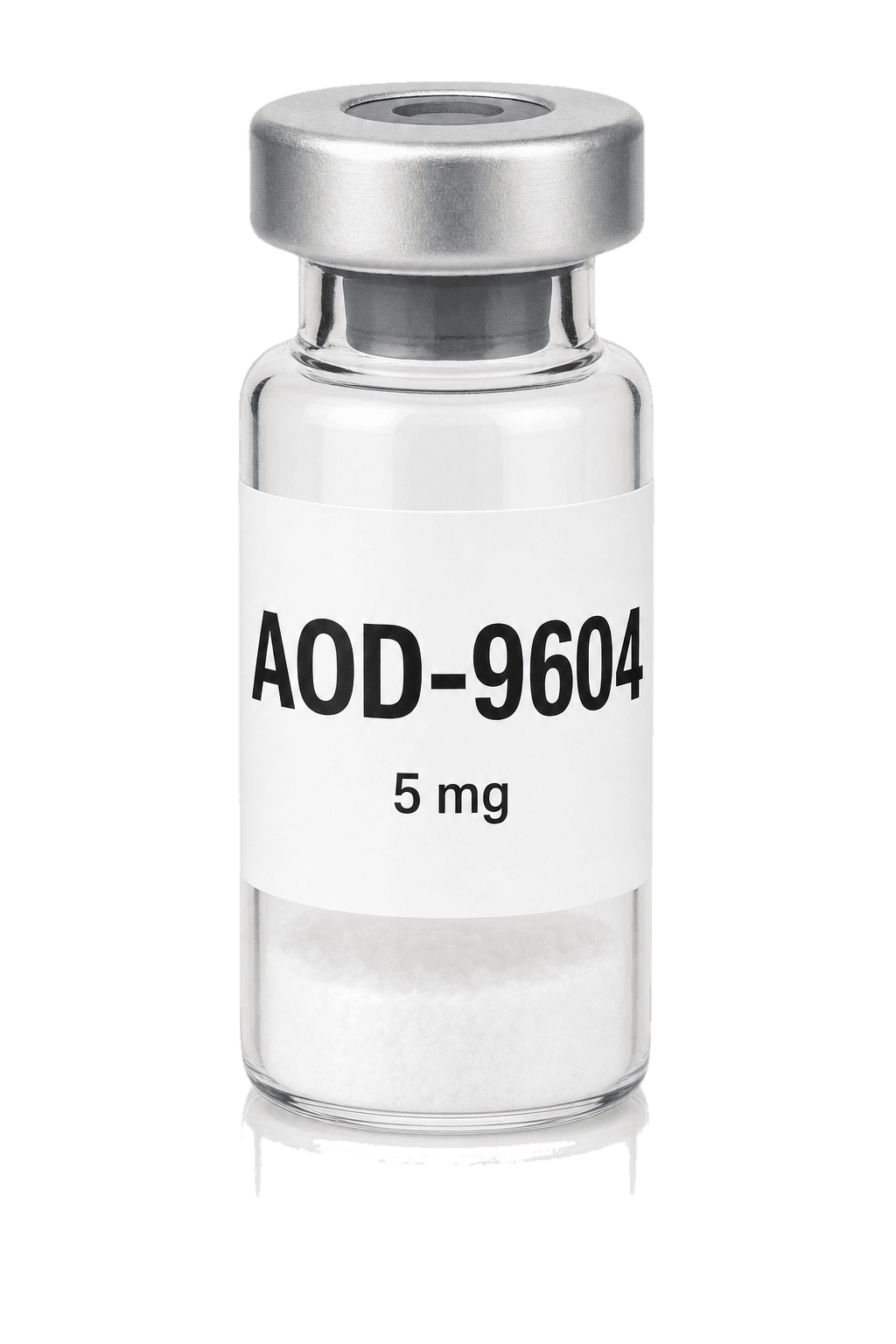
In plain words
AOD-9604 is a small piece of human growth hormone, first studied as a fat-loss drug. In its big human trial it was safe — but it didn’t actually beat a sugar-pill placebo for weight loss.
1 person has this in their stack
Key facts
- Category
- Metabolism
- Legal / FDA status
- Research chemical (not FDA-approved); failed human obesity trials and not an approved medicine
- Half-life
- Not well characterized in humans; reported to be short for the intact peptide
- Typical form
- Lyophilized (freeze-dried) powder for reconstitution
- Also known as
- AOD9604, Anti-Obesity Drug 9604, hGH fragment 176-191
Subcutaneous injection — studied orally in trials
AOD-9604 is community-administered by subcutaneous injection, but its human trials actually dosed it ORALLY (it was developed as an oral obesity drug candidate) — and it did not beat placebo for weight loss. No validated human dose or approved route exists.
Also seen: oral (as used in clinical trials)
Source: Community-reported SC practice; human safety/efficacy trials used oral dosing (Stier et al., J Endocrinol Metab 2013). Not FDA-approved.
AOD-9604 is a synthetic fragment of human growth hormone (residues 176-191) that was developed as an "Anti-Obesity Drug." In animal studies it increased fat breakdown, but in human obesity trials it did not beat placebo, and its developer discontinued it. It is a research chemical, not an FDA-approved medicine, and nothing here is medical advice or a recommendation to obtain or use it.
Important: AOD-9604 was tested in real human clinical trials and failed to show a meaningful weight-loss benefit. That history is a central part of understanding it. WikiPeps does not sell AOD-9604, does not provide dosing or sourcing guidance, and does not instruct self-administration. This page is for education only and is not medical advice.
What is AOD-9604?#
AOD-9604 is a short synthetic peptide based on the C-terminal lipolytic region of human growth hormone (hGH). It is commonly referred to as the "hGH fragment 176-191," and is built from that fragment plus an added tyrosine residue at the N-terminus to aid stability and detection; because the extra tyrosine shifts the numbering, the more precise designation in the literature is Tyr-hGH 177-191. Either way, it is the same 16-amino-acid peptide, sometimes called a "hexadecapeptide." Its name stands for Anti-Obesity Drug 9604.
It was developed in the 1990s by Metabolic Pharmaceuticals in Australia. The idea was to isolate the part of growth hormone thought to drive fat metabolism while avoiding the growth-promoting and blood-sugar effects of the full hormone. Because it never completed the approval process, AOD-9604 is sold today only as a lyophilized (freeze-dried) research chemical, often labeled "for research use only."
How does AOD-9604 work?#
The proposed mechanisms come mostly from cell and animal studies, so they should be read as hypotheses rather than established human facts. In those models, researchers reported that AOD-9604 may:
- Stimulate lipolysis — the breakdown of stored triglycerides into free fatty acids.
- Inhibit lipogenesis — the formation of new fat — in adipose tissue.
- Mimic the fat-related actions of growth hormone without raising IGF-1 or impairing glucose tolerance in the studies reported.
- Influence beta-3 adrenergic receptor expression; notably, animal work suggested its lipolytic effect is not mediated directly through the beta-3 adrenergic receptor.
These are mechanistic observations from preclinical research. They do not establish that AOD-9604 produces clinically meaningful fat loss in humans, and the human trial results below are the most relevant evidence.
What is AOD-9604 studied for?#
AOD-9604 was developed for obesity and fat loss. It went through preclinical work and a series of human trials, and has more recently drawn some research interest in cartilage and broader metabolic contexts. The key point is that the strongest claims come from animal data, while the human obesity data were disappointing.
| Research theme | Study type | Evidence level in humans |
|---|---|---|
| Fat breakdown / anti-obesity effect | Cell and rodent studies, then human trials | Low — human obesity trials did not show significant weight loss over placebo |
| Effect on IGF-1 and glucose tolerance | Human safety/tolerability studies | Limited — reported as not raising IGF-1 or impairing glucose, but data are sparse |
| Cartilage / metabolic / nutraceutical use | Mostly preclinical and exploratory | Very low — no approved or proven human indication |
After a larger Phase IIb obesity trial failed to reach statistical significance versus placebo, the developer discontinued AOD-9604 as an obesity drug (around 2007). No regulator has approved it for any indication.
Is AOD-9604 legal and FDA-approved?#
AOD-9604 is not FDA-approved for any use, and it is not an approved dietary supplement. It cannot legally be marketed for human consumption in the United States. Its standing under FDA pharmacy-compounding rules has changed over time. In 2023 the FDA placed AOD-9604 in Category 2 of its interim section 503A bulk-substances list — substances flagged as potentially posing significant safety risks — citing concerns such as limited human safety data and immunogenicity/quality questions. In September 2024 the FDA removed AOD-9604 from that Category 2 list after the nomination supporting it was withdrawn, and the substance was referred to the Pharmacy Compounding Advisory Committee for further review of whether it should appear on the 503A bulks list. None of this changed its core status: AOD-9604 is not an approved medicine, and the FDA has not cleared it for compounding into medicines.
In sport, the World Anti-Doping Agency (WADA) prohibits AOD-9604 as a growth-hormone fragment under category S2 (peptide hormones, growth factors, related substances, and mimetics). Laws and enforcement vary by country, so check local regulations and consult a licensed professional before assuming anything about legality.
How is AOD-9604 dosed in research?#
There is no validated human dose for AOD-9604. It is not an approved medicine, and the human obesity trials that were conducted did not demonstrate efficacy, so there is no established therapeutic regimen. Published studies used a range of doses that do not translate into safe or meaningful human guidance.
WikiPeps does not publish dosing protocols or amounts for AOD-9604. Any decision about whether a substance is appropriate, and at what dose, is a medical decision that belongs with a licensed clinician who can weigh an individual's health, medications, and goals.
How is AOD-9604 reconstituted?#
AOD-9604 is typically supplied as a lyophilized powder that must be reconstituted with a sterile diluent before it can be measured as a liquid. The educational overview in the steps above describes the general process — disinfecting the vials, adding bacteriostatic water slowly down the vial wall, swirling gently rather than shaking, and storing the reconstituted vial refrigerated.
For a fuller walkthrough of the technique, sterile handling, and the reconstitution math, see our guide at /learn/guides/how-to-reconstitute-a-peptide. This is educational information about handling a research chemical, not instruction to self-administer.
What are the safety considerations?#
Human safety data for AOD-9604 are limited, because it never completed full clinical development. In the trials that were run, it was generally reported as well tolerated over the study periods, and notably it did not appear to raise IGF-1 or impair glucose tolerance the way full-length growth hormone can. That is reassuring as far as it goes, but it is not the same as proven long-term safety.
Important considerations include:
- Long-term safety is unknown. The trials were short relative to how supplements and research chemicals are often used.
- Research-chemical sourcing is unregulated. Products sold for "research use only" are not manufactured to pharmaceutical standards, so purity, sterility, dose accuracy, and potential contaminants are uncertain.
- Injection carries its own risks — infection, irritation, and reaction at the injection site.
- It is banned in sport under WADA, so use can result in sanctions for tested athletes.
Anyone considering AOD-9604 should discuss it with a licensed clinician first, especially if they have existing health conditions or take other medications.
The bottom line#
AOD-9604 is a synthetic growth-hormone fragment (residues 176-191) that was developed as an anti-obesity drug. It showed fat-burning activity in animals but failed to outperform placebo in human obesity trials, and its developer discontinued it. It is not FDA-approved, is prohibited in sport by WADA, and has only limited human safety data. WikiPeps does not sell it, does not provide dosing or sourcing guidance, and shares this information purely for education — not as medical advice. Talk to a licensed clinician before making any decision.
Side effects & safety
In a human trial it was well tolerated, with side effects close to placebo.
Commonly reported
- Injection-site reactions
- Mild, transient effects (uncommon)
Its phase-2 trial showed placebo-like tolerability — but it did not prove effective, and long-term data is limited.
Educational only — not medical advice. Everyone responds differently; talk to a licensed clinician before starting AOD-9604, and stop and seek medical care for any severe or unusual reaction.
Tried AOD-9604, or have a question about it?
Ask the community or share what you noticed — real people doing this carefully. Takes 30 seconds.
How to reconstitute lyophilized AOD-9604 (educational overview)
What you'll need
- Vial of lyophilized AOD-9604
- Bacteriostatic water (or sterile water per product labeling)
- Sterile insulin syringe or reconstitution syringe
- Alcohol prep pads
- Clean, flat work surface
Wash hands and prepare the area
Wash your hands thoroughly and wipe down a clean, flat surface. Let both vials reach room temperature to reduce condensation.
Disinfect the stoppers
Wipe the rubber stopper of both the AOD-9604 vial and the bacteriostatic water vial with separate alcohol prep pads and let them air dry.
Draw the diluent
Draw your pre-calculated volume of bacteriostatic water into the syringe. Use our reconstitution math guide to choose a volume that makes measurement easy.
Add water slowly
Insert the needle into the AOD-9604 vial and let the water run slowly down the inside glass wall rather than blasting it directly onto the powder, which can damage the peptide.
Dissolve gently
Remove the syringe and gently swirl or roll the vial. Do not shake. Wait until the solution is completely clear with no visible particles.
Label and refrigerate
Label the vial with the concentration and date, then store it in the refrigerator per product guidance. Inspect for cloudiness or particles before any use.
Frequently asked questions
What is AOD-9604?
- AOD-9604 (Anti-Obesity Drug 9604) is a synthetic 16-amino-acid peptide based on the C-terminal region of human growth hormone (residues 176-191), with a small modification at one end. It was developed in Australia to study fat loss. It is a research chemical and has not been approved as a medicine.
What is AOD-9604 studied for?
- It was developed and studied primarily for obesity and fat loss, based on the lipolytic (fat-breaking) portion of growth hormone. Some later interest has been in cartilage and metabolic research. Most supportive data are from cell and animal studies; human obesity trials did not show a meaningful weight-loss benefit over placebo.
Does AOD-9604 actually work for weight loss?
- In preclinical (animal) models it increased fat breakdown and reduced fat buildup. However, in human clinical trials, including a larger Phase IIb obesity study, AOD-9604 did not produce statistically significant weight loss compared with placebo, and the developer discontinued it as an obesity drug around 2007. There is no proof it works for weight loss in people.
Is AOD-9604 FDA-approved?
- No. AOD-9604 is not approved by the U.S. FDA for any use, and it failed to demonstrate efficacy in human obesity trials. Its status under FDA pharmacy-compounding rules has shifted over time: in 2023 it was placed in Category 2 of the interim 503A bulk-substances list (substances flagged as potentially posing significant safety risks), and in September 2024 it was removed from that category after the nomination was withdrawn, with further review by the Pharmacy Compounding Advisory Committee. None of this makes it an approved product — it remains an unapproved substance.
Is AOD-9604 legal?
- AOD-9604 is not an approved drug or dietary supplement in the United States, so it cannot legally be marketed for human consumption. The World Anti-Doping Agency (WADA) prohibits AOD-9604 in sport as a growth-hormone fragment. Laws vary by country; check local regulations and consult a licensed professional.
What are the reported side effects of AOD-9604?
- Human safety data are limited. In the trials that were run, AOD-9604 was reported as generally well tolerated and did not appear to raise IGF-1 or impair glucose tolerance the way full-length growth hormone can. Even so, long-term safety in humans is not established, and anyone considering it should speak with a licensed clinician first.
How is AOD-9604 dosed in research?
- There is no validated human dose, because AOD-9604 is not an approved medicine and failed its obesity trials. Published studies used a range of doses that do not translate into safe human guidance. This page does not provide dosing instructions; dosing decisions belong with a licensed clinician.
How is AOD-9604 reconstituted?
- Lyophilized AOD-9604 powder is typically reconstituted with bacteriostatic water by slowly injecting the water down the inside wall of the vial and gently swirling until dissolved. See the reconstitution steps below and our full reconstitution guide.
References
- 1.The effects of human GH and its lipolytic fragment (AOD9604) on lipid metabolism following chronic treatment in obese mice and beta(3)-AR knock-out mice — Endocrinology (PubMed PMID 11713213) · 2001
- 2.Safety and Tolerability of the Hexadecapeptide AOD9604 in Humans — Journal of Endocrinology and Metabolism · 2013
- 3.Bulk Drug Substances Used in Compounding Under Section 503A of the FD&C Act (interim 503A bulks list; AOD-9604 placed in Category 2 in 2023 and removed in September 2024) — U.S. Food and Drug Administration · 2024
- 4.Prohibited List — Peptide Hormones, Growth Factors, Related Substances and Mimetics (S2) — World Anti-Doping Agency (WADA) · 2024
What the research shows
Human trials done — failed to beat placeboAOD-9604 (an hGH 176-191 fragment) was actually tested in humans for obesity and did NOT outperform placebo for weight loss; development was discontinued. A separate human study found it safe/well tolerated but no efficacy signal. Any fat-loss use is anecdotal; it is not FDA-approved.
Safety and Tolerability of the Hexadecapeptide AOD9604 in Humans
Stier H, Vos E, Kenley D · 2013 · J Endocrinol Metab 2013;3(1-2):7-15
The effects of human GH and its lipolytic fragment (AOD9604) on lipid metabolism following chronic treatment in obese mice and β3-AR knock-out mice
Heffernan M, Summers RJ, et al. · 2001 · Endocrinology 2001;142(12):5182-5189 (PMID 11713213)
Citations are real, published sources, graded conservatively. Educational only — not medical advice, and not an endorsement to use any compound.
Improve this page
See something out of date or unclear? Propose an edit — an admin reviews every suggestion before any change is made.
Comments & experiences
What members are saying about AOD-9604 — questions, observations, and lived experience. Not medical advice.
Add a comment
Ask a question or share what you've seen — a star rating is optional. Comments post right away once they pass a quick automated check; anything flagged is reviewed first.