
KLOW Blend (GHK-Cu · KPV · BPC-157 · TB-500)
KLOW Blend is a research-chemical mixture of four peptides — GHK-Cu, KPV, BPC-157, and TB-500 — combined for skin, inflammation, and tissue-repair research. It is not FDA-approved and has not been studied as a single product in humans. Education only, not medical advice.
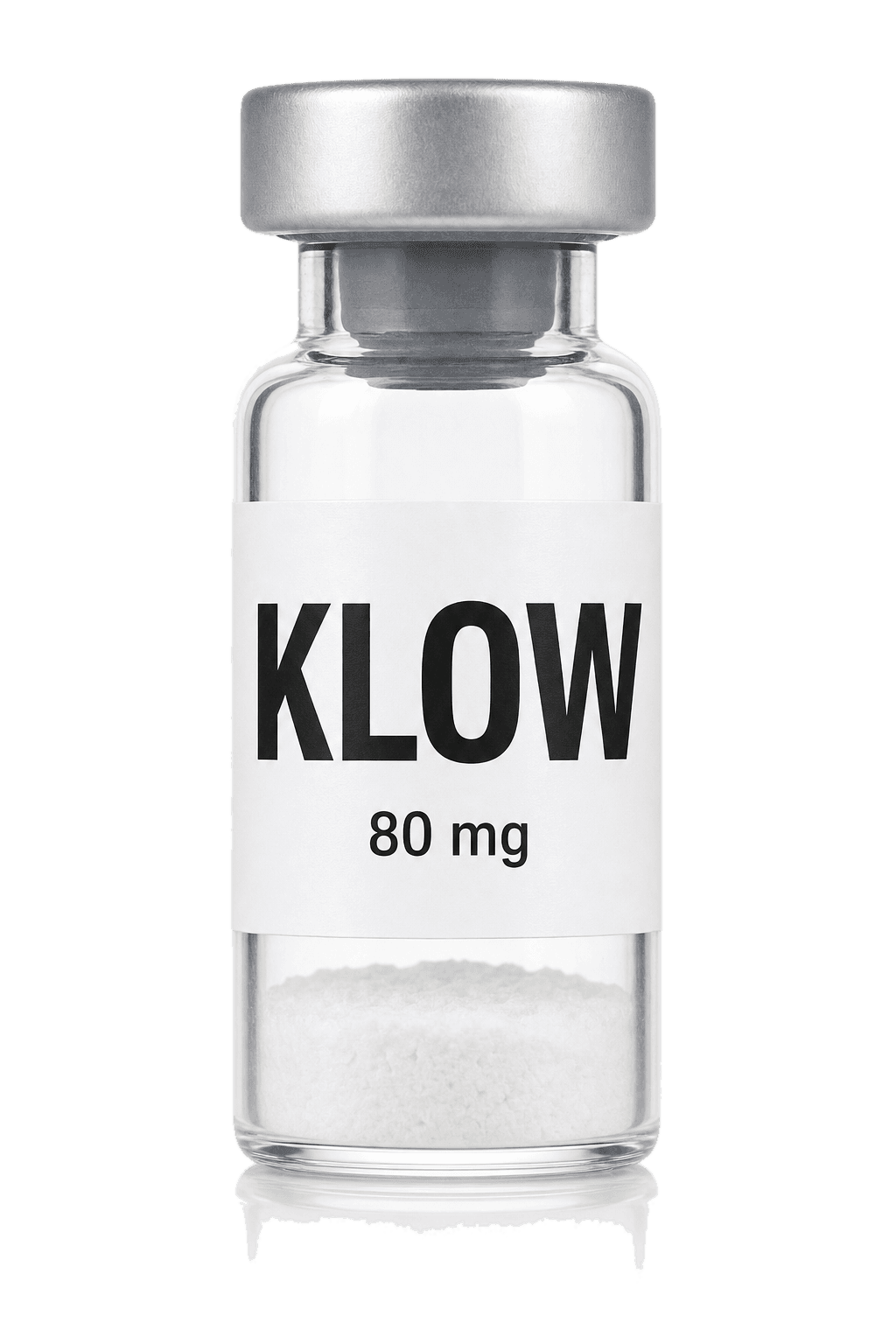
In plain words
“KLOW” is a five-part blend — the Glow peptides plus KPV — people use hoping for skin, healing, and gut/anti-inflammation benefits. It’s a mix of research peptides without solid human data.
Key facts
- Category
- Skin & healing
- Legal / FDA status
- Research-chemical blend (not FDA-approved); none of the four components is an approved injectable drug, and the combination itself has not been evaluated by the FDA
- Half-life
- Not well characterized in humans for any component; the small peptides (GHK-Cu, KPV) clear plasma within hours, but no validated data exist for the blend
- Typical form
- Lyophilized (freeze-dried) powder for reconstitution
- Also known as
- KLOW blend, KLOW peptide blend, GHK-Cu / KPV / BPC-157 / TB-500 blend
KLOW Blend is a research-chemical mixture of four peptides — GHK-Cu, KPV, BPC-157, and TB-500 — combined and marketed for skin, inflammation, and tissue-repair research. It is not an FDA-approved product, and the blend has not been studied as a single combination in humans. This page is for education only and is not medical advice; any decision about these compounds should be made with a licensed clinician.
What is KLOW Blend?#
KLOW Blend is an unofficial, informally named combination product rather than a single defined drug. The name is an acronym drawn from its four components, which have each been studied separately:
- GHK-Cu — a naturally occurring copper-binding tripeptide (glycine-histidine-lysine) best known as a cosmetic skincare ingredient and studied for skin remodeling and wound healing.
- KPV — a tripeptide (lysine-proline-valine) corresponding to the C-terminal region of alpha-melanocyte-stimulating hormone (α-MSH), studied in cell and animal models for anti-inflammatory activity.
- BPC-157 — a synthetic peptide derived from a sequence found in human gastric juice ("body protection compound"), studied mostly in animals for gut and connective-tissue healing.
- TB-500 — a synthetic peptide fragment related to thymosin beta-4, studied in animal and cell models for cell migration, blood-vessel formation, and wound repair.
The blend is typically sold as a lyophilized (freeze-dried) powder labeled "for research use only." There is no standardized formula, ratio, or manufacturer specification, so the exact contents and proportions can vary between sources.
How does KLOW Blend work?#
There is no established mechanism for the blend as a whole, because it has not been studied as a combination. What is known comes from research on the individual components, mostly in cells and animals:
- GHK-Cu appears to influence the extracellular matrix, supporting collagen and elastin synthesis and modulating remodeling enzymes; it also shows antioxidant and angiogenic activity in laboratory and animal studies.
- KPV has been described as suppressing pro-inflammatory signaling — notably the NF-κB pathway and cytokines such as TNF-α — while retaining the anti-inflammatory properties of its parent hormone α-MSH without the pigment-signaling effects.
- BPC-157 has been described in animal studies as interacting with growth-factor and nitric-oxide signaling pathways, with reported cytoprotective effects on gut, tendon, and other tissues.
- TB-500 corresponds to an actin-binding region of thymosin beta-4 and is studied for promoting cell migration and tissue repair.
The idea behind combining them is that complementary repair and anti-inflammatory pathways might reinforce one another. This rationale is theoretical — no human study has confirmed that the combination works, is safe, or offers any advantage over the individual peptides.
What is KLOW Blend studied for?#
The blend itself has not been the subject of published clinical research. The table below summarizes the research themes for the individual components and the level of human evidence behind each.
| Research theme | Study type | Evidence level in humans |
|---|---|---|
| GHK-Cu for skin remodeling / appearance | Cell, animal, and cosmetic studies | Limited; cosmetic-grade topical use only, not the injectable blend |
| KPV for inflammation (e.g., colitis models) | Cell and animal (rodent) studies | Very limited / no robust human trials |
| BPC-157 for gut and connective-tissue healing | Primarily animal (rodent) studies | Very limited / no robust human trials |
| TB-500 for wound healing and cell migration | Cell and animal studies | Very limited; injected TB-500 has no robust human trials |
| Full-length thymosin beta-4 for severe dry eye | Phase 2 randomized human trial (topical eye drops) | Exists, but for a different molecule and route — not TB-500 or the blend |
| KLOW Blend (combined) for skin / recovery | None published | None |
The clearest takeaway is that human evidence is thin even for the single peptides, and effectively absent for the combination.
Is KLOW Blend legal and FDA-approved?#
KLOW Blend is not FDA-approved, and the FDA has never evaluated the combination. Looking at each component:
- GHK-Cu is used as a cosmetic ingredient, which in the U.S. does not require pre-market drug approval; it is not an approved drug, and injectable research-chemical forms are not approved for human use.
- KPV is an unapproved research chemical with no therapeutic approval in any country.
- BPC-157 is an unapproved drug. In 2023 the FDA placed it in Category 2 of its interim list of bulk drug substances for compounding, citing concerns about immune reactions, impurities, and a lack of human safety data. (In 2026 the FDA removed BPC-157 from Category 2 after the underlying nominations were withdrawn; this is a change in compounding-list status, not a drug approval — BPC-157 remains unapproved and investigational.)
- TB-500 is an unapproved research chemical with no therapeutic approval in any country.
For athletes, BPC-157 and TB-500 are on the World Anti-Doping Agency (WADA) Prohibited List (BPC-157 under category S0, unapproved substances), so use can lead to sanctions. These peptides are commonly sold "for research use only," which is not a clearance for human use. Legal status varies by jurisdiction, so check local law and consult a licensed clinician.
How is KLOW Blend dosed in research?#
There is no validated human dose for KLOW Blend or any of its components. Because the blend is unapproved and unstudied in humans, no established, evidence-based dosing exists, and the safe-versus-harmful boundary is unknown. WikiPeps does not publish dosing protocols, amounts, schedules, or "cycles" for unapproved compounds. Any dosing question should be directed to a licensed clinician who can weigh an individual's circumstances; nothing on this page should be read as a dose or a recommendation to use.
How is KLOW Blend reconstituted?#
If a research product arrives as a lyophilized powder, the general reconstitution principles are the same as for other peptides: bring everything to room temperature, disinfect the stoppers, add bacteriostatic water slowly down the vial wall, and swirl gently rather than shake. Because this blend contains GHK-Cu, the solution may take on a faint blue tint from the copper ion, which is expected. For the full process, see our reconstitution guide. This is provided for education only and is not an instruction to prepare or self-administer any substance.
What are the safety considerations?#
The safety of KLOW Blend in humans is largely uncharacterized, and combining four active peptides adds uncertainty rather than removing it. Key considerations include:
- No human safety data for the blend, and limited data for the individual injectable peptides.
- Possible immune reactions — a concern the FDA specifically raised for BPC-157.
- Product quality risks — research chemicals are not held to pharmaceutical manufacturing standards, so impurities, mislabeling, or inaccurate contents and ratios are real possibilities.
- Injection and sterility risks — any injectable carries infection, irritation, and contamination risks.
- Unknown interactions — among the four peptides themselves, with medications, and with underlying health conditions.
- Anti-doping exposure — BPC-157 and TB-500 are WADA-prohibited.
Anyone with a medical condition, who is pregnant or breastfeeding, or who takes other medications should be especially cautious. A licensed clinician should be consulted before considering any use.
The bottom line#
KLOW Blend is an unofficial research-chemical mixture of GHK-Cu, KPV, BPC-157, and TB-500, grouped because each has been studied separately for repair or inflammation. It is not FDA-approved, has no published human studies as a combination, and its components include unapproved research chemicals that are also WADA-prohibited. Human evidence is thin for the single peptides and absent for the blend, and its safety is largely unknown. Use this page for education only, do not treat it as a dose or a recommendation, and consult a licensed clinician before making any health decision.
Side effects & safety
A four-peptide blend; reported effects are usually mild and mostly injection-related.
Commonly reported
- Injection-site reactions
- Mild, transient effects
Combines research peptides with little controlled human safety data — long-term effects are unknown.
Educational only — not medical advice. Everyone responds differently; talk to a licensed clinician before starting KLOW Blend (GHK-Cu · KPV · BPC-157 · TB-500), and stop and seek medical care for any severe or unusual reaction.
Tried KLOW Blend (GHK-Cu · KPV · BPC-157 · TB-500), or have a question about it?
Ask the community or share what you noticed — real people doing this carefully. Takes 30 seconds.
How lyophilized peptide blends are reconstituted (educational overview)
What you'll need
- Vial of lyophilized KLOW Blend
- Bacteriostatic water (or sterile water per product labeling)
- Sterile syringe
- Alcohol prep pads
- Clean, flat work surface
Wash hands and prepare the area
Wash your hands thoroughly and clean a flat work surface. Let the peptide vial and the diluent reach room temperature before starting.
Disinfect the stoppers
Wipe the rubber stoppers of both the peptide vial and the diluent with separate alcohol prep pads and let them air dry.
Add the diluent slowly
Direct the water down the inside wall of the vial rather than straight onto the powder. Because this blend contains GHK-Cu, the solution may take on a faint blue tint from the copper ion, which is expected. This page does not provide human dosing amounts or volumes; see our mixing-math guide for how diluent volume is worked out.
Dissolve by swirling
Gently swirl, do not shake, until the powder is fully dissolved and the solution is clear (a slight blue tint is normal). Discard the vial if anything remains cloudy, discolored beyond the expected tint, or contains particles.
Label, store, and inspect
Label the vial with the date, store it refrigerated per the product labeling, and visually inspect it before any handling. This is an educational overview, not an instruction to prepare or self-administer any substance.
Frequently asked questions
What is KLOW Blend?
- KLOW Blend is an unofficial research-chemical mixture of four peptides: GHK-Cu (a copper-binding tripeptide), KPV (a three-amino-acid fragment of alpha-MSH), BPC-157 (a synthetic gastric peptide fragment), and TB-500 (a synthetic fragment related to thymosin beta-4). It is sold and discussed as a skin-and-recovery blend, but it is not an FDA-approved product and has not been studied as a combination in humans.
Why are GHK-Cu, KPV, BPC-157, and TB-500 combined?
- The four are grouped because each has been studied individually for repair or inflammation: GHK-Cu for skin remodeling and collagen, KPV for anti-inflammatory signaling, BPC-157 for gut and connective-tissue healing in animals, and TB-500 for cell migration and wound repair in animals. The rationale for combining them is theoretical; there are no human trials of the blend confirming any added benefit.
Is KLOW Blend FDA-approved?
- No. KLOW Blend is not an FDA-approved drug, and the combination has never been evaluated by the FDA. GHK-Cu is used as a cosmetic ingredient but is not an approved drug; KPV, BPC-157, and TB-500 are unapproved research chemicals with no human approval in any country.
Is KLOW Blend proven to work in humans?
- No. The blend itself has no human studies. Most evidence for the individual peptides comes from cell and animal research. The strongest human data in this space involves full-length thymosin beta-4 as a topical eye drop — a different molecule and route from injected TB-500 — not the KLOW combination.
Is KLOW Blend legal?
- Legality varies by country and is complicated. In the U.S. these peptides are not approved for human use and are typically sold labeled 'for research use only.' BPC-157 and TB-500 are on the World Anti-Doping Agency prohibited list, so athletes subject to testing should avoid them. Check local law and consult a clinician.
What are the risks of KLOW Blend?
- The risks are largely uncharacterized because the blend is unstudied in humans. Concerns include unknown long-term safety, possible immune reactions, product impurities or mislabeling in unregulated research chemicals, sterility and injection risks, and the unpredictable effects of combining four active compounds. Talk to a licensed clinician before considering use.
Does WikiPeps provide KLOW Blend dosing?
- No. There is no validated human dose for KLOW Blend or its components, and WikiPeps does not publish dosing protocols or amounts for unapproved compounds. Any dosing decision should be made only with a licensed clinician.
References
- 1.GHK Peptide as a Natural Modulator of Multiple Cellular Pathways in Skin Regeneration — BioMed Research International (Wiley, PubMed-indexed) · 2015
- 2.Alpha-Melanocyte Stimulating Hormone: An Emerging Anti-Inflammatory Antimicrobial Peptide — BioMed Research International (Wiley, PubMed-indexed) · 2014
- 3.Multifunctionality and Possible Medical Application of the BPC 157 Peptide — Literature and Patent Review — Pharmaceuticals (MDPI, PubMed-indexed) · 2025
- 4.BPC-157: A prohibited peptide and an unapproved drug found in health and wellness products — Operation Supplement Safety (OPSS), U.S. Department of Defense · 2024
- 5.Interim Policy on Compounding Using Bulk Drug Substances Under Section 503A of the Federal Food, Drug, and Cosmetic Act — U.S. Food and Drug Administration (FDA.gov) · 2023
- 6.BPC-157: Experimental Peptide Creates Risk for Athletes — U.S. Anti-Doping Agency (USADA) · 2024
Improve this page
See something out of date or unclear? Propose an edit — an admin reviews every suggestion before any change is made.
Comments & experiences
What members are saying about KLOW Blend (GHK-Cu · KPV · BPC-157 · TB-500) — questions, observations, and lived experience. Not medical advice.
Add a comment
Ask a question or share what you've seen — a star rating is optional. Comments post right away once they pass a quick automated check; anything flagged is reviewed first.