
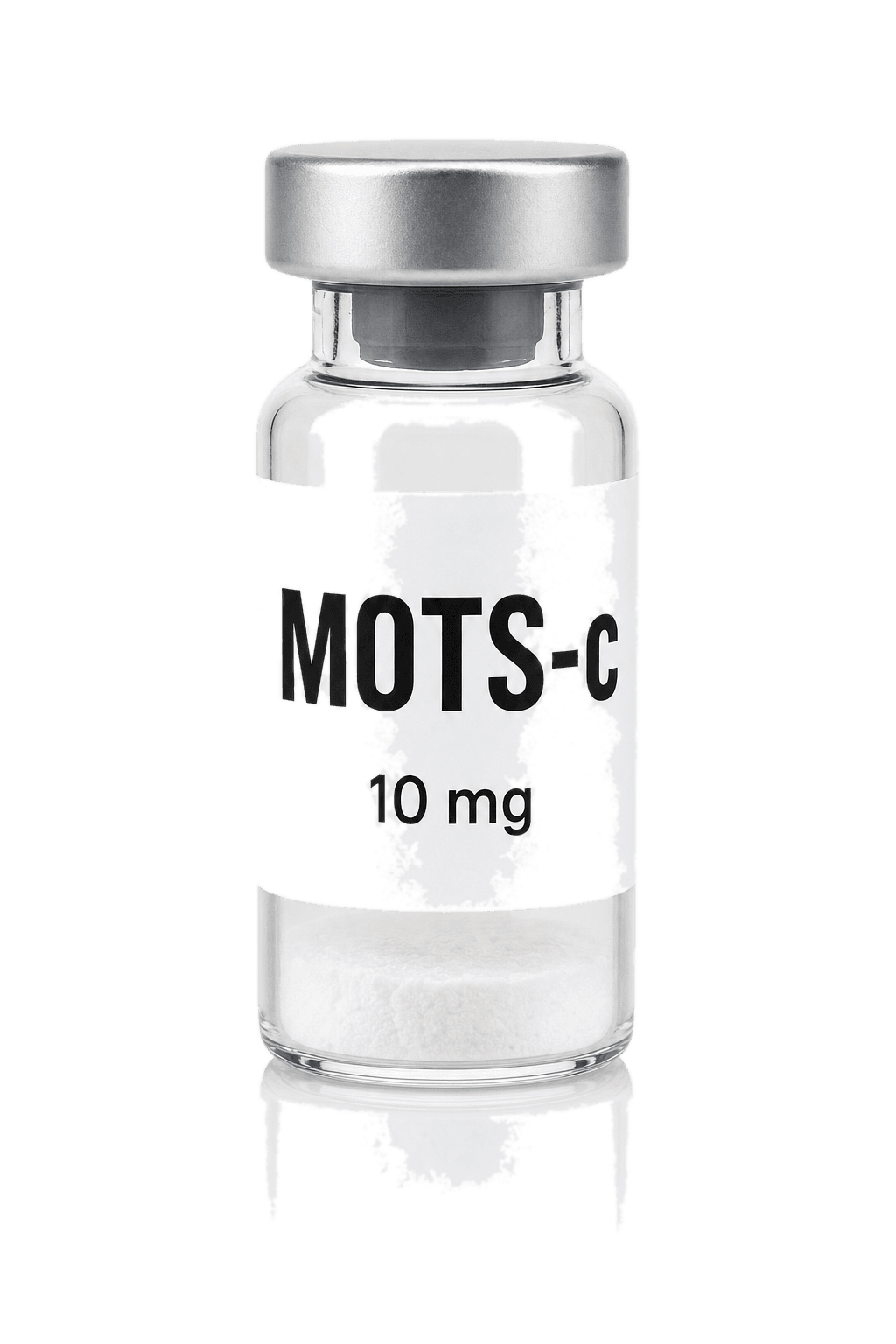
MOTS-c
MOTS-c is a 16-amino-acid mitochondrial-derived peptide studied as an 'exercise mimetic' for insulin sensitivity and metabolism via AMPK. Evidence is mostly from mice; it is a research chemical, not FDA-approved, and banned in sport by WADA.
In plain words
MOTS-c is a tiny peptide your cells make that’s linked to energy and metabolism. People take it hoping for more stamina and a better metabolism. Human research is still early.
1 person has this in their stack
Key facts
- Category
- Energy & metabolism
- Legal / FDA status
- Research chemical (not FDA-approved); no approved human product exists. Prohibited at all times in sport under the WADA Prohibited List (AMPK activators).
- Half-life
- Not well characterized in humans; mitochondrial-derived peptides are generally reported to have poor stability, low bioavailability, and short half-lives
- Typical form
- Lyophilized (freeze-dried) powder for reconstitution
- Also known as
- Mitochondrial-derived peptide MOTS-c, Mitochondrial open reading frame of the 12S rRNA-c
Subcutaneous injection
MOTS-c is community-administered by subcutaneous injection, often a weekly amount split across a few injections. The discovery work was preclinical (cells/animals, where it was given by IP injection); there are no completed human trials for native MOTS-c. No validated human dose or approved route exists.
Source: Community-reported practice; founding research (Lee et al., Cell Metab 2015) was preclinical. Not FDA-approved.
MOTS-c is a 16-amino-acid mitochondrial-derived peptide studied as an "exercise mimetic" for insulin sensitivity and metabolism through the AMPK pathway. The evidence is mostly from cell and mouse studies; it is a research chemical, not an FDA-approved medicine, and it is banned in sport. This page is for education only and is not medical advice; talk to a licensed clinician before making any health decision.
What is MOTS-c?#
MOTS-c stands for "mitochondrial open reading frame of the 12S rRNA-c." It is a short peptide — just 16 amino acids — that is encoded not in the cell's main (nuclear) genome but within mitochondrial DNA, in the 12S ribosomal RNA region. The body produces it naturally, which places it in a small family of mitochondrial-derived peptides that appear to act as signaling molecules rather than only as structural parts of the mitochondria.
It was first described by researchers at the University of Southern California (Changhan Lee, Pinchas Cohen, and colleagues). It is studied within the metabolic and mitochondrial category. The versions sold for study are unregulated research chemicals supplied as a lyophilized powder labeled "for research use only," and they are not part of any approved drug product.
How does MOTS-c work?#
The most-discussed proposed mechanism centers on AMPK (AMP-activated protein kinase), a master sensor of cellular energy status. In laboratory and animal work, MOTS-c is reported to act on the folate one-carbon cycle and the tethered de novo purine biosynthesis pathway. Inhibiting this pathway is described as causing accumulation of an intermediate called AICAR, which in turn activates AMPK.
Activating AMPK is associated with increased glucose uptake in skeletal muscle and shifts toward fat and glucose utilization — effects that overlap with what physical exercise does, which is why MOTS-c is sometimes labeled an "exercise mimetic." Researchers have also reported that, under metabolic stress, MOTS-c can translocate to the cell nucleus and help regulate stress-responsive and metabolic genes.
It is important to be clear that these mechanisms are largely preclinical (test-tube and animal). A reported mechanism is not the same as a proven benefit in people, and clinical development of MOTS-c has been slowed by practical problems such as poor stability, low bioavailability, and short half-life.
What is MOTS-c studied for?#
MOTS-c has been studied mainly for metabolic and aging-related outcomes. The evidence base is heavily weighted toward cell cultures and rodent models, with only limited human observational data (for example, that endogenous MOTS-c rises with exercise).
| Research theme | Study type | Evidence level in humans |
|---|---|---|
| Insulin sensitivity / glucose metabolism | Mouse models, cell studies | Very low — not established in humans |
| Diet-induced obesity and metabolic homeostasis | Mouse models | None established in humans |
| Exercise capacity / age-related physical decline | Mouse models; human observational (peptide rises with exercise) | Low — observational only, no trials of treatment |
| Mitochondrial / cardiac function in metabolic disease | Animal and cell studies | None established in humans |
| Aging and stress response | Cell and animal models | None established in humans |
In short, the preclinical signal is interesting, but there are no large randomized human clinical trials showing that taking MOTS-c is safe or effective for any condition.
Is MOTS-c legal and FDA-approved?#
MOTS-c is not FDA-approved for any medical condition and is not an ingredient in any approved drug product. It is not a controlled substance in the United States, but it is also not recognized as an approved drug or as a dietary supplement. It is sold only as a research chemical marked "for research use only."
MOTS-c is also prohibited in sport at all times by the World Anti-Doping Agency, classified under metabolic modulators as an activator of AMPK. Anti-doping guidance further notes that athletes cannot obtain a Therapeutic Use Exemption for MOTS-c because there is no approved therapeutic use. Regulatory and legal status varies by country, so anyone outside the U.S. should check local rules. None of this constitutes a recommendation to obtain or use the compound.
How is MOTS-c dosed in research?#
There is no validated human dose for MOTS-c, and WikiPeps does not publish dosing protocols or amounts. Doses used in animal studies were tied to specific experimental settings and are not a guide for personal use, and the unregulated research-chemical market provides no quality assurance on identity, purity, or sterility.
Any decision about whether a compound is appropriate, and at what amount, is a medical decision that belongs with a licensed clinician who can weigh an individual's health, other medications, and the lack of human evidence.
How is MOTS-c reconstituted?#
Research-grade MOTS-c arrives as a lyophilized (freeze-dried) powder that must be reconstituted with a sterile diluent before any laboratory use, kept cold, and protected from rough handling. The general process — disinfecting the stopper, adding diluent slowly down the vial wall, swirling gently rather than shaking, and labeling and refrigerating — is covered step by step in our reconstitution guide. This is described for education only and is not an instruction to self-administer.
What are the safety considerations?#
Because there is so little controlled human data, the safety profile of MOTS-c is largely uncharacterized. The known and plausible risks are mostly generic to unregulated injectable peptides:
- Contamination, mislabeling, or impurity in products sold "for research use only," which are not made to pharmaceutical standards.
- Infection or injection-site reactions from non-sterile preparation or technique.
- Unknown long-term effects and unstudied effects on blood sugar and metabolism, which could matter for people with diabetes or those taking glucose-lowering medications.
- Interactions with existing conditions or medications that have not been studied in humans.
- Anti-doping consequences for competitive athletes, since MOTS-c is banned at all times with no TUE available.
These concerns are reasons to involve a licensed clinician before considering any use, and to be skeptical of strong metabolic or anti-aging marketing claims that the human evidence does not support.
The bottom line#
MOTS-c is a 16-amino-acid mitochondrial-derived peptide studied mainly for insulin sensitivity, metabolism, and exercise-related effects through AMPK activation, earning it the "exercise mimetic" label. The mechanistic and animal data are intriguing, but human evidence is very limited and there are no large clinical trials. It is a research chemical, not FDA-approved, its safety is largely unknown, and it is banned in sport. Use this page for education, treat metabolic and longevity claims cautiously, and consult a licensed clinician before any health decision.
Side effects & safety
Limited human data; reported effects are generally mild.
Commonly reported
- Injection-site reactions
- Occasional fatigue or flushing
An emerging compound with little controlled human safety data — long-term effects are unknown.
Educational only — not medical advice. Everyone responds differently; talk to a licensed clinician before starting MOTS-c, and stop and seek medical care for any severe or unusual reaction.
Tried MOTS-c, or have a question about it?
Ask the community or share what you noticed — real people doing this carefully. Takes 30 seconds.
How to reconstitute lyophilized MOTS-c (educational overview)
What you'll need
- Vial of lyophilized MOTS-c
- Bacteriostatic water (or sterile water per product labeling)
- Sterile insulin syringe or reconstitution syringe
- Alcohol prep pads
- Clean, flat work surface
Wash hands and prepare the area
Wash your hands thoroughly and clean a flat work surface. Let the vial and diluent reach room temperature before starting.
Disinfect the stoppers
Wipe the rubber stopper of each vial with a fresh alcohol prep pad and let them air dry.
Draw the diluent
Draw your pre-planned volume of bacteriostatic water into the syringe. Choosing a round number of milliliters keeps later concentration math simple — see our mixing-math guide.
Add the water slowly
Insert the needle and let the water run gently down the inside wall of the vial rather than spraying directly onto the powder, which helps protect the delicate peptide.
Dissolve by swirling
Swirl gently until the solution is fully dissolved and clear. Do not shake. Discard the solution if it stays cloudy or shows particles.
Label and refrigerate
Label the vial with the contents, concentration, and date, then refrigerate per product guidance and inspect before any use.
Frequently asked questions
What is MOTS-c?
- MOTS-c is a small peptide of 16 amino acids encoded within mitochondrial DNA (the mitochondrial 12S rRNA region). The body makes it naturally, and researchers study it as a signal involved in metabolism and the cellular stress response. The injectable versions sold for study are unregulated research chemicals, not approved medicines.
How does MOTS-c work?
- In laboratory and animal studies, MOTS-c is reported to influence the folate one-carbon cycle and de novo purine synthesis, leading to accumulation of an intermediate (AICAR) that activates AMPK, a master regulator of cellular energy. It has also been described moving into the cell nucleus under metabolic stress to help regulate gene expression.
What is MOTS-c studied for?
- Most research looks at metabolism: insulin sensitivity, glucose handling, diet-induced obesity, and exercise-related effects, which is why it is sometimes called an 'exercise mimetic.' These findings come largely from cell and mouse studies. There are no large human clinical trials demonstrating safety or benefit.
Is MOTS-c FDA-approved?
- No. MOTS-c is not approved by the FDA for any condition and is not part of any approved drug product. It is sold only as a research chemical labeled 'for research use only' and has not completed human clinical trials for any medical use.
Is MOTS-c banned in sports?
- Yes. The World Anti-Doping Agency lists MOTS-c as prohibited at all times under metabolic modulators (activators of AMPK). According to anti-doping guidance, athletes cannot obtain a Therapeutic Use Exemption for it because there is no approved therapeutic use.
What are the risks of MOTS-c?
- Human safety data are very limited, so the risks are largely uncharacterized. General concerns with any reconstituted research peptide include injection-related infection, contamination or mislabeling of unregulated products, and unknown long-term effects. Anyone considering it should speak with a licensed clinician first.
Is MOTS-c legal to buy?
- MOTS-c is not a controlled substance in the U.S., but it is also not an approved drug or dietary supplement. It is sold as a research chemical for laboratory use only. Legal and regulatory status varies by country, and being available to purchase does not mean it is safe or approved for human use.
References
- 1.The Mitochondrial-Derived Peptide MOTS-c Promotes Metabolic Homeostasis and Reduces Obesity and Insulin Resistance — Cell Metabolism (PubMed-indexed) · 2015
- 2.MOTS-c is an exercise-induced mitochondrial-encoded regulator of age-dependent physical decline and muscle homeostasis — Nature Communications (PubMed-indexed) · 2021
- 3.The mitochondrial-derived peptide MOTS-c is a regulator of plasma metabolites and enhances insulin sensitivity — Physiological Reports (PubMed-indexed) · 2019
- 4.Mitochondria-derived peptide MOTS-c: effects and mechanisms related to stress, metabolism and aging — Journal of Translational Medicine (PubMed-indexed review) · 2023
- 5.What is the MOTS-c peptide? (athlete advisory: FDA status and Prohibited List classification) — U.S. Anti-Doping Agency (USADA) · 2025
- 6.2025 Prohibited List — S4 Hormone and Metabolic Modulators (4.4 Metabolic Modulators; activators of AMPK) — World Anti-Doping Agency (WADA) · 2025
What the research shows
Preclinical (animal/cell) evidenceMOTS-c is a genuine mitochondrial-derived peptide with strong cell and animal evidence for AMPK activation, insulin sensitivity, and exercise-mimetic effects. There are no completed human efficacy trials for native MOTS-c, and it is not FDA-approved.
The Mitochondrial-Derived Peptide MOTS-c Promotes Metabolic Homeostasis and Reduces Obesity and Insulin Resistance
Lee C, Zeng J, Cohen P, et al. · 2015 · Cell Metab 2015;21(3):443-454 (PMID 25738459)
The Mitochondrial-Encoded Peptide MOTS-c Translocates to the Nucleus to Regulate Nuclear Gene Expression in Response to Metabolic Stress
Reynolds JC, Lee C, et al. · 2018 · Cell Metab 2018;28(3):516-524
Citations are real, published sources, graded conservatively. Educational only — not medical advice, and not an endorsement to use any compound.
Improve this page
See something out of date or unclear? Propose an edit — an admin reviews every suggestion before any change is made.
Comments & experiences
What members are saying about MOTS-c — questions, observations, and lived experience. Not medical advice.
Add a comment
Ask a question or share what you've seen — a star rating is optional. Comments post right away once they pass a quick automated check; anything flagged is reviewed first.