
Retatrutide
Retatrutide (LY3437943) is an investigational once-weekly peptide that activates three receptors — GIP, GLP-1, and glucagon. Eli Lilly is studying it for obesity and type 2 diabetes in clinical trials. It is NOT FDA-approved. This page is education, not medical advice.
In plain words
Retatrutide is a newer weight-loss drug still being tested. It works like Ozempic but nudges three hunger signals instead of one. It isn’t approved yet, so for now it’s experimental.
5 people have this in their stack
Key facts
- Category
- Weight & metabolism
- Legal / FDA status
- Investigational drug in clinical trials (not FDA-approved); research-chemical versions sold online are not an approved product and are not tested for human use
- Half-life
- Approximately 6 days in humans (phase 1/2 data), which is consistent with once-weekly dosing in trials
- Typical form
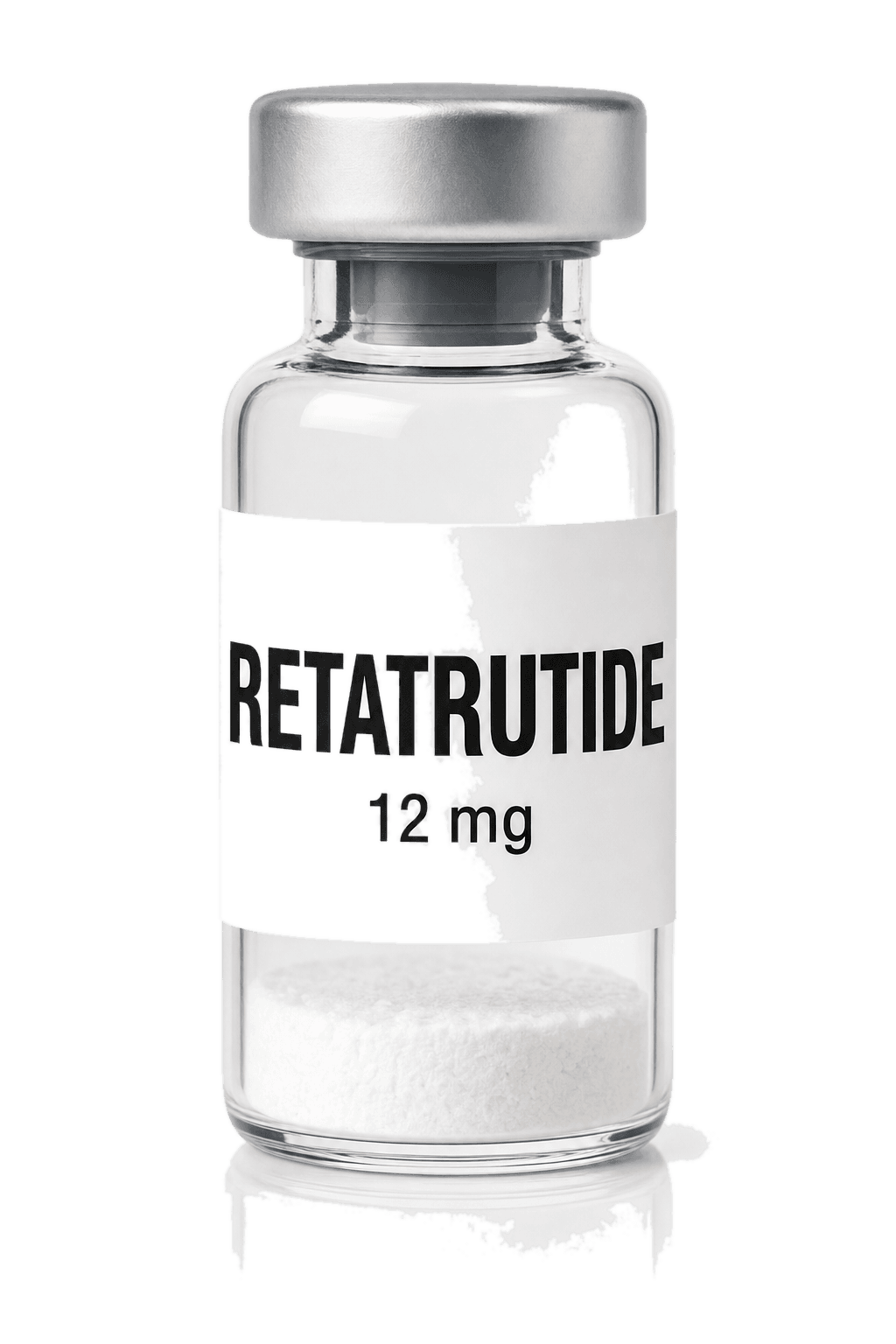
- Lyophilized (freeze-dried) powder for reconstitution
- Also known as
- LY3437943, triple GIP/GLP-1/glucagon agonist, GLP-3 (R)
Subcutaneous injection (investigational)
In its clinical trials, retatrutide is given as a once-weekly subcutaneous injection, consistent with its ~6-day half-life. It is investigational and not FDA-approved; trial material is a controlled formulation, and a research-chemical vial is not the trial product.
Source: Trial route — Jastreboff et al., NEJM 2023 (phase 2 obesity, once-weekly SC); NCT04881760.
Retatrutide (LY3437943) is an investigational once-weekly peptide that activates three receptors — GIP, GLP-1, and glucagon — and is being studied by Eli Lilly for obesity and type 2 diabetes in clinical trials. It is NOT FDA-approved and is not an available medicine. This page is educational only and is not medical advice; any decision about an investigational drug belongs with a licensed clinician.
Important: Retatrutide is a drug still going through human trials, not an approved product and not a settled supplement. Powders sold online as "research chemicals" are not the trial material and are not tested or quality-controlled for human use. WikiPeps does not sell retatrutide, does not say where to obtain it, and does not provide dosing amounts.
What is Retatrutide?#
Retatrutide is a synthetic peptide developed by Eli Lilly under the code name LY3437943. It belongs to the same broad family as semaglutide and tirzepatide but goes a step further: it is a triple agonist that engages three hormone receptors simultaneously — the GIP receptor, the GLP-1 receptor, and the glucagon (GCGR) receptor. Because of that third target, it is sometimes informally called a "GLP-3" or triple-G agonist. It has a long half-life (about 6 days) that, in trials, supports once-weekly subcutaneous dosing.
It is an investigational compound. That means it is still being tested in humans and has not been judged safe and effective by the FDA for any use.
How does Retatrutide work?#
The three receptors retatrutide activates each influence metabolism in a different way:
- GLP-1 receptor: promotes insulin release when blood sugar is high, slows gastric emptying, and increases satiety (feeling full).
- GIP receptor: another incretin pathway that works alongside GLP-1 to influence insulin response and appetite.
- Glucagon receptor: classically raises blood sugar, but sustained low-level activation in this context is thought to increase energy expenditure (calorie burn), which is the feature that distinguishes retatrutide from single- and dual-agonists.
Structural and preclinical work suggests retatrutide is tuned to be relatively more potent at GIP and somewhat less potent at the GLP-1 and glucagon receptors compared with the natural hormones. In animal studies this combination produced greater weight loss than dual agonists, but animal findings do not automatically carry over to humans.
What is Retatrutide studied for?#
Retatrutide has published phase 2 human data and an active phase 3 program (Eli Lilly's TRIUMPH program), with the first pivotal obesity trial having reported positive top-line results, but no use is FDA-approved. The table below summarizes the main research themes.
| Research theme | Study type | Evidence level in humans |
|---|---|---|
| Weight reduction in obesity/overweight | Randomized phase 2 trial (NEJM, 2023); pivotal phase 3 (TRIUMPH) | Substantial weight loss reported in phase 2, with positive top-line results from the first pivotal phase 3 obesity trial |
| Glycemic control in type 2 diabetes | Randomized phase 2 trial (Lancet, 2023) | Moderate — improvements in HbA1c and weight reported; phase 3 readouts still pending |
| Fatty liver (MASLD/MASH) | Randomized phase 2a trial (Nature Medicine, 2024) | Early/exploratory — large reductions in liver fat reported in a smaller study |
| Cardiovascular and other long-term outcomes | Phase 3 trials in progress | Not yet established — awaiting completed phase 3 readouts |
In the phase 2 obesity trial, participants on higher doses experienced large average weight reductions over roughly a year, but this was a 338-person trial of limited duration. The larger phase 3 TRIUMPH program is designed to confirm whether these effects hold up and are safe over the long term; the first pivotal obesity trial has reported positive top-line results, while other trials and the longer-term safety and cardiovascular outcomes are still being assessed.
Is Retatrutide legal and FDA-approved?#
No — retatrutide is not FDA-approved. It is an investigational drug, meaning it can lawfully be given to humans only within registered clinical trials under regulatory oversight. There is no approved prescription form, no approved brand, and no approved indication.
Because it is not approved, retatrutide cannot legally be sold or prescribed for human use. Vendors that offer it almost always label it "for research use only," which is not the same as being safe, legal, or appropriate to inject. Such products are not subject to the identity, purity, sterility, and potency controls that finished medicines must meet, and buying or self-administering them carries legal, quality, and health risks. WikiPeps does not link to sellers or advise on sourcing.
How is Retatrutide dosed in research?#
There is no validated human dose outside of a clinical trial, and WikiPeps does not publish dosing protocols or amounts. In trials, dosing is selected, titrated, and monitored by investigators under strict protocols; those numbers are not a do-it-yourself guide and do not transfer to unsupervised use of an unregulated powder. Any question about whether retatrutide is appropriate — and at what dose, if ever — belongs with a licensed clinician, ideally in the context of a monitored trial.
How is Retatrutide reconstituted?#
If you have encountered a lyophilized (freeze-dried) vial, reconstitution is simply the laboratory step of dissolving the powder in a sterile diluent; it is not an endorsement of human use. For a careful, general walkthrough of sterile technique and the math involved, see our guide at /learn/guides/how-to-reconstitute-a-peptide. That guide, and the educational overview in this page's structured steps, deliberately avoid human dosing amounts.
What are the safety considerations?#
The most frequently reported adverse events in retatrutide trials were gastrointestinal — nausea, vomiting, diarrhea, and constipation — which were generally mild to moderate, dose-related, and more common when starting or escalating. Trials also observed dose-dependent increases in heart rate. Because activating the glucagon receptor can influence blood sugar and other metabolic parameters, monitoring in trials is close.
Critically, long-term safety in humans is not established, and the unregulated powders sold online add further hazards: unknown purity, contamination, incorrect labeling, and non-sterile handling. Anyone considering an investigational metabolic drug should do so only under medical supervision. This page is not medical advice, and retatrutide is not proven safe or effective for any use in humans outside of controlled trials.
The bottom line#
Retatrutide (LY3437943) is a promising but investigational triple GIP/GLP-1/glucagon agonist that Eli Lilly is studying for obesity and type 2 diabetes. Early human trials reported substantial weight loss and metabolic improvements, but it is not FDA-approved, its long-term safety is unproven, and "research use only" powders are neither the trial product nor a safe substitute. There is no validated human dose, WikiPeps does not provide one, and the right next step for anyone interested is a conversation with a licensed clinician.
Side effects & safety
Investigational — in trials its side effects looked like the other GLP drugs: mostly gastrointestinal and dose-related.
Commonly reported
- Nausea
- Diarrhea
- Vomiting
- Constipation
- Reduced appetite
Less common — worth knowing
- A modest rise in heart rate was seen in trials
Not FDA-approved — the full long-term safety profile is still being established. Anything beyond trial settings is unproven.
Educational only — not medical advice. Everyone responds differently; talk to a licensed clinician before starting Retatrutide, and stop and seek medical care for any severe or unusual reaction.
Tried Retatrutide, or have a question about it?
Ask the community or share what you noticed — real people doing this carefully. Takes 30 seconds.
How to reconstitute lyophilized Retatrutide (educational overview)
What you'll need
- Vial of lyophilized Retatrutide
- Bacteriostatic water (or sterile water per product labeling)
- Sterile insulin syringe or reconstitution syringe
- Alcohol prep pads
- Clean, flat work surface
Wash hands and prepare the area
Wash your hands thoroughly and wipe down a clean, flat surface. Let both the peptide vial and the diluent reach room temperature to reduce condensation. This overview describes general laboratory handling of a lyophilized powder and is not instruction for human use.
Disinfect the stoppers
Wipe the rubber stopper of both the retatrutide vial and the bacteriostatic water vial with separate alcohol prep pads and let them air dry.
Draw the diluent
Draw your chosen volume of bacteriostatic water into the syringe. This page does not give human dosing amounts; see our reconstitution math guide for how concentration relates to volume.
Add water slowly
Insert the needle into the retatrutide vial and let the water run slowly down the inside glass wall rather than spraying it directly onto the powder, which can damage the peptide.
Dissolve gently
Remove the syringe and gently swirl or roll the vial. Do not shake. Wait until the solution is completely clear with no visible particles.
Label and refrigerate
Label the vial with the concentration and date, then store it in the refrigerator per product guidance. Inspect for cloudiness or particles before any handling. For any decision involving a human, stop here and consult a licensed clinician.
Frequently asked questions
What is retatrutide?
- Retatrutide (development code LY3437943) is an investigational peptide made by Eli Lilly that acts on three hormone receptors at once: GIP, GLP-1, and glucagon. It is being studied in clinical trials for obesity and type 2 diabetes. It is not FDA-approved and is not available as a prescription medicine.
Is retatrutide FDA-approved?
- No. As of mid-2026 retatrutide is investigational and has not been approved by the FDA or any major regulator. It is only available to people enrolled in registered clinical trials. Powders sold online as 'research chemicals' are not the trial product and are not approved or quality-assured for human use.
What is retatrutide being studied for?
- Published phase 2 trials examined retatrutide for weight reduction in obesity, glycemic control in type 2 diabetes, and metabolic dysfunction-associated steatotic liver disease (MASLD/fatty liver). Phase 3 trials (the TRIUMPH program) are under way, and the first pivotal obesity trial has reported positive top-line results. None of these uses is FDA-approved.
How is retatrutide different from semaglutide or tirzepatide?
- Semaglutide targets one receptor (GLP-1) and tirzepatide targets two (GIP and GLP-1). Retatrutide adds a third — the glucagon receptor — which in animal studies increases energy expenditure. Whether this translates into a meaningful long-term advantage in people is still being tested; it is not yet an approved drug.
What are the reported side effects of retatrutide?
- In phase 2 trials the most common adverse events were gastrointestinal (nausea, vomiting, diarrhea, constipation), mostly mild to moderate and dose-related. Dose-dependent increases in heart rate were also observed. Long-term safety is not established, and a clinician is the right person to assess risk.
Is retatrutide legal to buy?
- Retatrutide is not an approved medicine, so it cannot be legally prescribed or sold for human use. Vendors that sell it label it 'for research use only,' which does not make it safe or legal to inject. Buying or self-administering an unapproved drug carries legal, quality, and health risks. WikiPeps does not sell it or say where to get it.
Does WikiPeps provide a retatrutide dose?
- No. There is no validated human dose outside of clinical trials, and WikiPeps does not publish dosing protocols or amounts for any peptide. Any decision about an investigational drug belongs with a licensed clinician and, ideally, enrollment in a monitored trial.
References
- 1.Triple–Hormone-Receptor Agonist Retatrutide for Obesity — A Phase 2 Trial (Jastreboff et al.) — New England Journal of Medicine (PubMed-indexed; DOI 10.1056/NEJMoa2301972) · 2023
- 2.Retatrutide, a GIP, GLP-1 and glucagon receptor agonist, for people with type 2 diabetes: a phase 2 trial (Rosenstock et al.) — The Lancet (PubMed-indexed; 2023;402:529-544) · 2023
- 3.Triple hormone receptor agonist retatrutide for metabolic dysfunction-associated steatotic liver disease: a randomized phase 2a trial (Sanyal et al.) — Nature Medicine (PubMed-indexed; PMC11271400) · 2024
- 4.LY3437943, a novel triple GIP, GLP-1, and glucagon receptor agonist in people with type 2 diabetes: a phase 1b, multiple-ascending dose trial (Coskun et al.) — The Lancet (PubMed: 36354040) · 2022
- 5.Search results for 'retatrutide' (TRIUMPH phase 3 program and other registered studies) — ClinicalTrials.gov · 2025
What the research shows
Investigational (human trials)Retatrutide (LY3437943) is an investigational triple GIP/GLP-1/glucagon agonist from Eli Lilly with published phase 2 human trials (obesity, type 2 diabetes, fatty liver) and an active phase 3 program (TRIUMPH). It is NOT FDA-approved; research-chemical powders are not the trial product.
Triple–Hormone-Receptor Agonist Retatrutide for Obesity — A Phase 2 Trial
Jastreboff AM, Kaplan LM, et al. · 2023 · N Engl J Med 2023;389:514-526 (DOI 10.1056/NEJMoa2301972)
View source NCT04881760Retatrutide, a GIP, GLP-1 and glucagon receptor agonist, for people with type 2 diabetes: a phase 2 trial
Rosenstock J, Frias J, et al. · 2023 · Lancet 2023;402(10401):529-544
View source NCT04867785LY3437943, a novel triple GIP, GLP-1, and glucagon receptor agonist in people with type 2 diabetes: a phase 1b, multiple-ascending-dose study
Coskun T, Urva S, et al. · 2022 · Lancet 2022;400(10366):1869-1881 (PMID 36354040)
Citations are real, published sources, graded conservatively. Educational only — not medical advice, and not an endorsement to use any compound.
Improve this page
See something out of date or unclear? Propose an edit — an admin reviews every suggestion before any change is made.
Comments & experiences
What members are saying about Retatrutide — questions, observations, and lived experience. Not medical advice.
Add a comment
Ask a question or share what you've seen — a star rating is optional. Comments post right away once they pass a quick automated check; anything flagged is reviewed first.