
Semax
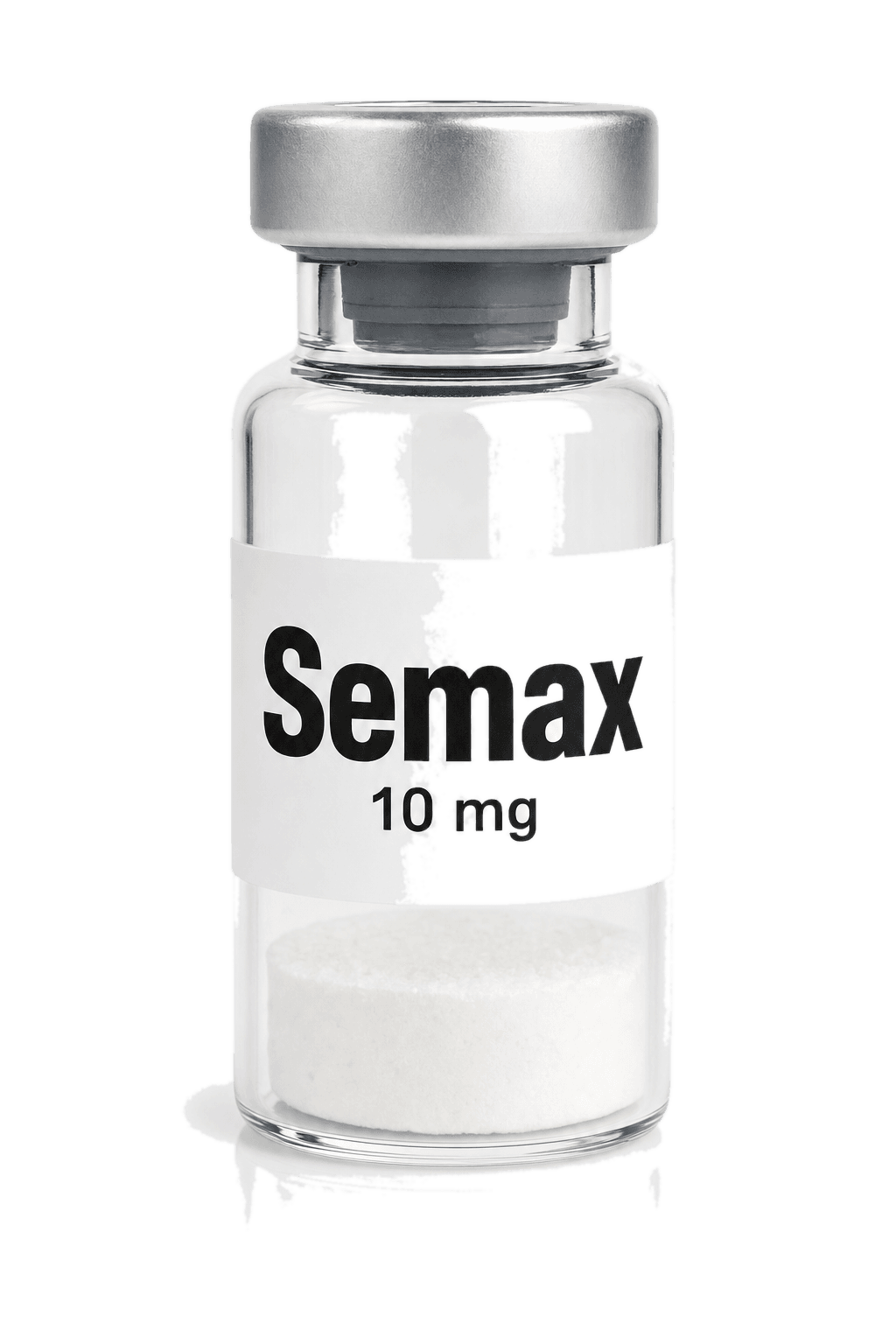
Semax is a synthetic seven-amino-acid peptide based on a fragment of ACTH, studied for cognition, stroke recovery, and BDNF. It is a prescription drug in Russia but is not FDA-approved; in the U.S. it is sold only as a research chemical.
In plain words
Semax is a lab-made peptide, usually sprayed in the nose, that people use hoping to focus better and protect the brain. Most of its research comes from Russia.
1 person has this in their stack
Key facts
- Category
- Brain & focus
- Legal / FDA status
- Research chemical in the U.S. (not FDA-approved); approved as a prescription drug in Russia, where it is on the official list of vital and essential medicines.
- Half-life
- Very short in plasma (the parent peptide is reported to clear within roughly minutes); behavioral and gene-expression effects appear to outlast measurable blood levels. Not well characterized by modern human pharmacokinetic studies.
- Typical form
- Lyophilized (freeze-dried) powder for reconstitution
- Also known as
- N-acetyl Semax amidate, NA-Semax-amidate, ACTH(4-7) PGP analog, Met-Glu-His-Phe-Pro-Gly-Pro
Intranasal (nasal spray / drops)
Semax's clinical dosing on record is INTRANASAL: in Russia it is used as a 0.1% nasal solution (≈1 mg/mL); higher-strength 1% products also exist. Prepare a research vial for this route by reconstituting into a METERED NASAL SPRAY bottle rather than a syringe — e.g. dissolving a 10 mg vial in ~3 mL gives ~3.3 mg/mL, so a typical 0.1 mL metered spray delivers on the order of ~330 mcg per spray (a 0.1% solution at ~1 mg/mL delivers ~100 mcg per 0.1 mL spray). This is arithmetic for measuring the studied microgram amount, not a dose recommendation. Semax is not FDA-approved and has no validated injectable dose.
Also seen: subcutaneous (community; not the studied route)
Source: Russian clinical use of Semax 0.1%/1% nasal solution; intranasal route in the Gusev et al. ischemic-stroke study (Zh Nevrol Psikhiatr 2018). Not FDA-approved.
Semax is a synthetic seven-amino-acid peptide based on a fragment of the hormone ACTH, studied mainly for cognition, ischemic-stroke recovery, and effects on brain-derived neurotrophic factor (BDNF). It is an approved prescription medicine in Russia but is not FDA-approved in the United States, where it is sold only as a research chemical. This page is for education only and is not medical advice; talk to a licensed clinician before making any health decision.
What is Semax?#
Semax is a synthetic heptapeptide — a short chain of seven amino acids with the sequence Met-Glu-His-Phe-Pro-Gly-Pro (MEHFPGP). It is built from the 4-7 fragment of adrenocorticotropic hormone (ACTH) with an added Pro-Gly-Pro "tail," so it is commonly described as an analog of the ACTH(4-10) region. That tail is thought to slow the enzymes that would otherwise break the peptide down quickly, giving it a longer functional window than the raw hormone fragment. Unlike ACTH itself, Semax is reported to lack the parent hormone's effect on the adrenal/cortisol axis.
Semax was developed at the Institute of Molecular Genetics of the Russian Academy of Sciences and appeared in the scientific literature around the early 1990s. Because peptides are poorly absorbed by mouth, it is typically given as a nasal (intranasal) preparation or by injection in research settings.
A modified version sold by research vendors, N-acetyl Semax amidate (NA-Semax-amidate), adds an acetyl group to one end and an amide group to the other. These chemical changes are intended to further slow breakdown and improve stability. It is a vendor modification rather than a separately approved drug, and it sits within the nootropic research category.
How does Semax work?#
The mechanism is not fully established, and most proposed pathways come from animal and cell studies. The most-discussed proposed action is an increase in brain-derived neurotrophic factor (BDNF) and signaling through its receptor TrkB. In rodents, a single intranasal dose has been reported to raise BDNF protein and messenger RNA in regions such as the basal forebrain and hippocampus.
Other proposed mechanisms reported in preclinical work include:
- Modulation of neurotrophins and their receptors, especially after experimental cerebral ischemia (reduced blood flow).
- Possible interaction with melanocortin receptors (a family ACTH itself acts on) and effects on enkephalin-degrading enzymes, which has been linked to mood and attention effects.
- Effects on dopaminergic and serotonergic systems and changes in the expression of genes tied to the immune and vascular response in injured brain tissue.
It is important to be clear that these are proposed, largely preclinical mechanisms. A described molecular effect in rats or cell cultures is not the same as a proven clinical benefit in people.
What is Semax studied for?#
Semax has been studied most for ischemic-stroke recovery and for cognitive and attention effects, plus broader neuroprotection. The evidence base leans heavily on Russian-language studies and animal models, with limited high-quality Western trial data.
| Research theme | Study type | Evidence level in humans |
|---|---|---|
| BDNF / neurotrophin upregulation | Animal and cell studies (with some human plasma-BDNF data) | Low — mostly preclinical; human data limited |
| Ischemic stroke recovery and function | Russian clinical studies (often non-randomized) | Low to moderate — not large blinded RCTs |
| Cognition, attention, mental performance | Small and older human studies, animal models | Low — limited blinding and replication |
| Neuroprotection after cerebral ischemia | Animal models | None established in humans |
| Optic nerve and other CNS conditions | Russian clinical use | Low — outside U.S. evidence standards |
A frequently cited 2018 Russian study in post-stroke patients reported faster functional recovery and higher plasma BDNF when Semax was added to rehabilitation, but it was not a randomized, placebo-controlled trial, which limits how much weight the result can carry. Overall, the field has many publications but few that meet modern Western trial standards.
Is Semax legal and FDA-approved?#
Regulatory status differs sharply by country. In Russia, Semax is an approved prescription drug and is included on the official list of vital and essential medicines, where it is used for conditions such as ischemic stroke, cognitive impairment, and optic nerve disease.
In the United States, Semax is not FDA-approved for any condition and is not part of any approved U.S. drug product. It is not a federally controlled substance, but it is also not recognized as an approved drug or as a dietary supplement, so domestic sales occur under "for research use only" labeling. Its compounding status has been in flux: Semax was designated a Section 503A "Category 2" bulk substance (substances that raise significant safety concerns for compounding) in 2023, then removed from that Category 2 list by the FDA in April 2026. It is now one of several peptides scheduled for review at the FDA's Pharmacy Compounding Advisory Committee meeting on July 23-24, 2026, where the committee is set to consider whether Semax (free base and acetate) should be added to the 503A bulk drug substances list. Removal from Category 2 does not, by itself, authorize compounding with Semax. None of this should be read as a recommendation to obtain or use the compound, and rules vary by country, so anyone outside the U.S. should check local law.
How is Semax dosed in research?#
There is no validated, standardized human dose that WikiPeps will publish, and we do not provide dosing protocols or amounts. The amounts used in Russian clinical practice are tied to specific approved products and medical supervision in that country, and they are not a guide for personal use elsewhere. The U.S. research-chemical market provides no assurance of identity, purity, or sterility.
Any decision about whether a compound is appropriate, and at what amount, is a medical decision that belongs with a licensed clinician who can weigh an individual's health, other medications, and the limits of the current evidence.
How is Semax reconstituted?#
Research-grade Semax usually arrives as a lyophilized (freeze-dried) powder that must be reconstituted with a sterile diluent before any laboratory use, kept cold, and protected from rough handling. The general process — disinfecting the stopper, adding diluent slowly down the vial wall, swirling gently rather than shaking, and labeling and refrigerating — is covered step by step in our reconstitution guide. This is described for education only and is not an instruction to self-administer.
What are the safety considerations?#
Semax has a relatively long history of supervised medical use in Russia, but controlled long-term safety data outside that setting are limited, and U.S.-sold research-chemical material is unregulated. The known and plausible risks include:
- Product quality problems — contamination, mislabeling, or impurity in "research use only" material that is not made to pharmaceutical standards.
- Infection or irritation from non-sterile preparation, injection, or repeated intranasal use.
- Unknown long-term and interaction effects, since it acts on neurotrophic and hormone-related (melanocortin) pathways that have not been fully studied for chronic use.
- Uncharacterized effects in people with existing neurological, psychiatric, or other medical conditions, or who take other medications.
These are reasons to involve a licensed clinician before considering any use, and to be skeptical of strong "smart drug" marketing claims that the human evidence does not support.
The bottom line#
Semax is a synthetic ACTH(4-10)-derived heptapeptide studied mainly for stroke recovery, cognition, and BDNF-related effects. It is an approved prescription drug in Russia but is not FDA-approved in the United States, where it is sold only as a research chemical. The mechanistic and animal data are interesting, and there is real clinical use abroad, but rigorous Western trials are limited and long-term safety outside supervised use is not well characterized. Use this page for education, treat nootropic marketing claims cautiously, and consult a licensed clinician before any health decision.
Side effects & safety
Generally reported as mild.
Commonly reported
- Nasal irritation (intranasal)
- Occasional mild stimulation or headache
Most data is Russian clinical/nootropic literature — limited Western study and unknown long-term effects.
Educational only — not medical advice. Everyone responds differently; talk to a licensed clinician before starting Semax, and stop and seek medical care for any severe or unusual reaction.
Tried Semax, or have a question about it?
Ask the community or share what you noticed — real people doing this carefully. Takes 30 seconds.
How to reconstitute lyophilized Semax (educational overview)
What you'll need
- Vial of lyophilized Semax
- Bacteriostatic water (or sterile water per product labeling)
- Sterile insulin syringe or reconstitution syringe
- Alcohol prep pads
- Clean, flat work surface
Wash hands and prepare the area
Wash your hands thoroughly and clean a flat work surface. Let the vial and diluent reach room temperature before starting.
Disinfect the stoppers
Wipe the rubber stopper of each vial with a fresh alcohol prep pad and let them air dry.
Draw the diluent
Draw your pre-planned volume of bacteriostatic water into the syringe. Choosing a round number of milliliters keeps later concentration math simple — see our mixing-math guide.
Add the water slowly
Insert the needle and let the water run gently down the inside wall of the vial rather than spraying directly onto the powder, which helps protect the delicate peptide.
Dissolve by swirling
Swirl gently until the solution is fully dissolved and clear. Do not shake. Discard the solution if it stays cloudy or shows particles.
Label and refrigerate
Label the vial with the contents, concentration, and date, then refrigerate per product guidance and inspect before any use.
Frequently asked questions
What is Semax?
- Semax is a synthetic heptapeptide (seven amino acids, sequence Met-Glu-His-Phe-Pro-Gly-Pro) built from the 4-7 fragment of adrenocorticotropic hormone (ACTH) with a Pro-Gly-Pro tail, so it is often described as an analog of the ACTH(4-10) region. It was developed in Russia and is studied as a nootropic and neuroprotective agent. In the U.S. it is sold only as a research chemical, not an approved medicine.
What is N-acetyl Semax amidate?
- N-acetyl Semax amidate (often shortened to NA-Semax-amidate or NASA) is a chemically modified version of Semax with an acetyl group added to one end and an amide group to the other. These changes are intended to slow enzymatic breakdown. It is a research-vendor modification, not a separately approved drug in Russia or the U.S.
What is Semax studied for?
- Most research focuses on ischemic stroke recovery, cognitive and attention effects, and neuroprotection, with proposed links to increased brain-derived neurotrophic factor (BDNF). A large share of this work was done in Russia and in animal models and has not been replicated in large Western randomized trials.
Is Semax FDA-approved?
- No. Semax is not approved by the U.S. FDA for any condition and is not part of any approved U.S. drug product. It is approved and prescribed in Russia, but that is a separate regulatory situation. In the U.S. it is sold only as a research chemical labeled 'for research use only.'
Does Semax actually improve memory or focus in healthy people?
- This is not well established. Much of the cognitive data comes from Russian studies and animal research; high-quality, blinded trials in healthy adults are limited. A reported effect in a small or unblinded study is not the same as a proven, reliable benefit.
Is Semax legal?
- In the U.S., Semax is not a federally controlled substance, but it is also not an approved drug or dietary supplement, and the FDA has been reviewing peptides like it for pharmacy compounding. It is approved as a prescription medicine in Russia. Legal status varies by country, so check local rules.
How is research-grade Semax stored and prepared?
- It usually ships as a lyophilized powder that must be kept cold and reconstituted with a sterile diluent before any laboratory use. WikiPeps describes the general handling process for education only and does not publish human dosing protocols or amounts.
References
- 1.Semax, an analogue of adrenocorticotropin (4-10), binds specifically and increases levels of brain-derived neurotrophic factor protein in rat basal forebrain — Journal of Neurochemistry (PubMed PMID 16635254) · 2006
- 2.Semax, an analog of ACTH(4-10) with cognitive effects, regulates BDNF and trkB expression in the rat hippocampus — Brain Research (PubMed PMID 16996037) · 2006
- 3.Semax and Pro-Gly-Pro activate the transcription of neurotrophins and their receptor genes after cerebral ischemia — Cellular and Molecular Neurobiology (PubMed PMID 19633950) · 2009
- 4.The efficacy of semax in the treatment of patients at different stages of ischemic stroke — Zhurnal Nevrologii i Psikhiatrii imeni S.S. Korsakova (PubMed PMID 29798983) · 2018
- 5.Bulk Drug Substances Used in Compounding Under Section 503A of the FD&C Act (503A bulks list and category framework) — U.S. Food & Drug Administration (FDA.gov) · 2026
- 6.July 23-24, 2026: Meeting of the Pharmacy Compounding Advisory Committee (Semax bulk drug substance on the agenda) — U.S. Food & Drug Administration (FDA.gov) · 2026
What the research shows
Non-Western clinical (Russia) + preclinicalSemax is an approved prescription drug in Russia with non-randomized Russian clinical studies in ischemic stroke and cognition, plus substantial animal work on BDNF/neurotrophins. It is NOT FDA-approved, large Western RCTs are lacking, and the studied route is intranasal.
The efficacy of semax in the treatment of patients at different stages of ischemic stroke
Gusev EI, Martynov MYu, Kostenko EV, Petrova LV, Bobyreva SN · 2018 · Zh Nevrol Psikhiatr Im S S Korsakova 2018;118(3 Vyp 2):61-68 (PMID 29798983)
Semax, an analogue of ACTH(4-10), binds specifically and increases levels of brain-derived neurotrophic factor protein in rat basal forebrain
Dolotov OV, Karpenko EA, et al. · 2006 · J Neurochem 2006;97 Suppl 1:82-86 (PMID 16635254)
Citations are real, published sources, graded conservatively. Educational only — not medical advice, and not an endorsement to use any compound.
Improve this page
See something out of date or unclear? Propose an edit — an admin reviews every suggestion before any change is made.
Comments & experiences
What members are saying about Semax — questions, observations, and lived experience. Not medical advice.
Add a comment
Ask a question or share what you've seen — a star rating is optional. Comments post right away once they pass a quick automated check; anything flagged is reviewed first.