
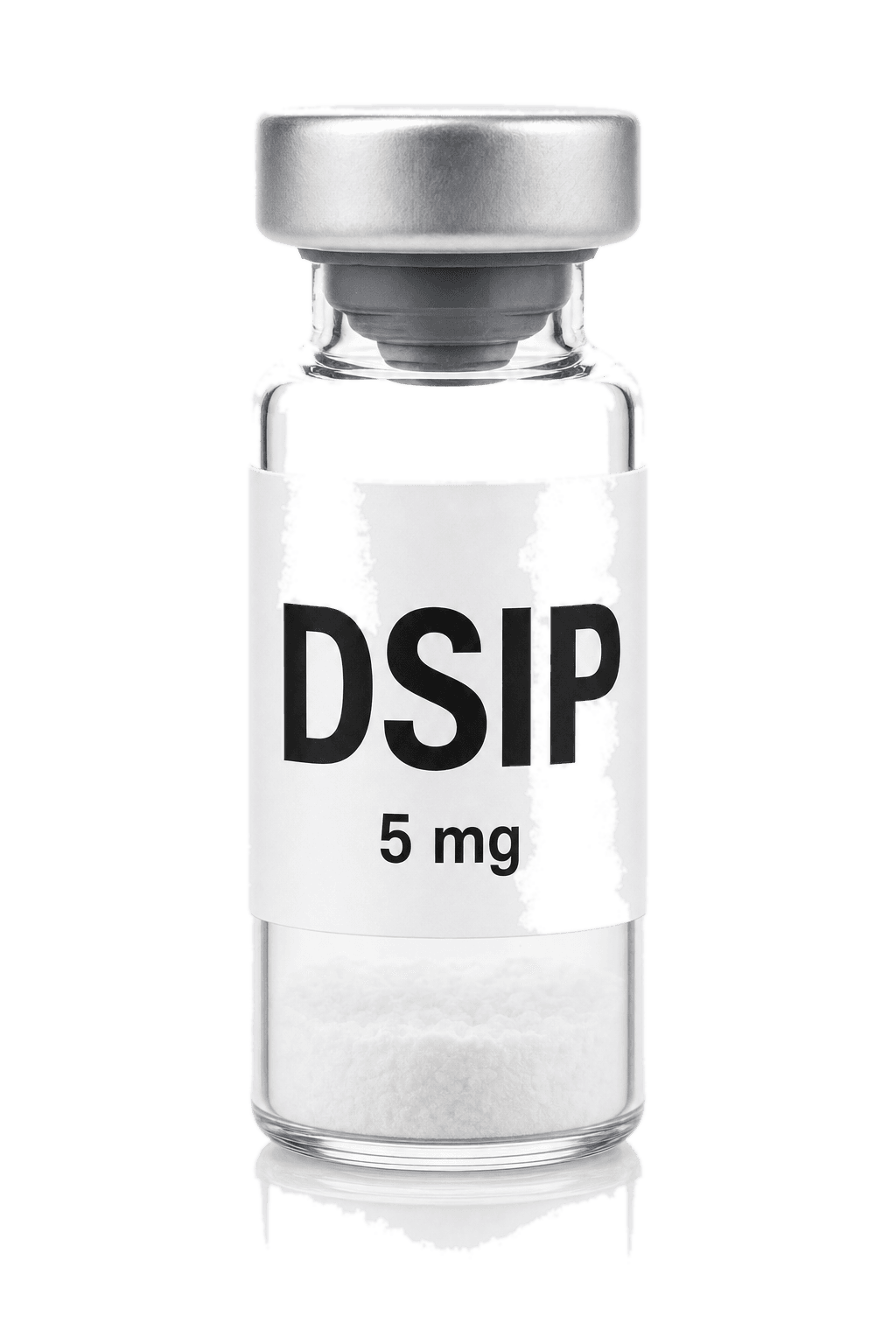
DSIP
DSIP (Delta Sleep-Inducing Peptide) is a nine-amino-acid peptide first isolated from rabbit brain in the 1970s and studied mainly for sleep and stress. It is a research chemical, not an FDA-approved drug, and is not a proven human therapy. Nothing here is medical advice.
In plain words
DSIP stands for “deep sleep peptide.” People take it hoping to sleep better and feel less stressed. There’s very little human research, so it’s unproven.
Key facts
- Category
- Sleep
- Legal / FDA status
- Research chemical (not FDA-approved)
- Half-life
- Very short; reported on the order of minutes in animal and human plasma due to rapid enzymatic breakdown. Not well characterized by modern human studies.
- Typical form
- Lyophilized (freeze-dried) powder for reconstitution
- Also known as
- Delta Sleep-Inducing Peptide, Emideltide
Subcutaneous injection — studied IV in older trials
DSIP is community-administered by subcutaneous injection, usually in the evening before bed. The older human sleep studies actually gave it by IV infusion. Modern human data are very limited; there is no validated dose or approved route.
Also seen: intravenous (older human studies)
Source: Community-reported SC practice; early human insomnia trials used IV (Schneider-Helmert & Schoenenberger). Not FDA-approved.
DSIP (Delta Sleep-Inducing Peptide) is a small, naturally occurring peptide first isolated in the 1970s from the cerebral blood of sleeping rabbits and studied mainly for its effects on sleep, stress, and hormone release. It is a research chemical, not an approved medicine, and is not a proven human therapy. Everything here is for education only and is not medical advice or a recommendation to obtain or use it.
What is DSIP?#
DSIP is a nine-amino-acid peptide (a "nonapeptide") with a molecular weight of roughly 850 daltons. It was first identified by a Swiss research group that isolated a sleep-promoting substance from the cerebral venous blood of rabbits placed in an induced sleep state. The peptide was later reported in both free and protein-bound forms in brain regions such as the hypothalamus, the limbic system, and the pituitary, as well as in some peripheral tissues and body fluids.
Despite its name, decades of research have not fully resolved what DSIP does in the body, and a frequently cited 2006 review described it as a "still unresolved riddle." For research and sale it is usually supplied as a lyophilized (freeze-dried) white powder that must be reconstituted with a sterile diluent before it can be measured in liquid form. It is commonly labeled "for research use only."
How does DSIP work?#
The proposed mechanisms come mostly from older animal and laboratory studies, so they should be read as hypotheses rather than settled facts. Reported observations include:
- A sleep-modulating effect that appears greater when sleep is already disturbed and minimal in healthy sleepers, which is why some researchers describe it as a sleep-promoting substance rather than a sedative.
- Transport across the blood-brain barrier by a high-affinity, saturable mechanism, allowing it to reach brain regions involved in sleep regulation.
- Influence on hormone release, including reports that it can affect corticotropin, luteinizing hormone, growth hormone, and somatostatin, in some cases through a proposed dopaminergic pathway.
- A possible role as a stress-limiting factor affecting neurotransmitter levels and circadian patterns.
A practical complication is that DSIP breaks down very quickly in blood, so how a naturally short-lived peptide could exert lasting effects remains debated. None of these mechanisms has been confirmed in adequately powered modern human trials. A licensed clinician is the right person to interpret what, if anything, this means for an individual.
What is DSIP studied for?#
The DSIP literature is dominated by older preclinical work, with only a handful of small human studies. The table below summarizes common research themes and their evidence level in humans.
| Research theme | Study type | Evidence level in humans |
|---|---|---|
| Sleep regulation / disturbed sleep | Small 1980s human studies; animal models | Weak, dated; no modern controlled trials |
| Stress response modulation | Animal models | No controlled human trials |
| Hormone release (corticotropin, GH, LH, somatostatin) | Animal and in vitro studies | No controlled human trials |
| Opioid / alcohol withdrawal symptoms | Limited and preliminary | Not established |
| Antioxidant / general adaptation effects | Animal and in vitro studies | No controlled human trials |
The recurring caveat applies throughout: animal results do not reliably predict human outcomes, the human sleep data are decades old and involve very small numbers of participants, and DSIP has not been validated as a treatment for any condition.
Is DSIP legal and FDA-approved?#
DSIP is not FDA-approved and is not a recognized dietary supplement, so it cannot lawfully be marketed for human consumption in the United States. Under the name emideltide it is on the agenda of the FDA's Pharmacy Compounding Advisory Committee, whose meeting (scheduled for July 2026) is set to discuss whether emideltide/DSIP should be added to the Section 503A list of bulk drug substances permitted in pharmacy compounding. That committee is advisory and a 503A listing is not the same as drug approval; until and unless a regulator approves it, it remains a research compound. Anti-doping rules and national laws differ, and broad anti-doping categories can capture peptide hormones, so anyone subject to drug testing or considering use should verify the current rules where they live and consult a licensed professional.
How is DSIP dosed?#
There is no validated human dose. The small older human studies used amounts that do not translate into safe, current human guidance, and there is no modern dosing standard. WikiPeps does not publish dosing protocols. Any decision about quantity, route, or frequency is a medical decision that belongs with a licensed clinician who knows your history.
How is DSIP reconstituted?#
Lyophilized DSIP is reconstituted by slowly adding a sterile diluent (such as bacteriostatic water) to the vial and gently swirling until the powder fully dissolves. The numbered steps in the "How To" section above outline the general, education-only handling process. This page does not specify diluent volumes or concentrations; those are measurement decisions to discuss with a licensed clinician who knows your situation.
What are the safety considerations?#
Human safety data are sparse and out of date because rigorous modern clinical trials have not been completed. The few older human studies reported relatively few effects, with occasional transient headache, nausea, or dizziness, but these were small studies and tell us little about long-term safety. That uncertainty is itself a safety concern: unknown long-term effects, variable product purity in the research-chemical market, and the absence of regulatory oversight all raise risk. Sterility during handling matters, and contamination can cause infection. Because of these unknowns, the only responsible step before considering any peptide is a conversation with a licensed clinician.
The bottom line#
DSIP is a naturally occurring peptide with an intriguing history and a small, dated body of evidence centered on sleep and stress. It is not FDA-approved, not proven in humans, and not a validated treatment for insomnia or anything else. Treat everything here as education, verify the law where you live, and talk to a licensed clinician before making any health decision.
Side effects & safety
Limited human data; reported effects are generally mild.
Commonly reported
- Occasional grogginess
- Mild headache
- Injection-site reactions
Very little controlled human data exists — long-term effects are unknown.
Educational only — not medical advice. Everyone responds differently; talk to a licensed clinician before starting DSIP, and stop and seek medical care for any severe or unusual reaction.
Tried DSIP, or have a question about it?
Ask the community or share what you noticed — real people doing this carefully. Takes 30 seconds.
How to reconstitute lyophilized DSIP (educational overview)
What you'll need
- Vial of lyophilized DSIP
- Bacteriostatic water (or sterile water per product labeling)
- Sterile insulin syringe or reconstitution syringe
- Alcohol prep pads
- Clean, flat work surface
Wash hands and prepare the area
Wash your hands thoroughly and wipe down a clean, flat surface. Let both vials reach room temperature to reduce condensation.
Disinfect the stoppers
Wipe the rubber stopper of both the DSIP vial and the diluent vial with separate alcohol prep pads and let them air dry.
Draw the diluent
Draw the diluent into the syringe. Choosing a diluent volume and converting it to syringe units is a measurement decision; this page does not specify amounts.
Add water slowly
Insert the needle into the DSIP vial and let the water run slowly down the inside glass wall rather than spraying it directly onto the powder, which can damage the peptide.
Dissolve gently
Remove the syringe and gently swirl or roll the vial. Do not shake. Wait until the solution is completely clear with no visible particles.
Label and refrigerate
Label the vial with the date, then store it in the refrigerator per product guidance. Inspect for cloudiness or particles before any use.
Frequently asked questions
What is DSIP?
- DSIP (Delta Sleep-Inducing Peptide) is a naturally occurring nine-amino-acid peptide first isolated in the 1970s from the cerebral blood of sleeping rabbits. It has been studied mainly in animals for effects on sleep, stress, and hormone release. It is a research chemical and is not an approved medicine.
What is DSIP studied for?
- Most DSIP research is older preclinical (animal) work plus a small number of human sleep studies from the 1980s. Reported research themes include sleep regulation, stress responses, and possible roles in opioid-withdrawal symptoms. None of this establishes that DSIP is safe or effective in humans.
Is DSIP FDA-approved?
- No. DSIP is not approved by the U.S. FDA for any use. Under the name emideltide it is on the agenda of the FDA's Pharmacy Compounding Advisory Committee (a meeting scheduled for July 2026) to discuss whether it should be added to the Section 503A list of bulk substances allowed in pharmacy compounding. That is an advisory process, not drug approval, and as of mid-2026 it remains a research compound, not an approved drug. It is sold only for research use, not for human consumption.
Is DSIP legal?
- DSIP is not an approved drug or dietary supplement in the United States, so it cannot legally be marketed for human consumption. It is generally sold only as a research chemical. Anti-doping rules and laws differ by country and sport, so verify local regulations and consult a licensed professional.
What are the reported side effects of DSIP?
- Human safety data are very limited because rigorous modern trials are lacking. Older human studies reported few effects, with occasional transient headache, nausea, or dizziness. Long-term safety is unknown, and research-chemical purity is not guaranteed. Speak with a licensed clinician before considering it.
Does DSIP actually work for sleep?
- The evidence is weak and dated. A few small 1980s human studies suggested modest improvements in people with disturbed sleep, while healthy sleepers saw little effect. There are no adequately powered, modern, placebo-controlled trials, so DSIP is not a proven sleep treatment.
How is DSIP dosed?
- There is no validated human dose. Older studies used amounts that do not translate into safe human guidance. This page does not provide dosing instructions; any decision about dose, route, or frequency is a medical decision that belongs with a licensed clinician who knows your history.
References
- 1.Delta-sleep-inducing peptide (DSIP): a review — Neuroscience and Biobehavioral Reviews (PubMed PMID 6145137) · 1984
- 2.Delta sleep-inducing peptide (DSIP): a still unresolved riddle — Journal of Neurochemistry (Wiley; doi 10.1111/j.1471-4159.2006.03693.x) · 2006
- 3.The influence of synthetic DSIP (delta-sleep-inducing-peptide) on disturbed human sleep — Experientia (PubMed PMID 7028502) · 1981
- 4.Pichia pastoris secreted peptides crossing the blood-brain barrier and DSIP fusion peptide efficacy in PCPA-induced insomnia mouse models — Frontiers in Pharmacology (PubMed PMID 39444618) · 2024
- 5.Pharmacy Compounding Advisory Committee; Notice of Meeting (bulk drug substances nominated for the Section 503A list, including emideltide/DSIP), meeting scheduled July 23-24, 2026 — U.S. Federal Register (FDA) · 2026
What the research shows
Very limited, dated human dataDSIP (Delta Sleep-Inducing Peptide) was discovered in the 1970s and tested in small, dated human sleep studies with mixed results; modern, rigorous trials are essentially absent. Its sleep use today is community-reported, and it is not FDA-approved.
The influence of synthetic DSIP (delta-sleep-inducing peptide) on disturbed human sleep
Schneider-Helmert D, Schoenenberger GA · 1981 · Experientia 1981 (PMID 7028502)
Characterization, properties and multivariate functions of delta-sleep-inducing peptide (DSIP) (review)
Graf MV, Kastin AJ · 1986 · review (PMID 6548966)
Citations are real, published sources, graded conservatively. Educational only — not medical advice, and not an endorsement to use any compound.
Improve this page
See something out of date or unclear? Propose an edit — an admin reviews every suggestion before any change is made.
Comments & experiences
What members are saying about DSIP — questions, observations, and lived experience. Not medical advice.
Add a comment
Ask a question or share what you've seen — a star rating is optional. Comments post right away once they pass a quick automated check; anything flagged is reviewed first.