
Epithalon
Epithalon is a synthetic four-amino-acid peptide (Ala-Glu-Asp-Gly) derived from a pineal-gland extract and studied for telomerase activity, melatonin, and aging. It is a research chemical, not FDA-approved, and its human evidence is very limited.
In plain words
Epithalon is a lab-made peptide some people take hoping to slow aging and sleep better. The research is old and thin, so treat it as unproven.
Key facts
- Category
- Aging
- Legal / FDA status
- Research chemical (not FDA-approved); no approved human product exists
- Half-life
- Not well characterized in humans; small linear peptides are generally cleared quickly
- Typical form
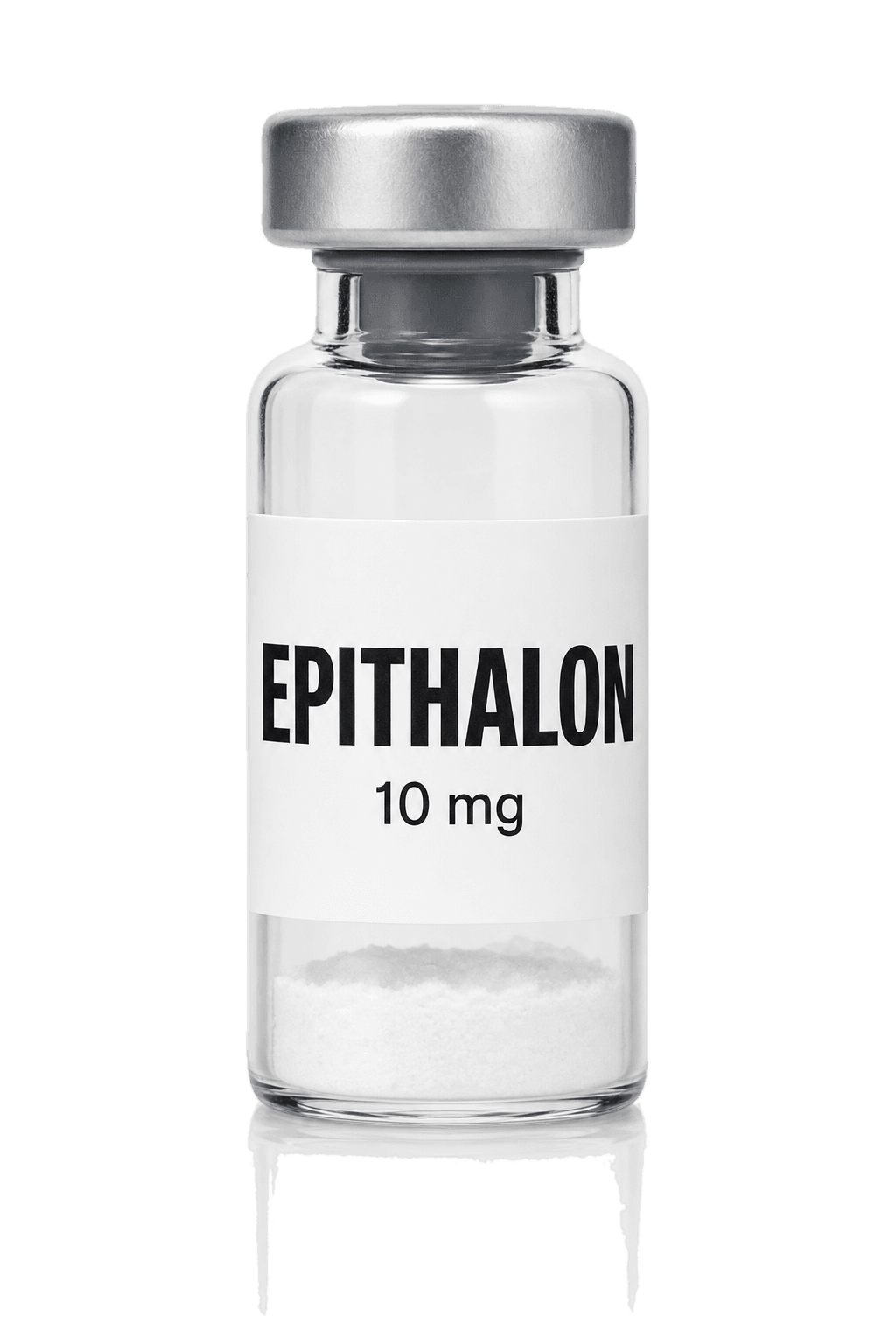
- Lyophilized (freeze-dried) powder for reconstitution
- Also known as
- Epitalon, Epithalone, AEDG peptide, Ala-Glu-Asp-Gly
Subcutaneous injection (short courses)
Epithalon is community-administered by subcutaneous injection, typically as a short defined course (e.g. a daily injection for ~10–20 days). The related Russian research used the peptide bioregulator epithalamin parenterally. Human data are very limited; there is no validated dose or approved route.
Source: Community-reported practice echoing the Khavinson/St. Petersburg research. Not FDA-approved.
Epithalon is a synthetic four-amino-acid peptide (Ala-Glu-Asp-Gly) derived from a pineal-gland extract and studied for telomerase activity, melatonin rhythms, and aging. It is a research chemical, not an FDA-approved medicine, and its human evidence is very limited. This page is for education only and is not medical advice; talk to a licensed clinician before making any health decision.
What is Epithalon?#
Epithalon is a synthetic tetrapeptide — a short chain of four amino acids: alanine, glutamic acid, aspartic acid, and glycine, abbreviated AEDG. It was developed by Vladimir Khavinson and colleagues at the St. Petersburg Institute of Bioregulation and Gerontology in Russia, who designed it as the proposed active fragment of epithalamin, a polypeptide extract of the bovine pineal gland.
The peptide is also written as "Epitalon" or "Epithalone." It is studied within the longevity or geroprotector category. In practice it exists as an unregulated research chemical, sold as a lyophilized powder labeled "for research use only," and is not part of any approved drug product.
How does Epithalon work?#
The most-discussed proposed mechanism is telomerase activation. Telomeres are the protective caps at the ends of chromosomes that shorten each time a cell divides; once they become critically short, cells stop dividing or die, which is one part of cellular aging. Laboratory research has reported that Epithalon can switch on the telomerase enzyme and lengthen telomeres in cultured human cells.
Other proposed actions, drawn mostly from cell and animal studies, include:
- Restoring melatonin rhythms by acting on the pineal gland.
- Antioxidant and antimutagenic effects.
- Modulation of gene expression and chromatin activity in aged cells.
It is important to be clear that these mechanisms are largely preclinical (test-tube and animal) and come disproportionately from one research group. A reported mechanism is not the same as a proven benefit in people.
What is Epithalon studied for?#
Epithalon has been studied primarily for aging-related outcomes. The evidence base is heavily weighted toward laboratory and animal work, with only a small amount of human data of limited quality.
| Research theme | Study type | Evidence level in humans |
|---|---|---|
| Telomerase activity / telomere elongation | Human cell cultures (in vitro) | Very low — not shown to translate to clinical benefit |
| Melatonin and circadian rhythm restoration | Small older human studies, animal models | Low — small, mostly non-blinded |
| Mortality / cardiovascular aging (as part of pineal-peptide programs) | Older Russian clinical studies | Low — not modern randomized controlled trials |
| Antioxidant, neuroprotective, antimutagenic effects | Cell cultures and animal models | None established in humans |
A 2025 review summarized the field as showing "significant geroprotective and neuroendocrine effects" in experimental models while stressing that comprehensive human safety and efficacy data remain insufficient for regulatory approval.
Is Epithalon legal and FDA-approved?#
Epithalon is not FDA-approved for any medical condition and is not an ingredient in any approved drug product. It is not a controlled substance in the United States, but it is also not recognized as an approved drug or as a dietary supplement. It is sold only as a research chemical marked "for research use only."
Epithalon (Epitalon) has been nominated as a bulk drug substance for possible use in pharmacy compounding under Section 503A of the FD&C Act and is under review by the FDA's Pharmacy Compounding Advisory Committee. As of this page's review date it is not approved for compounding, and its inclusion on the 503A bulks list has not been finalized. Regulatory and legal status can change and varies by country, so anyone outside the U.S. should check local rules. None of this constitutes a recommendation to obtain or use the compound.
How is Epithalon dosed in research?#
There is no validated human dose for Epithalon, and WikiPeps does not publish dosing protocols or amounts. Doses used in the older Russian studies were tied to a specific research setting and are not a guide for personal use, and the unregulated research-chemical market provides no quality assurance on identity, purity, or sterility.
Any decision about whether a compound is appropriate, and at what amount, is a medical decision that belongs with a licensed clinician who can weigh an individual's health, other medications, and the lack of human evidence.
How is Epithalon reconstituted?#
Research-grade Epithalon arrives as a lyophilized (freeze-dried) powder that must be reconstituted with a sterile diluent before any laboratory use, kept cold, and protected from rough handling. The general process — disinfecting the stopper, adding diluent slowly down the vial wall, swirling gently rather than shaking, and labeling and refrigerating — is described in the step-by-step overview above. This is provided for education only and is not an instruction to self-administer.
What are the safety considerations?#
Because there is so little controlled human data, the safety profile of Epithalon is largely uncharacterized. The known and plausible risks are mostly generic to unregulated injectable peptides:
- Contamination, mislabeling, or impurity in products sold "for research use only," which are not made to pharmaceutical standards.
- Infection or injection-site reactions from non-sterile preparation or technique.
- Unknown long-term effects, including theoretical concerns about manipulating telomerase, an enzyme also relevant to cell-growth and cancer biology.
- Interactions with existing conditions or medications that have not been studied.
These concerns are reasons to involve a licensed clinician before considering any use, and to be skeptical of strong anti-aging marketing claims that the evidence does not support.
The bottom line#
Epithalon is a synthetic AEDG tetrapeptide derived from a pineal-gland extract and studied mainly for telomerase activity, melatonin, and aging. The mechanistic and animal data are interesting, but human evidence is very limited and mostly does not meet modern trial standards. It is a research chemical, not FDA-approved, and its safety is largely unknown. Use this page for education, treat anti-aging claims cautiously, and consult a licensed clinician before any health decision.
Side effects & safety
Reported as well tolerated in the (limited, mostly older) literature.
Commonly reported
- Injection-site reactions
- Little else commonly reported
Human data is sparse and largely from one research group; long-term effects are unknown.
Educational only — not medical advice. Everyone responds differently; talk to a licensed clinician before starting Epithalon, and stop and seek medical care for any severe or unusual reaction.
Tried Epithalon, or have a question about it?
Ask the community or share what you noticed — real people doing this carefully. Takes 30 seconds.
How to reconstitute lyophilized Epithalon (educational overview)
What you'll need
- Vial of lyophilized Epithalon
- Bacteriostatic water (or sterile water per product labeling)
- Sterile insulin syringe or reconstitution syringe
- Alcohol prep pads
- Clean, flat work surface
Wash hands and prepare the area
Wash your hands thoroughly and clean a flat work surface. Let the vial and diluent reach room temperature before starting.
Disinfect the stoppers
Wipe the rubber stopper of each vial with a fresh alcohol prep pad and let them air dry.
Draw the diluent
Draw your pre-planned volume of bacteriostatic water into the syringe. Choosing a round number of milliliters keeps later concentration math simple.
Add the water slowly
Insert the needle and let the water run gently down the inside wall of the vial rather than spraying directly onto the powder, which helps protect the delicate peptide.
Dissolve by swirling
Swirl gently until the solution is fully dissolved and clear. Do not shake. Discard the solution if it stays cloudy or shows particles.
Label and refrigerate
Label the vial with the contents, concentration, and date, then refrigerate per product guidance and inspect before any use.
Frequently asked questions
What is Epithalon?
- Epithalon is a synthetic tetrapeptide made of four amino acids — alanine, glutamic acid, aspartic acid, and glycine (Ala-Glu-Asp-Gly). It was developed by Russian researchers as a synthetic version of the active fragment of epithalamin, an extract of the pineal gland. It is a research chemical, not an approved medicine.
What is Epithalon studied for?
- Most Epithalon research focuses on aging: activation of the enzyme telomerase, lengthening of telomeres in cell cultures, restoration of melatonin rhythms, and antioxidant effects. Much of this work is laboratory or animal research from a single research group, and human data are very limited.
Is Epithalon FDA-approved?
- No. Epithalon is not approved by the FDA for any condition and is not part of any approved drug product. It is sold only as a research chemical labeled 'for research use only.' It has not been evaluated in large Western clinical trials.
Does Epithalon actually extend telomeres or lifespan in humans?
- This is not established. Telomere and telomerase effects have been reported mainly in cell cultures, and lifespan or mortality findings come largely from older Russian studies that do not meet modern randomized-trial standards. There is no reliable proof of an anti-aging benefit in humans.
What are the risks of Epithalon?
- Human safety data are very limited, so the risks are largely uncharacterized. General concerns with any reconstituted research peptide include injection-related infection, contamination or mislabeling of unregulated products, and unknown long-term effects. Anyone considering it should talk to a licensed clinician first.
Is Epithalon legal?
- Epithalon is not a controlled substance in the U.S., but it is also not an approved drug or dietary supplement. It is sold as a research chemical. It has been nominated as a bulk drug substance for possible use in pharmacy compounding and is under FDA advisory-committee review; it is not currently approved for compounding. Legal status differs by country, so check local rules.
How is research-grade Epithalon stored and prepared?
- It typically ships as a lyophilized powder that must be kept cold and reconstituted with a sterile diluent before any laboratory use. WikiPeps describes the general handling process for education only and does not publish human dosing protocols.
References
- 1.Epithalon peptide induces telomerase activity and telomere elongation in human somatic cells — Bulletin of Experimental Biology and Medicine (PubMed PMID 12937682) · 2003
- 2.Peptides of pineal gland and thymus prolong human life — Neuro Endocrinology Letters (PubMed PMID 14523363) · 2003
- 3.Peptide geroprotector from the pituitary gland inhibits rapid aging of elderly people: results of 15-year follow-up — Bulletin of Experimental Biology and Medicine (PubMed PMID 22451889) · 2011
- 4.Overview of Epitalon — Highly Bioactive Pineal Tetrapeptide with Promising Properties — International Journal of Molecular Sciences (PubMed PMID 40141333) · 2025
- 5.Bulk Drug Substances Used in Compounding Under Section 503A of the FD&C Act (Epitalon nominated; under Pharmacy Compounding Advisory Committee review) — U.S. Food & Drug Administration (FDA.gov) · 2026
What the research shows
Limited / single-group human + preclinicalEpithalon (AEDG tetrapeptide) has cell-culture evidence of telomerase activation and a small body of human longevity work, but it comes almost entirely from one Russian research group (Khavinson and colleagues) and lacks independent Western randomized replication. Not FDA-approved.
Epithalon peptide induces telomerase activity and telomere elongation in human somatic cells
Khavinson VKh, Bondarev IE, Butyugov AA · 2003 · Bull Exp Biol Med 2003;135(6):590-592 (PMID 12937682)
Peptide promotes overcoming of the division limit in human somatic cell
Khavinson VKh, et al. · 2004 · Bull Exp Biol Med (PMID 15455129)
Citations are real, published sources, graded conservatively. Educational only — not medical advice, and not an endorsement to use any compound.
Improve this page
See something out of date or unclear? Propose an edit — an admin reviews every suggestion before any change is made.
Comments & experiences
What members are saying about Epithalon — questions, observations, and lived experience. Not medical advice.
Add a comment
Ask a question or share what you've seen — a star rating is optional. Comments post right away once they pass a quick automated check; anything flagged is reviewed first.