
GHK-Cu (Copper Peptide)
GHK-Cu is a naturally occurring copper-binding tripeptide (glycyl-histidyl-lysine) studied for skin remodeling, wound healing, and antioxidant effects. It is widely used as a cosmetic ingredient but is not an FDA-approved drug for medical treatment.
In plain words
GHK-Cu is a tiny copper-carrying peptide your body makes on its own. It’s mostly used in skin creams to try to smooth skin and help wounds heal. Injecting it isn’t well studied.
2 people have this in their stack
Key facts
- Category
- Skin & beauty
- Legal / FDA status
- Cosmetic ingredient / research compound (not an FDA-approved drug)
- Half-life
- Not well characterized; the GHK tripeptide declines naturally with age in human plasma
- Typical form
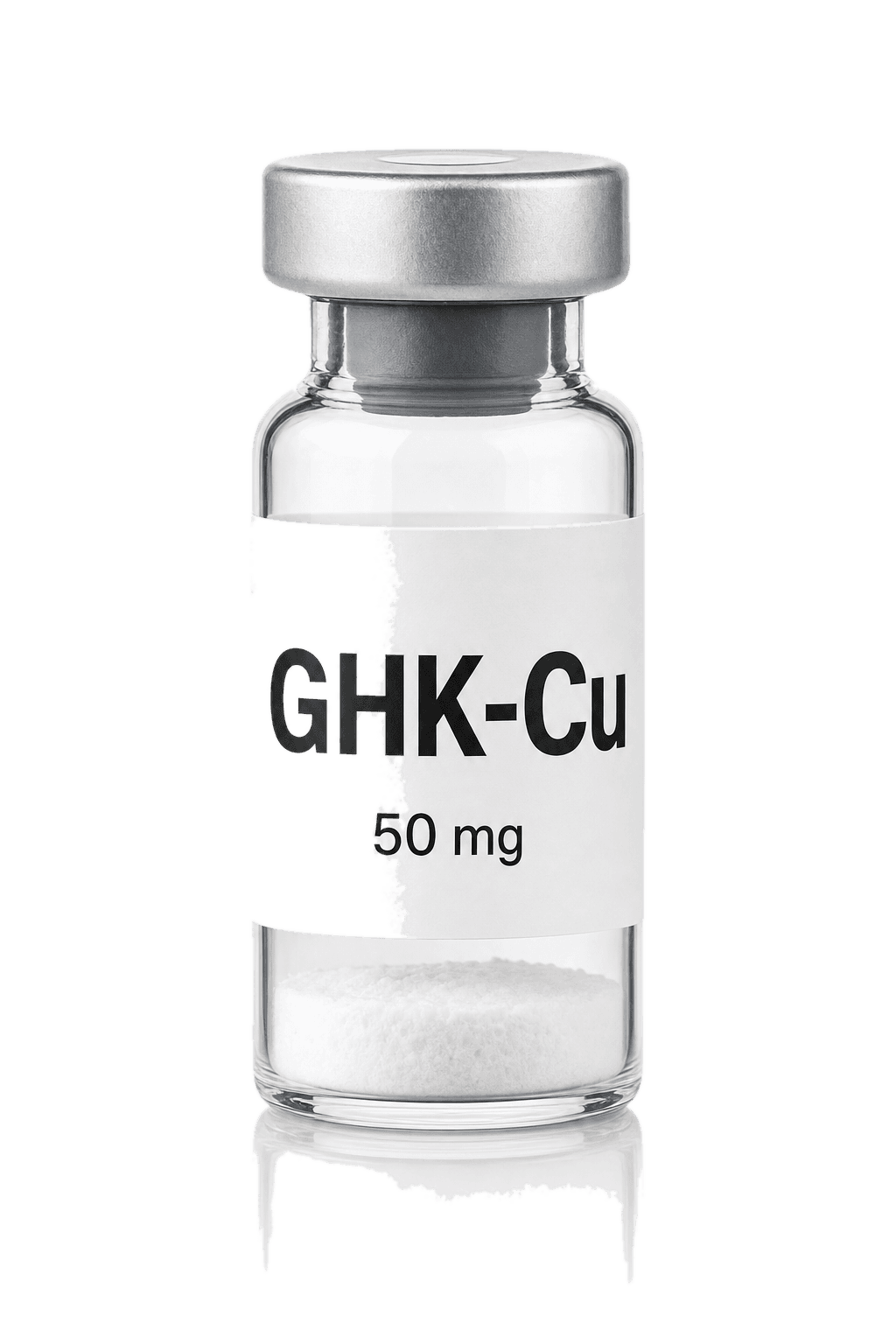
- Lyophilized powder for reconstitution, or pre-formulated in topical cosmetics
- Also known as
- GHK-Cu, Copper tripeptide-1, Glycyl-L-histidyl-L-lysine copper, Copper peptide
Topical (skincare) — also injected as a research chemical
The overwhelming majority of GHK-Cu's real-world use and evidence is TOPICAL — it is a long-standing cosmetic ingredient ('copper tripeptide-1') in serums and creams for skin. A reconstituted research-chemical form is also injected subcutaneously, but that systemic use is poorly characterized and not the basis of its evidence. The reconstituted solution turns blue from the copper ion.
Also seen: subcutaneous (research-chemical, community)
Source: Cosmetic/clinical literature on topical GHK-Cu (Pickart & Margolina, Int J Mol Sci 2018); injectable use is community-reported. Not an FDA-approved drug.
GHK-Cu is a naturally occurring copper-binding tripeptide (glycyl-histidyl-lysine) studied for skin remodeling, wound healing, and antioxidant effects. It is widely used as a cosmetic ingredient but is not an FDA-approved drug for treating any medical condition. Nothing here is medical advice.
What is GHK-Cu?#
GHK-Cu is a small tripeptide — glycine, histidine, and lysine — bound to a copper ion. It occurs naturally in human plasma, saliva, and urine, and its concentration in the body declines with age, which is part of why it became interesting to researchers studying skin aging and repair. It is found both in cosmetic skincare formulations and as a lyophilized research compound.
What is GHK-Cu used for?#
By far its most common real-world use is as a cosmetic ingredient (often listed as "copper tripeptide-1") in serums and creams marketed for skin firmness, texture, and the appearance of fine lines. In laboratory and clinical-cosmetic research, GHK and GHK-Cu have been studied for:
- Collagen and elastin synthesis in skin cells.
- Wound healing and tissue remodeling.
- Antioxidant and anti-inflammatory activity.
- General skin-barrier and appearance benefits.
It is not an approved drug for treating any disease. Cosmetic claims about appearance are regulated differently from medical claims about treatment.
Is topical GHK-Cu different from injectable GHK-Cu?#
Yes, and the difference is important for safety. Topical GHK-Cu in cosmetics has a long history of personal-care use and a generally favorable tolerability profile. Reconstituted, injectable research-chemical GHK-Cu is a different matter: it is not FDA-approved for human use, its risks are largely uncharacterized, and copper handling in the body is tightly regulated. This page describes both for education only and does not recommend injectable use.
Is GHK-Cu FDA-approved?#
GHK-Cu is used as a cosmetic ingredient, and cosmetics in the U.S. do not require the pre-market drug approval that medicines do. It is not an FDA-approved drug for any medical condition, and injectable research-chemical forms are not approved for human use. A dermatologist or licensed clinician can clarify what is appropriate for an individual.
Does GHK-Cu help with hair or anti-aging?#
Some cosmetic research and products explore copper peptides for scalp, hair appearance, and skin aging, and there is genuine interest in this area. However, the evidence is limited and GHK-Cu is not an approved treatment for hair loss or any aging-related condition. Marketing claims often outpace the science, so a dermatologist's input is the most reliable guide.
How is research-grade GHK-Cu reconstituted?#
Lyophilized GHK-Cu is reconstituted by slowly adding bacteriostatic water down the vial wall and swirling gently; the dissolved solution typically turns a characteristic blue color from the copper ion, which is expected. Our reconstitution guide and mixing-math guide cover the process in full. This is education only, not an instruction to self-administer.
What are the safety considerations?#
Topical cosmetic GHK-Cu is generally well tolerated, though it can cause irritation or contact reactions in some people; patch-testing a new product is sensible. For any non-cosmetic, research-chemical form, the unknowns are large and copper balance in the body matters, so a licensed clinician or dermatologist should be consulted first.
The bottom line#
GHK-Cu is a natural copper tripeptide best known as a cosmetic skincare ingredient and studied for skin repair and antioxidant effects. It is not an FDA-approved drug, and injectable research-chemical forms are not approved for human use. Use this page for education, patch-test cosmetics, and consult a dermatologist or licensed clinician before any health decision.
Side effects & safety
Topical GHK-Cu is generally well tolerated; injected use has little human safety data.
Commonly reported
- Mild skin irritation or redness (topical)
- Injection-site reactions (injected)
Most evidence is topical/cosmetic. Injectable systemic use isn't well studied, and in theory excess copper could accumulate — long-term effects are unknown.
Educational only — not medical advice. Everyone responds differently; talk to a licensed clinician before starting GHK-Cu (Copper Peptide), and stop and seek medical care for any severe or unusual reaction.
Tried GHK-Cu (Copper Peptide), or have a question about it?
Ask the community or share what you noticed — real people doing this carefully. Takes 30 seconds.
How to reconstitute lyophilized GHK-Cu (educational overview)
What you'll need
- Vial of lyophilized GHK-Cu
- Bacteriostatic water (or sterile water per product labeling)
- Sterile insulin or reconstitution syringe
- Alcohol prep pads
- Clean, flat work surface
Wash hands and prep
Wash your hands and clean a flat surface. Let both vials reach room temperature before starting.
Disinfect the stoppers
Wipe both rubber stoppers with separate alcohol prep pads and let them air dry.
Measure the diluent
Draw your pre-calculated volume of bacteriostatic water; a round number simplifies later math — see our mixing-math guide.
Add water slowly
Let the water run down the inside vial wall rather than directly onto the powder. The dissolved solution typically turns blue from the copper ion, which is expected.
Dissolve by swirling
Gently swirl until fully dissolved and clear (with a blue tint). Do not shake.
Label and refrigerate
Label with concentration and date, refrigerate per product guidance, and inspect before any use.
Frequently asked questions
What is GHK-Cu?
- GHK-Cu is a small naturally occurring tripeptide made of glycine, histidine, and lysine that binds a copper ion. It is found in human plasma, saliva, and urine, and declines with age. It is widely used in skincare and studied for wound healing and tissue remodeling.
What is GHK-Cu used for?
- GHK-Cu is most commonly used as a cosmetic ingredient in serums and creams marketed for skin firmness, fine lines, and skin repair. In research it has been studied for wound healing, collagen synthesis, and antioxidant activity. It is not an approved drug for treating disease.
Is GHK-Cu FDA-approved?
- GHK-Cu is used as a cosmetic ingredient, which in the U.S. does not require pre-market FDA drug approval. It is not an FDA-approved drug for any medical condition, and injectable research-chemical forms are not approved for human use.
Is topical GHK-Cu different from injectable GHK-Cu?
- Yes. Topical GHK-Cu in cosmetics is a regulated personal-care use with a long history. Injectable or reconstituted research-chemical GHK-Cu is not FDA-approved for human use and carries different and largely uncharacterized risks. This page is educational only.
What are the reported side effects of GHK-Cu?
- Topical use is generally well tolerated but can cause irritation or contact reactions in some people. Data on injectable research-chemical GHK-Cu are very limited. Consult a licensed clinician or dermatologist before use, especially anything beyond topical cosmetics.
Does GHK-Cu help with hair?
- Some cosmetic research and products explore copper peptides for scalp and hair appearance, but evidence is limited and it is not an approved hair-loss treatment. A dermatologist can advise on what is actually supported for an individual.
How is research-grade GHK-Cu reconstituted?
- Lyophilized GHK-Cu powder is typically reconstituted with bacteriostatic water added slowly down the vial wall and swirled gently. The solution often takes on a blue tint from the copper ion. See the steps below and our reconstitution guide.
References
- 1.GHK peptide as a natural modulator of multiple cellular pathways in skin regeneration — BioMed Research International (PubMed-indexed) · 2015
- 2.The human tripeptide GHK-Cu in prevention of oxidative stress and degenerative conditions of aging — Oxidative Medicine and Cellular Longevity (PubMed-indexed) · 2018
- 3.Copper peptide GHK-Cu cosmetic ingredient safety assessment — Cosmetic Ingredient Review (CIR) literature · 2019
What the research shows
Preclinical / cosmetic evidenceGHK-Cu is a real human copper tripeptide with extensive cell, animal, and cosmetic-formulation research on skin remodeling and wound healing. It is used as a cosmetic ingredient (no FDA drug approval); injectable systemic use is community-reported and largely uncharacterized.
Regenerative and Protective Actions of the GHK-Cu Peptide in the Light of the New Gene Data
Pickart L, Margolina A · 2018 · Int J Mol Sci 2018;19(7):1987 (PMC6073405)
GHK Peptide as a Natural Modulator of Multiple Cellular Pathways in Skin Regeneration
Pickart L, Vasquez-Soltero JM, Margolina A · 2015 · BioMed Res Int 2015;648108 (PMC4508379)
Citations are real, published sources, graded conservatively. Educational only — not medical advice, and not an endorsement to use any compound.
Improve this page
See something out of date or unclear? Propose an edit — an admin reviews every suggestion before any change is made.
Comments & experiences
What members are saying about GHK-Cu (Copper Peptide) — questions, observations, and lived experience. Not medical advice.
Add a comment
Ask a question or share what you've seen — a star rating is optional. Comments post right away once they pass a quick automated check; anything flagged is reviewed first.