
Kisspeptin
Kisspeptin is a naturally occurring hormone that triggers the brain to release GnRH, driving the reproductive hormone axis. It is an investigational research peptide studied for fertility and reproductive disorders, not an FDA-approved drug. This page is education, not medical advice.
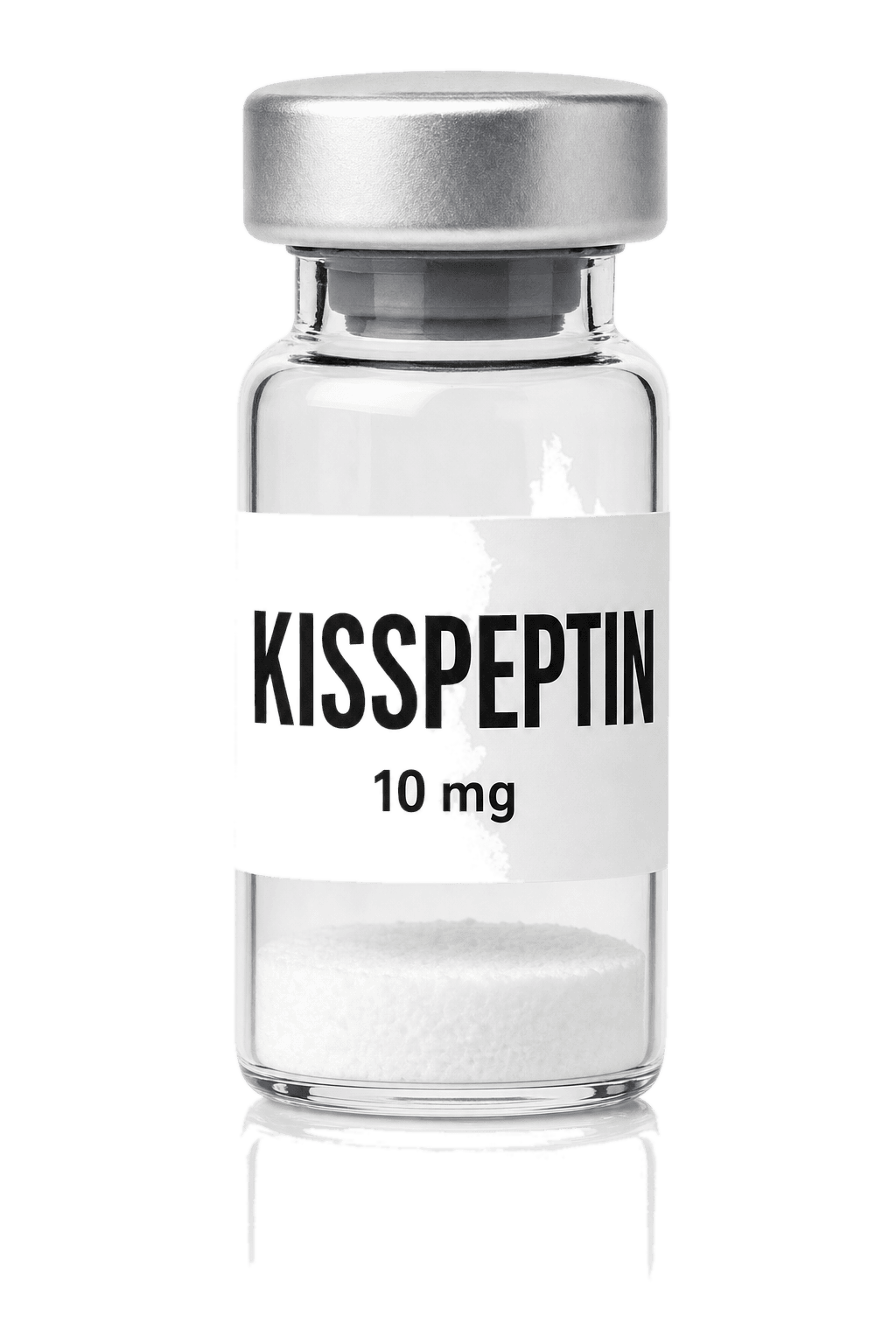
In plain words
Kisspeptin is a natural hormone that kick-starts the body’s sex-hormone system. It’s mostly studied in fertility research, given by IV. Everyday use isn’t well understood yet.
1 person has this in their stack
Key facts
- Category
- Hormones
- Legal / FDA status
- Investigational research peptide (not FDA-approved); studied in clinical trials but not an approved medicine
- Half-life
- Very short — roughly 4 minutes in humans for kisspeptin-10; largely cleared within about 30 minutes of a bolus
- Typical form
- Lyophilized (freeze-dried) powder for reconstitution
- Also known as
- Kisspeptin-10, KP-10, Metastin
Subcutaneous injection (research; also IV infusion)
In human reproductive-endocrinology research, kisspeptin-54 is given by subcutaneous injection (and kisspeptin has also been given by IV infusion); a single SC dose of kisspeptin-54 has been used to trigger egg maturation in IVF. Doses are weight-based research doses, not a fixed consumer dose. There is no validated consumer dose or approved route.
Also seen: intravenous infusion (research)
Source: Trial route — Jayasena et al., J Clin Invest 2014 (single SC kisspeptin-54 in IVF); NCT-registered reproductive-endocrinology studies. Not FDA-approved.
Kisspeptin is a naturally occurring hormone that triggers the brain to release GnRH, driving the reproductive hormone axis. It is an investigational research peptide studied mainly for fertility and reproductive disorders — it is not an FDA-approved drug, and it has not been proven safe or effective for general use. This page is purely educational and is not medical advice; any decision about kisspeptin belongs with a licensed clinician.
Important: Most published human work on kisspeptin comes from controlled hospital and clinical-trial settings, not from at-home use. "Research use only" material sold online is not an approved medicine and is not a substitute for supervised care.
What is Kisspeptin?#
Kisspeptin is a family of signaling peptides produced from the KISS1 gene. The gene was originally identified in 1996 as a suppressor of cancer metastasis (hence the early name metastin), and only later was its central role in reproduction recognized. The peptides act through the KISS1R receptor, also known as GPR54.
Kisspeptin-10 (KP-10), also called metastin (45–54), is the short, 10-amino-acid fragment that retains the peptide's biological activity and is the form most commonly used in research. Longer fragments such as kisspeptin-54 also exist and behave somewhat differently — for example, kisspeptin-54 has a longer reported half-life than kisspeptin-10.
How does Kisspeptin work?#
Kisspeptin sits at the top of the body's reproductive hormone system, the hypothalamic-pituitary-gonadal (HPG) axis:
- Kisspeptin binds the KISS1R (GPR54) receptor on GnRH neurons in the hypothalamus.
- This prompts those neurons to release GnRH (gonadotropin-releasing hormone) in pulses.
- GnRH signals the pituitary gland to release LH and FSH.
- LH and FSH then act on the ovaries or testes to drive sex-hormone production and gametogenesis.
Because kisspeptin acts upstream of GnRH, it is often described as a key part of the "GnRH pulse generator." Research also suggests kisspeptin helps relay information about the body's energy stores to the reproductive axis, which is one reason it is of interest in conditions linked to negative energy balance.
What is Kisspeptin studied for?#
Most human research treats kisspeptin as a physiological tool and a potential therapy for reproductive conditions. It is not an approved treatment for any of these.
| Research theme | Study type | Evidence level in humans |
|---|---|---|
| Stimulating reproductive hormone (LH/FSH) release | Controlled physiological studies in healthy adults | Moderate — reproducible acute hormone response |
| Triggering egg maturation in IVF / assisted reproduction | Early-phase clinical trials | Emerging / early clinical |
| Functional hypothalamic amenorrhea and reproductive disorders | Ongoing clinical trials | Investigational |
| Hypoactive (low) sexual desire and sexual brain processing | Small randomized trials (men and women) | Preliminary |
| Cancer-metastasis biology (original "metastin" role) | Preclinical / mechanistic | Mostly preclinical |
Reported effects in well-controlled studies have been generally encouraging for stimulating reproductive hormones, but the evidence base is early, sample sizes are often small, and no regulatory body has approved kisspeptin as a therapy.
Is Kisspeptin legal and FDA-approved?#
Kisspeptin is not FDA-approved for any indication. It is an investigational research peptide. It has been administered to people under research authorizations in clinical-trial and hospital settings, including registered trials on ClinicalTrials.gov, but that is different from being an approved drug you can be prescribed for routine care.
In 2024, an FDA advisory committee (the Pharmacy Compounding Advisory Committee) reviewed whether kisspeptin-10 should be added to the 503A bulks list (which would allow certain pharmacy compounding), in the context of treating secondary hypogonadism in men. The FDA proposed not adding it, citing that the peptide is not well characterized physicochemically, that there is limited information on immunogenicity risk, and that there is insufficient evidence of effectiveness (and that FDA-approved alternatives already exist). Material sold "for research use only" has not been evaluated by the FDA for safety, purity, or effectiveness, and its quality cannot be assumed.
Nothing here is legal advice; regulations vary by country and change over time. Check the rules in your jurisdiction.
How is Kisspeptin dosed in research?#
There is no validated, approved human dose of kisspeptin, and WikiPeps does not publish dosing protocols or amounts for any peptide. Published studies have used various forms (such as kisspeptin-10 and kisspeptin-54) and various routes and schedules under direct medical supervision, but those research conditions do not translate into a safe at-home regimen.
Dosing is a medical decision. If you are considering kisspeptin for any reason, that conversation should happen with a licensed clinician who can evaluate your individual health, monitor you, and weigh the risks.
How is Kisspeptin reconstituted?#
Kisspeptin is typically supplied as a lyophilized (freeze-dried) powder that must be reconstituted with a sterile diluent before it can go into solution. A general, education-only overview of how lyophilized peptides are handled is included in this page's "how-to" data, covering sterile technique, gentle mixing, and storage.
That overview is educational only and does not tell anyone how much to use or instruct self-administration.
What are the safety considerations?#
In the controlled human studies conducted so far, kisspeptin has generally been reported as well tolerated, without major safety signals in those settings. That is reassuring but limited: the studies are typically short, small, and run under medical supervision.
Key cautions:
- Long-term and repeated-use safety is not established. Most data are from single or short-course administration.
- It acts on a central hormone system (the HPG axis). Altering reproductive hormone signaling can have effects that are not obvious without monitoring, and is especially inappropriate without oversight in pregnancy, hormone-sensitive conditions, or fertility treatment.
- Unregulated "research" material is an unknown. Purity, identity, dose accuracy, and sterility are not guaranteed, which introduces risks beyond the peptide itself.
- Drug and condition interactions have not been well mapped outside trials.
Tell a clinician about any peptide you are considering, and seek prompt medical care for unexpected symptoms.
The bottom line#
Kisspeptin (KP-10, metastin) is a naturally occurring hormone that sits at the very top of the reproductive hormone axis, triggering GnRH release and the downstream LH/FSH cascade. It is a genuinely interesting subject of reproductive-medicine research — studied for fertility, hypothalamic amenorrhea, and sexual desire — but it is investigational and not FDA-approved, its human half-life is extremely short, and its long-term safety is unproven. There is no validated human dose, and WikiPeps does not provide one. Treat anything you read online as background for an informed conversation with a licensed clinician, not as medical advice.
Side effects & safety
In controlled research (mostly IV) it has been well tolerated.
Commonly reported
- Little commonly reported
- Transient shifts in reproductive hormones (its mechanism)
Studied mainly in controlled IV research; everyday subcutaneous use isn't well characterized.
Educational only — not medical advice. Everyone responds differently; talk to a licensed clinician before starting Kisspeptin, and stop and seek medical care for any severe or unusual reaction.
Tried Kisspeptin, or have a question about it?
Ask the community or share what you noticed — real people doing this carefully. Takes 30 seconds.
How to reconstitute lyophilized Kisspeptin (educational overview)
What you'll need
- Vial of lyophilized Kisspeptin
- Bacteriostatic water (or sterile water per product labeling)
- Sterile insulin syringe or reconstitution syringe
- Alcohol prep pads
- Clean, flat work surface
Wash hands and prepare the area
Wash your hands thoroughly and clean a flat work surface. Lay out the sealed vial, your diluent, a fresh syringe, and alcohol prep pads. This is a general, education-only overview of how lyophilized peptides are handled in a lab context — it is not instruction to self-administer.
Inspect the vial
Check that the lyophilized powder looks intact and that the vial and seal are undamaged. Discard anything that looks compromised, discolored, or contaminated. Let refrigerated materials come to room temperature so condensation does not form.
Disinfect the stoppers
Wipe the rubber stopper of both the peptide vial and the diluent vial with a fresh alcohol prep pad and let them air-dry. Do not touch the cleaned surfaces.
Draw the diluent
Draw the volume of bacteriostatic or sterile water specified by the product labeling into the syringe. The exact diluent volume is a product-specific and clinical question — WikiPeps does not provide peptide dosing amounts.
Add diluent slowly down the vial wall
Insert the needle and let the liquid run slowly down the inside wall of the vial rather than spraying directly onto the powder. Peptides are fragile; avoid forceful jets that can damage them.
Dissolve gently, then store
Do not shake. Gently swirl or let the vial sit until the powder fully dissolves into a clear solution. Discard the solution if it stays cloudy or shows particles. Store reconstituted peptide refrigerated and protected from light, following the labeling.
Frequently asked questions
What is kisspeptin?
- Kisspeptin is a naturally occurring signaling peptide encoded by the KISS1 gene. It acts on the KISS1R (GPR54) receptor on GnRH neurons in the hypothalamus and is a key upstream regulator of the body's reproductive hormone system. Kisspeptin-10 (KP-10), also called metastin, is the short, biologically active fragment most often used in research. It is investigational and not an FDA-approved drug.
What is kisspeptin studied for?
- In human research it has been studied mainly as a tool and potential therapy for reproductive conditions — stimulating reproductive hormone release, supporting egg maturation in IVF, and exploring functional hypothalamic amenorrhea and certain forms of low sexual desire. These are active research areas, not proven, approved treatments.
Is kisspeptin FDA-approved or legal?
- Kisspeptin is not FDA-approved for any use. It has been used under research authorizations in hospital and clinical-trial settings. In 2024 an FDA advisory committee reviewed kisspeptin-10 for the 503A compounding bulks list, and the FDA proposed not adding it, citing limited physicochemical characterization, gaps in immunogenicity data, and insufficient evidence of effectiveness. Material sold for 'research use only' is not an approved medicine and is not a substitute for clinician-supervised care.
How does kisspeptin work?
- Kisspeptin binds the KISS1R (GPR54) receptor on GnRH neurons in the hypothalamus, prompting them to release GnRH (gonadotropin-releasing hormone). GnRH then signals the pituitary to release LH and FSH, which act on the gonads. In effect, kisspeptin sits upstream of the whole hypothalamic-pituitary-gonadal axis.
What is kisspeptin's half-life?
- Kisspeptin-10 has a very short half-life in humans — reported at roughly 4 minutes — because it is rapidly broken down by enzymes in the blood and filtered by the kidneys. The parent peptide is largely cleared within about 30 minutes of a single dose. Longer-acting forms such as kisspeptin-54 and engineered analogs are being explored in research.
Is kisspeptin safe?
- Human studies to date have generally reported it to be well tolerated in controlled research settings, with no major safety signals noted in the trials conducted so far. However, long-term safety, the effects of repeated use, and the quality of unregulated 'research' material are not established. Any decision about use belongs with a licensed clinician, not a website.
Does WikiPeps provide a kisspeptin dose?
- No. There is no validated, approved human dose, and WikiPeps does not publish dosing protocols or amounts for any peptide. Dosing decisions are medical decisions that require a licensed clinician who can weigh your individual situation.
References
- 1.The kisspeptin-GnRH pathway in human reproductive health and disease — Human Reproduction Update (Oxford Academic / PMC) · 2014
- 2.The Emerging Therapeutic Potential of Kisspeptin and Neurokinin B — Endocrine Reviews (Oxford Academic / PMC) · 2023
- 3.Kisspeptin and its Current Clinical Status — A Systematic Review — Current Medicinal Chemistry (PubMed) · 2025
- 4.Effects of Kisspeptin Administration in Women With Hypoactive Sexual Desire Disorder: A Randomized Clinical Trial — JAMA Network Open (PubMed/PMC) · 2022
- 5.The Effects of Kisspeptin-10 on Reproductive Hormone Release Show Sexual Dimorphism in Humans — Journal of Clinical Endocrinology & Metabolism (PubMed/PMC) · 2011
- 6.FDA Briefing Document, Pharmacy Compounding Advisory Committee: review of kisspeptin-10 for the 503A Bulks List — U.S. Food and Drug Administration · 2024
What the research shows
Investigational (human reproductive trials)Kisspeptin has a genuine human research base in reproductive endocrinology: kisspeptin-54 has been used in registered trials to stimulate gonadotropins and to trigger egg maturation in IVF. It is not an approved drug, and doses are weight-based research doses, not a consumer protocol.
Kisspeptin-54 triggers egg maturation in women undergoing in vitro fertilization
Jayasena CN, Abbara A, Comninos AN, Dhillo WS, et al. · 2014 · J Clin Invest 2014;124(8):3667-3677 (PMC4109525)
A second dose of kisspeptin-54 improves oocyte maturation in women at high risk of ovarian hyperstimulation syndrome: a Phase 2 randomized controlled trial
Abbara A, Jayasena CN, Comninos AN, Dhillo WS, et al. · 2017 · Hum Reprod 2017;32(9):1915-1924
Subcutaneous infusion of kisspeptin-54 stimulates gonadotrophin release in women and the response correlates with basal oestradiol levels
Jayasena CN, Abbara A, Dhillo WS, et al. · 2016 · Clin Endocrinol (Oxf) (PMC4914955)
Citations are real, published sources, graded conservatively. Educational only — not medical advice, and not an endorsement to use any compound.
Improve this page
See something out of date or unclear? Propose an edit — an admin reviews every suggestion before any change is made.
Comments & experiences
What members are saying about Kisspeptin — questions, observations, and lived experience. Not medical advice.
Add a comment
Ask a question or share what you've seen — a star rating is optional. Comments post right away once they pass a quick automated check; anything flagged is reviewed first.