
Melanotan II
Melanotan II is a synthetic melanocortin-receptor agonist studied for skin tanning and sexual function. It is a research chemical — not FDA-approved — and regulators have warned against unapproved use. This page is education, not medical advice.
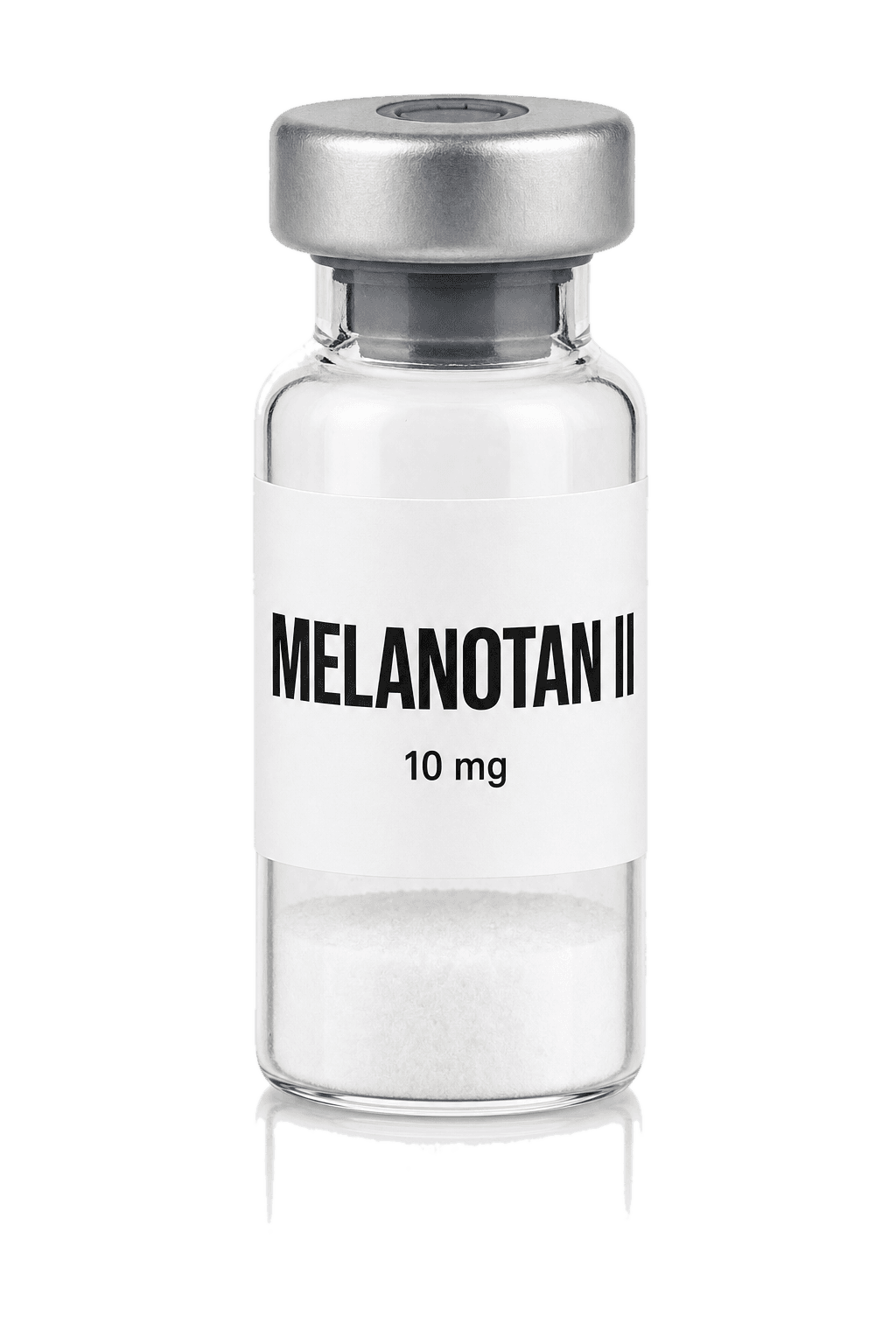
In plain words
Melanotan II is a lab-made peptide that darkens the skin (a “tan from a needle”) and can raise sex drive. It isn’t approved, and the biggest worry is what it does to moles and skin over time.
Key facts
- Category
- Skin color & sex drive
- Legal / FDA status
- Research chemical (not FDA-approved); the FDA and other health agencies have warned consumers against using unapproved melanotan products
- Half-life
- Not well characterized in humans; limited data suggest a plasma half-life on the order of roughly 1-2 hours, while visible effects (such as tanning) can persist far longer because they depend on slower biological changes
- Typical form
- Lyophilized (freeze-dried) powder for reconstitution
- Also known as
- MT-II, MT2
Subcutaneous injection
Melanotan II is community-administered by subcutaneous injection. It is an unapproved research chemical that regulators (including the FDA and agencies in the UK/EU/Australia) have specifically warned consumers against; reported effects include nausea, blood-pressure changes, and darkening or changes of moles. The early human erection/desire studies also used the subcutaneous route. No validated, safe human dose or approved route exists.
Source: Community-reported practice; early human studies (Wessells et al., 2000) used SC. Regulators warn against unapproved melanotan products; not FDA-approved.
Melanotan II is a synthetic peptide that activates melanocortin receptors and has been studied for darkening skin and for effects on sexual function. It is a research chemical — it is not FDA-approved, and the FDA and other health agencies have specifically warned against using unapproved melanotan products. It has not been proven safe or effective for general use. This page is purely educational and is not medical advice; any decision about Melanotan II belongs with a licensed clinician.
Important: Most of what is publicly documented about Melanotan II in everyday use comes from case reports of harm and from regulator warnings, not from large, approved clinical programs. "Research use only" material sold online is not an approved medicine, its purity is not guaranteed, and it is not a substitute for supervised care.
What is Melanotan II?#
Melanotan II (also written MT-II or MT2) is a small, synthetic, cyclic peptide modeled on alpha-melanocyte-stimulating hormone (alpha-MSH), a natural hormone that helps regulate skin pigmentation. It was originally explored in academic research as a tool to stimulate the body's own pigment-producing pathway, with the idea of producing a protective tan with less ultraviolet (UV) exposure.
Unlike its relative melanotan I (afamelanotide), Melanotan II is not an approved medicine. It is sold and used as an unregulated research chemical, frequently as injections or nasal sprays marketed for tanning, appetite suppression, or libido — all uses for which it has not been approved or proven safe.
How does Melanotan II work?#
Melanotan II is a non-selective melanocortin-receptor agonist — it activates several melanocortin (MC) receptor subtypes rather than just one:
- At the MC1 receptor on melanocytes (pigment cells in the skin), it stimulates the production of melanin, which darkens the skin. This is the basis of its "tanning" effect.
- At the MC3 and MC4 receptors in the brain, it influences pathways involved in appetite and sexual arousal, which is why reduced appetite and increased sexual desire and erections have been reported in research.
This broad, non-selective activity is also why Melanotan II produces effects far beyond tanning — and why some of those off-target effects (on the cardiovascular system, blood vessels, and pigmented lesions) are a safety concern.
What is Melanotan II studied for?#
Melanotan II has been investigated in animals and in some small human studies, but it is not an approved treatment for any of the uses below. Much of the human safety information comes from case reports rather than controlled trials.
| Research theme | Study type | Evidence level in humans |
|---|---|---|
| Skin tanning / melanogenesis with reduced UV | Early human and mechanistic studies | Limited; development as a drug was not completed |
| Erectile function and sexual desire | Small human studies | Preliminary; drug development shifted to a related molecule (bremelanotide) |
| Appetite suppression / body weight | Mostly preclinical (animal) | Mostly preclinical |
| Serious adverse events (rhabdomyolysis, renal infarction, PRES, melanoma) | Published case reports | Documented harms in real-world users |
Notably, development of Melanotan II for sexual dysfunction was discontinued, and a closely related molecule — bremelanotide (PT-141) — was developed instead and later FDA-approved as Vyleesi (2019) for a specific condition in some premenopausal women. Melanotan II itself never completed an approval pathway.
Is Melanotan II legal and FDA-approved?#
Melanotan II is not FDA-approved for any indication. It is an unapproved research chemical. The FDA has issued warnings and warning letters about products containing melanotan, stating there is no evidence they are generally recognized as safe and effective, and advising consumers who are using such products to stop and consult their health care provider.
International regulators echo this. The UK's MHRA, Australia's Therapeutic Goods Administration (TGA), and EU authorities have all warned against tanning products containing melanotan, citing unknown long-term effects and serious documented harms.
It is important not to confuse Melanotan II with two different, approved drugs in the same family: afamelanotide (Scenesse), an FDA-approved melanotan-I-based product for a rare light-sensitivity disorder (erythropoietic protoporphyria), and bremelanotide (Vyleesi), an approved melanocortin agonist derived from melanotan-II chemistry. The fact that related molecules are approved does not make Melanotan II approved, safe, or interchangeable with them. Material sold "for research use only" has not been evaluated by the FDA for safety, purity, or effectiveness.
How is Melanotan II dosed in research?#
There is no validated, approved human dose for Melanotan II, and WikiPeps does not publish dosing protocols or amounts for any peptide. Because it was never developed into an approved medicine, there is no established therapeutic dose, no standard concentration, and no quality assurance on the unregulated material sold online.
Importantly, several of the most serious published harms — including a case of rhabdomyolysis and acute kidney injury — followed real-world self-injection of material obtained over the internet. Dosing decisions are medical decisions. If you are considering anything in this space, that conversation belongs with a licensed clinician who can weigh your individual risks, not with a website or vendor.
How is Melanotan II reconstituted?#
Melanotan II is supplied as a lyophilized (freeze-dried) powder that would be reconstituted with bacteriostatic or sterile water before use in a research setting. The general, education-only steps — inspecting the vial, disinfecting stoppers, adding diluent slowly down the vial wall, swirling gently rather than shaking, and storing the solution refrigerated and protected from light — are the same handling principles that apply to lyophilized peptides generally.
For a complete walk-through of the technique, see our guide at /learn/guides/how-to-reconstitute-a-peptide. Reconstitution information is provided for understanding only; it is not an endorsement of using an unapproved substance, and the specific diluent volume is a product- and clinician-specific question that we do not answer with amounts.
What are the safety considerations?#
Melanotan II's safety profile is a serious concern, ranging from common, predictable effects to rare but severe events documented in the medical literature:
- Common effects: nausea, facial flushing, and appetite suppression are frequently reported. Spontaneous erections have also been reported in men.
- Pigment and mole changes: Melanotan II can darken existing moles and freckles, create new moles, and cause uneven pigmentation. Dermatologists warn this can mask the warning signs of melanoma, making skin cancer harder to detect.
- Skin cancer concern: Multiple case reports describe melanoma diagnosed in melanotan users, sometimes arising in pre-existing moles. A causal link is not proven in controlled studies, but the association is taken seriously.
- Serious, documented events: Published case reports include rhabdomyolysis (severe muscle breakdown) with acute kidney injury after injection, renal infarction, posterior reversible encephalopathy syndrome (PRES) (with seizures, visual disturbance, headache, and confusion), priapism, and cardiovascular effects from sympathetic overstimulation.
- Product-quality risk: Because this is an unregulated research chemical, the actual contents, purity, sterility, and concentration of any given vial cannot be assumed. Contamination and mislabeling are real risks. Injection and nasal-spray use also carry infection risks.
- Unknown long-term effects: There is no long-term human safety data. The effects of repeated, sustained use are simply not established.
Anyone who has used Melanotan II and notices changing moles, new skin lesions, severe muscle pain, dark urine, severe headaches, vision changes, or other concerning symptoms should seek medical care promptly.
The bottom line#
Melanotan II is a synthetic melanocortin agonist that can darken skin and affect appetite and sexual function — but it is an unapproved research chemical, not a proven or regulated medicine. The FDA and international health agencies have warned against it, and the published literature includes serious harms such as rhabdomyolysis, renal infarction, PRES, and melanoma in users, alongside its tendency to change moles in ways that can hide skin cancer.
Related molecules (afamelanotide and bremelanotide) are approved for specific, narrow uses, but that does not make Melanotan II safe, legal as a medicine, or interchangeable with them. This page is education, not medical advice, and WikiPeps does not publish dosing protocols. Any decision about Melanotan II should be made with a licensed clinician who can weigh the documented risks against your individual situation.
Side effects & safety
Commonly-reported effects are noticeable, and there are real safety points to know.
Commonly reported
- Nausea and flushing (especially early on)
- Reduced appetite
- Darkening of skin, moles, and freckles
- Spontaneous erections (in men)
Less common — worth knowing
- New or changing moles
Unregulated and not approved. The main concern is skin: it can darken moles and its long-term effect on melanoma risk is unknown — regular skin checks with a dermatologist are wise.
Educational only — not medical advice. Everyone responds differently; talk to a licensed clinician before starting Melanotan II, and stop and seek medical care for any severe or unusual reaction.
Tried Melanotan II, or have a question about it?
Ask the community or share what you noticed — real people doing this carefully. Takes 30 seconds.
How to reconstitute lyophilized Melanotan II (educational overview)
What you'll need
- Vial of lyophilized Melanotan II
- Bacteriostatic water (or sterile water per product labeling)
- Sterile insulin syringe or reconstitution syringe
- Alcohol prep pads
- Clean, flat work surface
Wash hands and prepare the area
Wash your hands thoroughly and clean a flat work surface. Lay out the sealed vial, your diluent, a fresh syringe, and alcohol prep pads. This is a general, education-only overview of how lyophilized peptides are handled in a lab context — it is not instruction to self-administer an unapproved substance.
Inspect the vial
Check that the lyophilized powder looks intact and that the vial and seal are undamaged. Discard anything that looks compromised, discolored, or contaminated. Let refrigerated materials come to room temperature so condensation does not form.
Disinfect the stoppers
Wipe the rubber stopper of both the peptide vial and the diluent vial with a fresh alcohol prep pad and let them air-dry. Do not touch the cleaned surfaces.
Add diluent slowly down the vial wall
Draw the volume of bacteriostatic or sterile water specified by the product labeling into the syringe, then insert the needle and let the liquid run slowly down the inside wall of the vial rather than spraying directly onto the powder. The exact diluent volume is a product-specific and clinical question — WikiPeps does not provide peptide dosing amounts.
Dissolve gently, do not shake
Do not shake. Gently swirl or let the vial sit until the powder fully dissolves into a clear solution. Peptides are fragile, and forceful agitation can damage them. Discard the solution if it stays cloudy or shows particles.
Store and label correctly
Store reconstituted peptide refrigerated and protected from light, following the product labeling, and discard it by the labeled date. For the full walk-through, see our reconstitution guide. Remember that reconstitution is not an endorsement of use — Melanotan II is unapproved and carries documented risks.
Frequently asked questions
What is Melanotan II?
- Melanotan II (MT-II, MT2) is a synthetic cyclic peptide that mimics alpha-melanocyte-stimulating hormone (alpha-MSH). It activates melanocortin receptors and has been studied for darkening skin and for effects on sexual function. It is a research chemical, not an FDA-approved medicine, and has not been proven safe or effective for general use.
Is Melanotan II FDA-approved or legal?
- No. Melanotan II is not approved by the FDA for any use. The FDA has issued warnings and warning letters about unapproved melanotan products, and agencies in the UK, Australia, and the EU have warned against them. Material sold 'for research use only' is not an approved medicine and is not a substitute for clinician-supervised care.
How does Melanotan II work?
- Melanotan II is a non-selective agonist at melanocortin receptors. By activating the MC1 receptor on pigment cells (melanocytes), it can stimulate melanin production and skin darkening. Its activity at MC3 and MC4 receptors in the brain is thought to underlie reported effects on appetite and sexual arousal.
Is Melanotan II the same as bremelanotide (Vyleesi) or PT-141?
- No, but they are related. Bremelanotide (brand name Vyleesi, PT-141) is a melanocortin agonist that was developed from melanotan II chemistry and is FDA-approved (2019) for a specific condition in some premenopausal women. Melanotan II itself is a different, unapproved research chemical, and the two are not interchangeable.
What are the side effects of Melanotan II?
- Commonly reported effects include nausea, facial flushing, and appetite suppression, plus darkening of moles and freckles. Published case reports have described more serious events including rhabdomyolysis (muscle breakdown), renal infarction, posterior reversible encephalopathy syndrome, priapism, and melanoma diagnosed in users. Long-term safety is unknown.
Can Melanotan II cause skin cancer?
- A direct causal link has not been established in controlled studies, but several case reports describe melanoma arising in moles during or shortly after melanotan use, and the drug can darken and change existing moles in ways that may mask the warning signs of skin cancer. This is a recognized concern raised by dermatologists and regulators.
Does WikiPeps provide a Melanotan II dose?
- No. There is no validated, approved human dose, and WikiPeps does not publish dosing protocols or amounts for any peptide. Dosing is a medical decision that requires a licensed clinician who can weigh your individual situation and the known risks.
References
- 1.Melanocortin receptor agonists, penile erection, and sexual motivation: human studies with Melanotan II — International Journal of Impotence Research (Nature/PubMed) · 2000
- 2.Melanocortin receptor agonists in the treatment of male and female sexual dysfunctions: results from basic research and clinical studies — Expert Opinion on Investigational Drugs (PubMed) · 2014
- 3.Melanotan and the posterior reversible encephalopathy syndrome — Annals of Internal Medicine · 2013
- 4.Melanotan II: a possible cause of renal infarction: review of the literature and case report — CEN Case Reports (PubMed) · 2020
- 5.Melanotan II injection resulting in systemic toxicity and rhabdomyolysis — Clinical Toxicology (PubMed) · 2012
- 6.VYLEESI (bremelanotide injection) prescribing information and approval (a melanotan-II-derived, FDA-approved melanocortin agonist) — U.S. Food and Drug Administration · 2019
- 7.Melanotan II — DermNet (DermNet NZ) · 2015
What the research shows
Unapproved — regulators warn against itMelanotan II is an unapproved research chemical. Small early human studies explored the melanocortin pathway for erectile/sexual function, but MT-II itself was never approved, and the FDA and other agencies have specifically warned consumers against unapproved melanotan products (nausea, blood-pressure changes, mole darkening). (Note: afamelanotide/Scenesse is a DIFFERENT, FDA-approved α-MSH analog — not Melanotan II.)
Melanocortin receptor agonists, penile erection, and sexual motivation: human studies with Melanotan II
Wessells H, Levine N, Hadley ME, Dorr R, Hruby V · 2000 · Int J Impot Res 2000;12 Suppl 4:S74-S79 (PMID 11035392)
Effect of an alpha-melanocyte stimulating hormone analog (Melanotan II) on penile erection and sexual desire in men with organic erectile dysfunction
Wessells H, Gralnek D, Dorr R, Hruby VJ, Hadley ME, Levine N · 2000 · Urology 2000;56(4):641-646 (PMID 11018622)
FDA: Tanning products marketed as supplements / unapproved melanotan products (consumer warnings)
U.S. Food & Drug Administration · 2024 · FDA consumer guidance
Citations are real, published sources, graded conservatively. Educational only — not medical advice, and not an endorsement to use any compound.
Improve this page
See something out of date or unclear? Propose an edit — an admin reviews every suggestion before any change is made.
Comments & experiences
What members are saying about Melanotan II — questions, observations, and lived experience. Not medical advice.
Add a comment
Ask a question or share what you've seen — a star rating is optional. Comments post right away once they pass a quick automated check; anything flagged is reviewed first.