
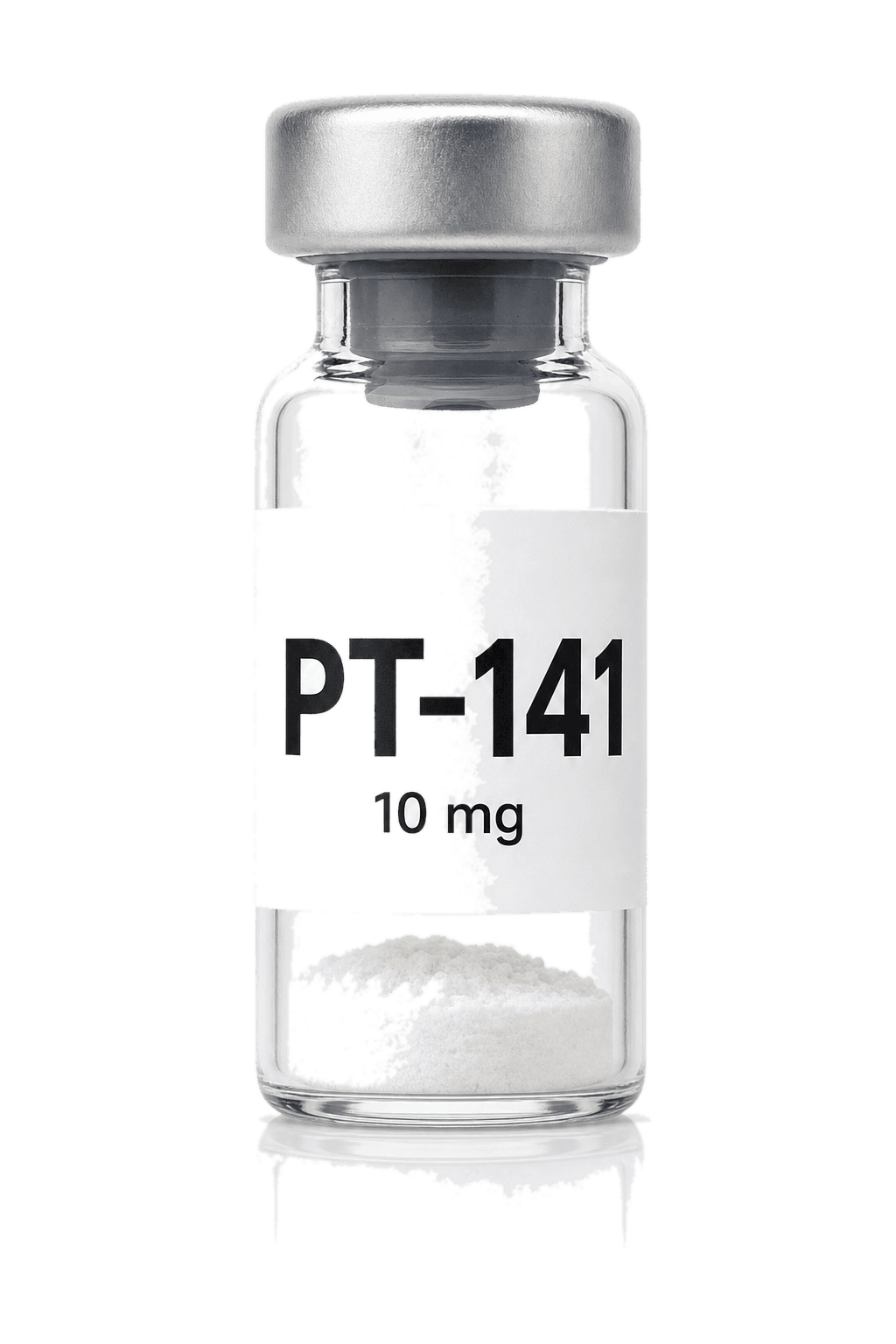
PT-141
PT-141 (bremelanotide) is a melanocortin receptor agonist that acts in the brain to influence sexual desire. It IS FDA-approved as the prescription drug Vyleesi for HSDD in premenopausal women; 'research-only' versions sold online are not the approved product. Education only, not medical advice.
In plain words
PT-141 (bremelanotide) is an approved drug for low sexual desire. Instead of working on blood flow like Viagra, it works in the brain. The approved version is sold as Vyleesi.
Key facts
- Category
- Sex drive
- Legal / FDA status
- FDA-approved drug (as Vyleesi, bremelanotide injection, approved 2019 for HSDD in premenopausal women); research-chemical versions sold 'for research use only' are NOT the approved product
- Half-life
- Roughly 2.7 hours in humans after subcutaneous injection (range about 1.9–4.0 hours, per FDA labeling and published reviews)
- Typical form
- Lyophilized (freeze-dried) powder for reconstitution
- Also known as
- Bremelanotide, Vyleesi
Subcutaneous injection (approved product is a single-use autoinjector)
PT-141 is the active ingredient in Vyleesi (bremelanotide), an FDA-approved subcutaneous injection given as needed via a finished single-use autoinjector (no reconstitution). An intranasal bremelanotide was tested earlier in development but is not the approved product. Vyleesi is prescription-only.
Also seen: intranasal (earlier, non-approved formulation)
Source: FDA prescribing information — Vyleesi (bremelanotide), 1.75 mg subcutaneous autoinjector.
PT-141 (bremelanotide) is a melanocortin receptor agonist that acts in the brain to influence sexual desire. Unusually for the peptides covered here, the molecule is FDA-approved — it is the active ingredient in the prescription drug Vyleesi, cleared in 2019 for hypoactive sexual desire disorder (HSDD) in premenopausal women. However, "research use only" PT-141 sold online is not that approved product. This page is purely educational and is not medical advice; any decision about PT-141 belongs with a licensed clinician.
Important: There is a real, FDA-approved version of this molecule (Vyleesi) with specific labeling, warnings, and usage limits. Unregulated "research" vials are not the same thing and have not been evaluated by the FDA for safety, identity, purity, or potency.
What is PT-141?#
PT-141 is the common name for bremelanotide, a synthetic cyclic peptide. It is a metabolite and analog of an earlier compound (melanotan II) and was developed specifically for its central effects on sexual desire rather than for tanning, muscle, or recovery.
The molecule works as a melanocortin receptor agonist. It non-selectively activates several melanocortin receptor subtypes, with activity at MC1R and MC4R being the most relevant at therapeutic levels. MC4R, in particular, is tied to brain pathways involved in sexual motivation.
In its approved form, bremelanotide is marketed as Vyleesi, supplied as a prefilled subcutaneous autoinjector. The "PT-141" name is most often used for non-approved, "research" material sold as a lyophilized powder.
How does PT-141 work?#
PT-141 is notable because it acts centrally, in the brain, rather than on blood vessels. This is different from common erectile-dysfunction drugs (such as PDE5 inhibitors), which act on the vascular system to affect blood flow.
- PT-141 activates melanocortin receptors in the central nervous system, primarily MC4R.
- This activity is thought to engage brain regions and signaling associated with sexual motivation and arousal.
- Because the effect originates in the brain rather than the bloodstream, its mechanism is described as neurological/central.
The exact downstream chain of events is still being characterized. Even in the FDA labeling, the precise mechanism by which melanocortin signaling improves sexual desire and related distress is described as not known.
What is PT-141 studied for?#
The approved use is narrow and specific; other uses are investigational. PT-141 is not an approved treatment for anything outside the labeled HSDD indication.
| Research theme | Study type | Evidence level in humans |
|---|---|---|
| Low sexual desire (HSDD) in premenopausal women | Phase 3 randomized, placebo-controlled trials (RECONNECT) | Strong enough for FDA approval (Vyleesi) |
| Sexual dysfunction in men (historical development) | Earlier-phase clinical studies | Investigational; not an approved use |
| General female/sexual arousal beyond the approved indication | Smaller / mixed studies | Limited / not approved |
In the pivotal trials, more women using bremelanotide met responder criteria for improved sexual desire and reduced distress than those on placebo, though the absolute difference was modest. The approval reflects a benefit in a specific, distress-causing condition — not a general "libido booster" for the broad population.
Is PT-141 legal and FDA-approved?#
The molecule is FDA-approved. Bremelanotide was approved by the FDA in 2019 as Vyleesi (bremelanotide injection) for the treatment of premenopausal women with acquired, generalized hypoactive sexual desire disorder (HSDD). Here, "acquired" means the low desire developed after a period of normal desire, and "generalized" means it occurs regardless of partner, situation, or type of stimulation.
The crucial distinction: that approval applies to the specific Vyleesi product, dispensed by prescription with FDA-reviewed labeling and warnings. Vials of "PT-141" sold "for research use only" are not the approved medicine. They have not been evaluated by the FDA for safety, identity, purity, sterility, or potency, and using them is not equivalent to taking the approved drug.
Nothing here is legal advice; regulations vary by country and change over time. Check the rules in your jurisdiction.
How is PT-141 dosed in research?#
There is an FDA-approved product with specific labeled instructions, a defined route, and an explicit limit on how often it may be used — but WikiPeps does not publish dosing protocols or amounts for any peptide, including this one. Copying a number from a website while using unregulated "research" material is not the same as taking a labeled, prescribed medicine under supervision.
Dosing, eligibility, the maximum dosing frequency, and the contraindications and warnings on the approved label are all medical decisions. If you are considering bremelanotide, that conversation belongs with a licensed clinician who can confirm it is appropriate for you, prescribe the approved product, and monitor you.
How is PT-141 reconstituted?#
The approved product (Vyleesi) comes as a prefilled autoinjector and does not require mixing. The "research" form of PT-141 is typically supplied as a lyophilized (freeze-dried) powder that would have to be reconstituted with a sterile diluent. The general handling steps are outlined in the educational overview in this page's "how-to" data, but that overview covers sterile technique and storage only — it does not provide amounts.
That overview is educational only and does not tell anyone how much to use or instruct self-administration.
What are the safety considerations?#
Because an approved product exists, the safety profile of bremelanotide is better characterized than that of many research-only peptides — and that profile includes real, common side effects.
Key cautions from the approved labeling and published reviews:
- Nausea is very common — reported by roughly 40% of users, often most pronounced with the first dose, and sometimes severe enough to require treatment or to cause people to stop.
- Flushing, headache, vomiting, and injection-site reactions are also common.
- Transient cardiovascular effects. Bremelanotide can cause a temporary increase in blood pressure and a decrease in heart rate after each dose (the approved label reports maximal increases of about 6 mmHg systolic and 3 mmHg diastolic, peaking 2–4 hours post-dose and usually resolving within 12 hours). For this reason the approved label lists use in people with uncontrolled high blood pressure or known cardiovascular disease as a contraindication, and it is not recommended in people at high cardiovascular risk.
- Skin darkening (hyperpigmentation). A small percentage of users in trials developed focal hyperpigmentation (including the face, gums, and breasts); the risk appeared higher with more frequent dosing and in people with darker skin, and it did not always resolve.
- Rare liver injury (limited data). NIH's LiverTox rates bremelanotide as a possible rare cause of clinically apparent liver injury (likelihood score "D"), based on a single reported case; in the pre-approval trials, serum enzyme elevations occurred in similar proportions of treated and placebo participants, and overall clinical experience remains limited.
- Unregulated "research" material is an added, separate risk. Beyond the drug's own effects, "research-only" PT-141 has unknown purity, identity, dose accuracy, and sterility, which introduces hazards the approved product is designed to avoid.
Tell a clinician about any peptide you are considering, do not assume "research" material behaves like the approved drug, and seek prompt medical care for unexpected symptoms (for example, chest pain, severe headache, or a marked change in blood pressure).
The bottom line#
PT-141 (bremelanotide) is a centrally acting melanocortin receptor agonist that influences sexual desire from the brain rather than the bloodstream. It is genuinely FDA-approved as Vyleesi for HSDD in premenopausal women — a real medicine with a defined benefit, a defined indication, and well-documented side effects such as nausea, flushing, transient blood-pressure changes, and occasional skin darkening. But the approval applies to that specific product, not to "research-only" PT-141 sold online, which is unregulated and unverified. There is an approved label, but WikiPeps does not publish doses. Treat anything you read here as background for an informed conversation with a licensed clinician, not as medical advice. </content> </invoke>
Side effects & safety
Side effects are well documented from its FDA-approved form (Vyleesi).
Commonly reported
- Nausea (common, sometimes notable)
- Flushing
- Headache
- Injection-site reactions
Less common — worth knowing
- A transient rise in blood pressure / dip in heart rate
- Skin/gum darkening with repeated use
The label flags transient blood-pressure increases — it's not advised with uncontrolled high blood pressure or cardiovascular disease. A clinician should weigh this.
Educational only — not medical advice. Everyone responds differently; talk to a licensed clinician before starting PT-141, and stop and seek medical care for any severe or unusual reaction.
Tried PT-141, or have a question about it?
Ask the community or share what you noticed — real people doing this carefully. Takes 30 seconds.
How to reconstitute lyophilized PT-141 (educational overview)
What you'll need
- Vial of lyophilized PT-141
- Bacteriostatic water (or sterile water per product labeling)
- Sterile insulin syringe or reconstitution syringe
- Alcohol prep pads
- Clean, flat work surface
Wash hands and prepare the area
Wash your hands thoroughly and clean a flat work surface. Lay out the sealed vial, your diluent, a fresh syringe, and alcohol prep pads. This is a general, education-only overview of how lyophilized peptides are handled in a lab context — it is not instruction to self-administer, and the FDA-approved product (Vyleesi) comes as a prefilled autoinjector that does not require this step.
Inspect the vial
Check that the lyophilized powder looks intact and that the vial and seal are undamaged. Discard anything that looks compromised, discolored, or contaminated. Let refrigerated materials come to room temperature so condensation does not form.
Disinfect the stoppers
Wipe the rubber stopper of both the peptide vial and the diluent vial with a fresh alcohol prep pad and let them air-dry. Do not touch the cleaned surfaces.
Add the diluent slowly down the vial wall
Draw the volume of bacteriostatic or sterile water specified by the product labeling, insert the needle, and let the liquid run slowly down the inside wall of the vial rather than spraying directly onto the powder. The exact diluent volume is a product-specific and clinical question — WikiPeps does not provide peptide dosing amounts.
Dissolve gently
Do not shake. Gently swirl or let the vial sit until the powder fully dissolves into a clear solution. Peptides are fragile; forceful mixing can damage them. Discard the solution if it stays cloudy or shows particles.
Store correctly
Store reconstituted peptide refrigerated and protected from light, following the labeling, and respect any beyond-use date.
Frequently asked questions
What is PT-141?
- PT-141, known generically as bremelanotide, is a synthetic cyclic peptide that activates melanocortin receptors in the brain — primarily MC4R, and also MC1R. It is the active ingredient in the FDA-approved prescription drug Vyleesi. It is studied and used for its effect on sexual desire rather than for muscle, recovery, or anti-aging.
Is PT-141 FDA-approved?
- Yes — the molecule is FDA-approved. Bremelanotide was approved in 2019 under the brand name Vyleesi (bremelanotide injection) for premenopausal women with acquired, generalized hypoactive sexual desire disorder (HSDD). Importantly, that approval applies to the specific Vyleesi product, not to vials of 'research-only' PT-141 sold online, which are not the approved medicine and have not been evaluated for safety, purity, or potency.
How does PT-141 work?
- Unlike erectile-dysfunction drugs that act on blood vessels, PT-141 works centrally in the brain. It is a melanocortin receptor agonist that activates MC4R (and other melanocortin receptors), pathways linked to sexual motivation and arousal. The exact mechanism by which it improves sexual desire is not fully understood, and it does not work primarily through the vascular system.
What is PT-141 studied for?
- Its main, FDA-approved use is low sexual desire (HSDD) in premenopausal women. It has also been studied historically for sexual dysfunction more broadly, including in men, but the approved indication is the HSDD use in premenopausal women. Other uses are investigational and not approved.
What are the common side effects?
- In the trials behind Vyleesi, the most common adverse reactions were nausea (about 40%, often with the first dose), flushing (about 20%), headache, injection-site reactions, and vomiting. It can cause a transient rise in blood pressure and a drop in heart rate after dosing, and a small percentage of users reported focal skin darkening (hyperpigmentation). Discuss your individual risks with a clinician.
What is PT-141's half-life?
- After subcutaneous injection, bremelanotide is absorbed quickly and has a reported terminal half-life of roughly 2.7 hours in humans (range about 1.9–4.0 hours), which is part of why the approved product is used on an as-needed basis rather than daily.
Does WikiPeps provide a PT-141 dose?
- No. Even though an approved product exists, WikiPeps does not publish dosing protocols or amounts for any peptide. The approved drug carries specific labeling, warnings, and a limit on how often it can be used — those are medical decisions for a licensed clinician, not something to copy from a website using unregulated material.
References
- 1.VYLEESI (bremelanotide injection) — Full Prescribing Information (NDA 210557) — U.S. Food and Drug Administration · 2019
- 2.FDA Approves New Treatment for Hypoactive Sexual Desire Disorder in Premenopausal Women — U.S. Food and Drug Administration · 2019
- 3.Bremelanotide for Treatment of Female Hypoactive Sexual Desire — Neurology International (MDPI; indexed in PubMed/PMC) · 2022
- 4.Bremelanotide — LiverTox: Clinical and Research Information on Drug-Induced Liver Injury — National Institute of Diabetes and Digestive and Kidney Diseases / National Library of Medicine (NIH) · 2021
- 5.Bremelanotide for the Treatment of Hypoactive Sexual Desire Disorder: Two Randomized Phase 3 Trials (RECONNECT) — Obstetrics & Gynecology (PubMed) · 2019
What the research shows
FDA-approved drugPT-141 (bremelanotide) is the active ingredient in Vyleesi, FDA-approved in 2019 for hypoactive sexual desire disorder in premenopausal women on the strength of the two RECONNECT phase 3 trials. Earlier human work studied the melanocortin pathway for erectile function.
Bremelanotide for the Treatment of Hypoactive Sexual Desire Disorder: Two Randomized Phase 3 Trials (RECONNECT)
Kingsberg SA, Clayton AH, Portman D, Williams LA, Krop J, et al. · 2019 · Obstet Gynecol 2019;134(5):899-908 (PMID 31599840)
View source NCT02333071FDA approval of Vyleesi (bremelanotide) injection
U.S. Food & Drug Administration · 2019 · FDA Drugs@FDA / prescribing information (NDA 210557)
Citations are real, published sources, graded conservatively. Educational only — not medical advice, and not an endorsement to use any compound.
Improve this page
See something out of date or unclear? Propose an edit — an admin reviews every suggestion before any change is made.
Comments & experiences
What members are saying about PT-141 — questions, observations, and lived experience. Not medical advice.
Add a comment
Ask a question or share what you've seen — a star rating is optional. Comments post right away once they pass a quick automated check; anything flagged is reviewed first.