
NAD+
NAD+ is a coenzyme your cells already make that helps power metabolism, energy production, and DNA repair. It is sold as a research compound and as IV/injectable wellness products, but it is not an FDA-approved drug for anti-aging or performance.
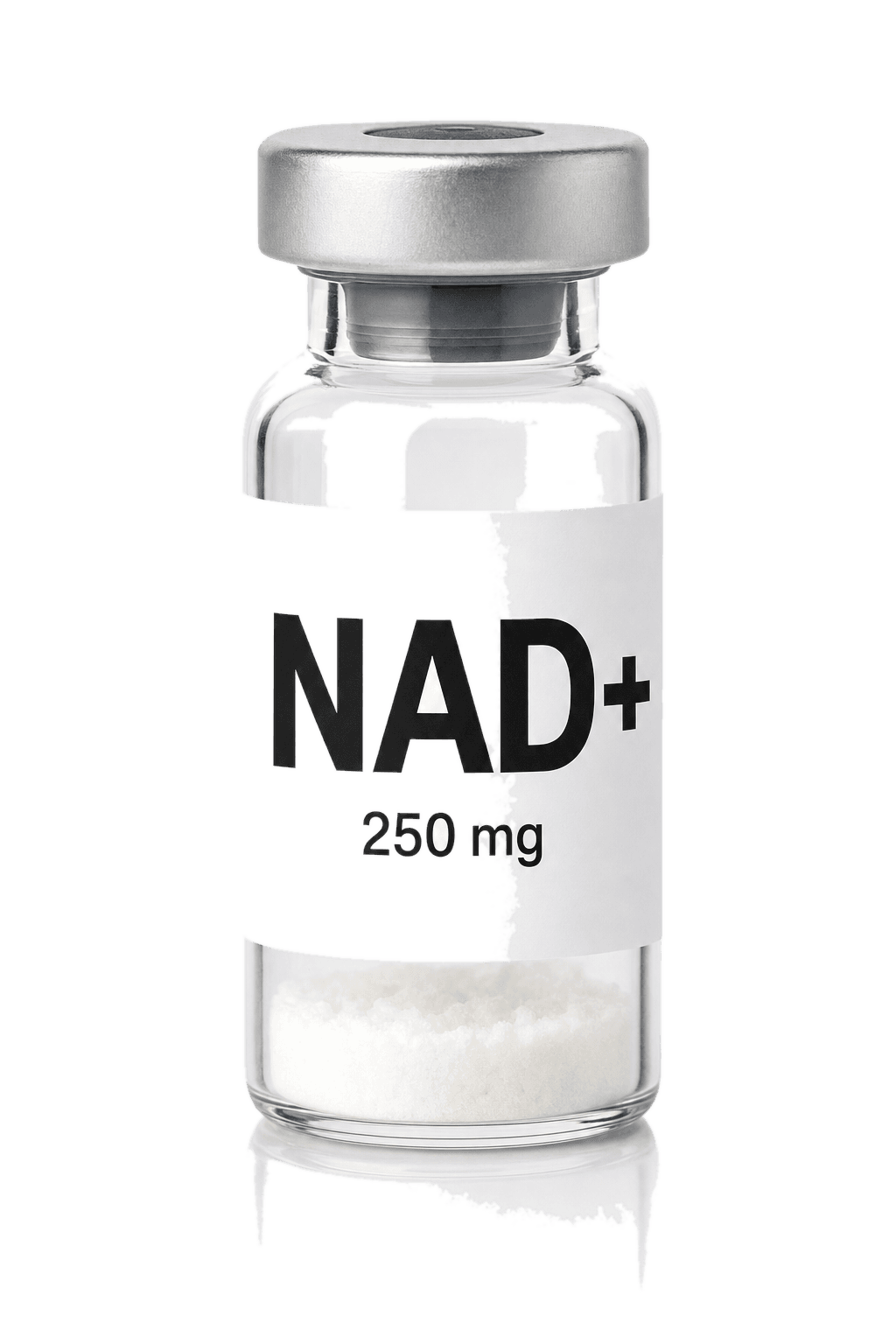
In plain words
NAD+ is a helper molecule every cell uses to make energy. People take it (often by IV) hoping for more energy and “anti-aging” effects. Most side effects come from taking it in too fast.
2 people have this in their stack
Key facts
- Category
- Aging & metabolism
- Legal / FDA status
- Endogenous coenzyme; not an FDA-approved drug for anti-aging or performance. Sold as a research compound and as IV/clinic wellness products, none of which are FDA-approved for those uses
- Half-life
- Not well characterized for administered NAD+ in humans; intracellular NAD+ turns over continuously and is tightly regulated
- Typical form
- Lyophilized (freeze-dried) powder for reconstitution
- Also known as
- Nicotinamide adenine dinucleotide, NAD
Intravenous infusion (clinic) — SC injection is community practice
In clinics, NAD+ is given as a SLOW intravenous infusion (often over hours) — pushing it faster is commonly reported as uncomfortable. Some people report small SUBCUTANEOUS injections at home, which are notoriously stingy at the volumes involved. NAD+ is an endogenous coenzyme, not an FDA-approved drug for anti-aging or performance, and these uses have no validated dose.
Also seen: subcutaneous (community) · intramuscular (community)
Source: Clinic IV practice; human IV pharmacokinetics studied over a 6-hour infusion (Grant et al., Front Aging Neurosci 2019). Not an approved drug for these uses.
NAD+ (nicotinamide adenine dinucleotide) is a coenzyme your cells already make that helps power metabolism, energy production, and DNA repair. It is sold as a research compound and as IV or injectable wellness products, but it is not an FDA-approved drug for anti-aging or performance. This page is for education only and is not medical advice; talk to a licensed clinician before making any health decision.
What is NAD+?#
NAD+ is a coenzyme — a small helper molecule — found in every living cell. Unlike most peptides cataloged here, it is not a synthetic drug or a foreign substance: your body continuously makes its own NAD+ from forms of vitamin B3 (niacin, nicotinamide) and from precursors such as nicotinamide riboside (NR) and nicotinamide mononucleotide (NMN).
Chemically, NAD+ is a dinucleotide built from two nucleotides joined through their phosphate groups, one carrying an adenine base and the other carrying a nicotinamide group. It exists in two interchangeable forms, the oxidized NAD+ and the reduced NADH, and the ratio between them is a key signal of a cell's energy and metabolic state.
In the wellness market, "NAD+" is sold in several different forms: research-grade lyophilized powder labeled "for research use only," injectable preparations, and clinic-administered IV infusions. It is discussed in the longevity and metabolic category because tissue NAD+ levels are reported to decline with age.
How does NAD+ work?#
NAD+ has two broad jobs in the cell.
- Redox / energy metabolism. NAD+ shuttles electrons during the breakdown of carbohydrates, fats, and proteins, cycling between NAD+ and NADH to help drive ATP (energy) production in the mitochondria. This role is fundamental to how cells generate energy.
- Signaling and repair. NAD+ is also consumed as a substrate by enzymes including sirtuins (linked to stress resistance and gene regulation), PARPs (involved in DNA repair), and CD38. Because these enzymes use up NAD+, the cell must constantly regenerate it.
The central idea behind NAD+ research is that tissue NAD+ tends to fall with age and in some disease and ischemic states, which could contribute to mitochondrial dysfunction and impaired repair. The hypothesis is that restoring NAD+ — directly or through precursors — might support healthier aging and metabolism.
It is important to separate mechanism from proven benefit. A plausible biochemical role, even a well-established one, does not by itself prove that taking extra NAD+ or its precursors makes a healthy person live longer or perform better.
What is NAD+ studied for?#
Most human evidence comes from trials of oral precursors (NR and NMN) rather than from NAD+ given directly, and reviewers generally describe the clinical results so far as modest and not firmly established.
| Research theme | Study type | Evidence level in humans |
|---|---|---|
| Raising blood NAD+ levels | Randomized human trials of NR / NMN | Moderate — precursors reliably raise measured NAD+ |
| Healthy aging / longevity | Cell, animal, and small human studies | Low — no proof of extended human lifespan |
| Metabolic health (glucose, lipids) | Small human trials and meta-analyses | Low to mixed — effects small and inconsistent |
| Physical performance / muscle | Randomized trials of NMN (systematic review) | Low — improvements largely non-significant |
| Exercise adaptation, mitochondrial function | Mechanistic and animal studies, some human work | Low — mostly preclinical |
A 2023 Endocrine Reviews paper framed NAD+ in aging biology as having real promise but "many unknowns." A 2023 Science Advances analysis of nicotinamide riboside concluded that oral NR has shown few clinically relevant effects in humans and that the literature tends to exaggerate the importance of reported findings. A 2024 systematic review of NMN trials found mostly non-significant changes in physical performance, while noting it was generally well tolerated.
Is NAD+ legal and FDA-approved?#
NAD+ is not an FDA-approved drug for anti-aging, energy, addiction recovery, cognitive enhancement, or athletic performance. There is no approved NAD+ medicine for those uses.
- IV and injectable NAD+ are offered by wellness clinics under off-label or "integrative" frameworks rather than as FDA-approved treatments; the FDA has not recognized NAD+ infusions as a proven therapy.
- Research-grade NAD+ is sold "for research use only" and is not made to pharmaceutical standards.
- Oral precursors such as NR and NMN are marketed as dietary supplements; under the U.S. DSHEA framework, supplements are not approved by the FDA before sale. The status of NMN specifically was contested — the FDA in 2022 said it was excluded from the supplement definition, then in 2025 reversed course and stated NMN is not excluded — but "lawful as a supplement" is not the same as being an FDA-approved drug.
For athletes: NAD+ is not named on the 2026 WADA Prohibited List. However, anti-doping resources caution that WADA's S0 category can capture non-approved or experimental substances, and that WADA's IV-infusion volume limits may be exceeded by the large fluid volumes used in typical NAD+ drips. Under strict liability, athletes should verify current rules before using any form. None of this is a recommendation to obtain or use the compound, and legal status varies by country.
How is NAD+ dosed in research?#
There is no validated, universally accepted human dose of NAD+ for any anti-aging or performance use, and WikiPeps does not publish dosing protocols or amounts. Reported clinic IV protocols and supplement precursor doses vary widely, come from settings that are not standardized, and are not a guide for personal use. Unregulated research-grade products also carry no assurance of identity, purity, or sterility.
Whether any NAD+ product is appropriate, in what form, and at what amount, is a medical decision that belongs with a licensed clinician who can weigh an individual's health, other medications, and the limited human evidence.
How is NAD+ reconstituted?#
Research-grade NAD+ generally arrives as a lyophilized (freeze-dried) powder that must be reconstituted with a sterile diluent before any laboratory use, kept cold, and protected from rough handling. The general process — disinfecting the stopper, adding diluent slowly down the vial wall, swirling gently rather than shaking, and labeling and refrigerating — is covered step by step in our reconstitution guide. This is described for education only and is not an instruction to self-administer.
What are the safety considerations?#
NAD+ is a natural molecule, but taking it as an infusion or injection is a different matter from the NAD+ your body makes internally, and the long-term safety of supplemental NAD+ in healthy people is not well established.
- IV infusion reactions. Reported side effects of IV NAD+ include nausea, flushing or warmth, lightheadedness, headache, chest pressure or tightness, and muscle cramps. These are commonly linked to fast infusion rates and often ease when the drip is slowed, which is why clinic infusions are typically given slowly over hours.
- Injection and product risks. Any injection carries risks of infection and injection-site reactions, and "research use only" products are not pharmaceutical-grade and may be contaminated or mislabeled.
- Unknown long-term effects. Because NAD+ feeds enzymes involved in cell growth and DNA repair, the long-term consequences of chronically pushing NAD+ levels up are not fully understood, including any theoretical effects on cell-growth biology.
- Interactions and individual factors. Effects in people with existing conditions or on other medications have not been well studied.
These are reasons to involve a licensed clinician before considering any use and to be skeptical of strong anti-aging or energy marketing claims that the current evidence does not support.
The bottom line#
NAD+ is an essential coenzyme your body already makes, central to energy metabolism, DNA repair, and cell signaling, and it appears to decline with age. That biology has fueled interest in NAD+ and its precursors for longevity, metabolic health, and performance — but human evidence to date is modest and far from settled, and most of it tests oral precursors rather than NAD+ itself. NAD+ is not an FDA-approved drug for these uses, IV and injectable products sit in a regulatory gray zone, and supplemental safety over the long term is not well characterized. Use this page for education, treat bold claims cautiously, and consult a licensed clinician before any health decision.
Side effects & safety
Most side effects are tied to infusing or injecting it too fast.
Commonly reported
- Flushing or warmth
- Nausea
- Chest or stomach pressure / cramping (with fast infusion)
- Lightheadedness
These are usually rate-related and ease when slowed down. Long-term injectable use isn't well studied.
Educational only — not medical advice. Everyone responds differently; talk to a licensed clinician before starting NAD+, and stop and seek medical care for any severe or unusual reaction.
Tried NAD+, or have a question about it?
Ask the community or share what you noticed — real people doing this carefully. Takes 30 seconds.
How to reconstitute lyophilized NAD+ (educational overview)
What you'll need
- Vial of lyophilized NAD+
- Bacteriostatic water (or sterile water per product labeling)
- Sterile insulin syringe or reconstitution syringe
- Alcohol prep pads
- Clean, flat work surface
Wash hands and prepare the area
Wash your hands thoroughly and clean a flat work surface. Let the vial and diluent reach room temperature before starting.
Disinfect the stoppers
Wipe the rubber stopper of each vial with a fresh alcohol prep pad and let them air dry.
Draw the diluent
Draw your pre-planned volume of bacteriostatic water into the syringe. Choosing a round number of milliliters keeps later concentration math simple — see our mixing-math guide.
Add the water slowly
Insert the needle and let the water run gently down the inside wall of the vial rather than spraying directly onto the powder, which helps protect the compound.
Dissolve by swirling
Swirl gently until the solution is fully dissolved and clear. Do not shake. Discard the solution if it stays cloudy or shows particles.
Label and refrigerate
Label the vial with the contents, concentration, and date, then refrigerate per product guidance and inspect before any use.
Frequently asked questions
What is NAD+?
- NAD+ (nicotinamide adenine dinucleotide) is a coenzyme found in every living cell. It is not a foreign drug — your body makes it from vitamin B3 forms and from precursors like nicotinamide riboside (NR) and nicotinamide mononucleotide (NMN). It is central to how cells turn food into energy and repair DNA.
What is NAD+ studied for?
- Research interest focuses on aging, metabolic health, mitochondrial function, and exercise adaptation, because tissue NAD+ levels appear to fall with age. Most human work has tested oral precursors (NR, NMN) rather than NAD+ itself, and reviewers describe the clinical benefits to date as modest and not firmly established.
Is NAD+ FDA-approved?
- No. NAD+ is not an FDA-approved drug for anti-aging, energy, addiction recovery, or athletic performance. IV NAD+ infusions and injectable NAD+ are offered by wellness clinics under off-label or 'integrative' frameworks, and research-grade NAD+ is sold 'for research use only.' None of these are FDA-approved products for those uses.
Do oral NAD+ precursors actually raise NAD+ levels?
- Human trials show that oral precursors such as nicotinamide riboside and nicotinamide mononucleotide can raise blood NAD+ levels, often roughly doubling them after about two weeks in some studies. Whether that translates into meaningful clinical benefits in healthy people is still uncertain, and several reviewers caution that effects have been overstated.
What are the risks of IV or injectable NAD+?
- Reported IV NAD+ side effects include nausea, flushing, lightheadedness, headache, chest pressure, and muscle cramps, which are often tied to fast infusion rates. Any injection also carries risks of infection or reactions, and unregulated research-grade products may be contaminated or mislabeled. Talk to a licensed clinician before considering it.
Is NAD+ legal, and is it allowed for athletes?
- NAD+ itself is not a controlled substance and is not named on the 2026 WADA Prohibited List. However, anti-doping experts note that WADA's S0 category covers non-approved substances, and WADA's IV-infusion limits can be exceeded by typical NAD+ drip volumes. Athletes should verify current rules and use strict liability caution.
How is research-grade NAD+ stored and prepared?
- It usually ships as a lyophilized powder that must be kept cold and reconstituted with a sterile diluent before any laboratory use. WikiPeps describes the general handling process for education only and does not publish human dosing protocols or amounts.
References
- 1.Nicotinamide Adenine Dinucleotide in Aging Biology: Potential Applications and Many Unknowns — Endocrine Reviews (PubMed-indexed) · 2023
- 2.Chronic nicotinamide riboside supplementation is well-tolerated and elevates NAD+ in healthy middle-aged and older adults — Nature Communications (PubMed-indexed) · 2018
- 3.What is really known about the effects of nicotinamide riboside supplementation in humans — Science Advances (PubMed-indexed) · 2023
- 4.Improved Physical Performance Parameters in Patients Taking Nicotinamide Mononucleotide (NMN): A Systematic Review of Randomized Control Trials — Cureus (PubMed-indexed) · 2024
- 5.NAD+ homeostasis and its role in exercise adaptation: A comprehensive review — Free Radical Biology and Medicine (PubMed-indexed) · 2024
- 6.Rules, Risks, and Testing of NAD+ in Athletics and Armed Forces — Banned Substances Control Group (BSCG) · 2025
What the research shows
Early human PK; no approved anti-aging useNAD+ is an essential endogenous coenzyme; a small human study characterized the pharmacokinetics of a 6-hour IV infusion, but there are no rigorous trials supporting IV/SC NAD+ for anti-aging or performance. It is not an FDA-approved drug for those uses, which have no validated dose.
A Pilot Study Investigating Changes in the Human Plasma and Urine NAD+ Metabolome During a 6-Hour Intravenous Infusion of NAD+
Grant R, Berg J, Mestayer R, et al. · 2019 · Front Aging Neurosci 2019;11:257
Citations are real, published sources, graded conservatively. Educational only — not medical advice, and not an endorsement to use any compound.
Improve this page
See something out of date or unclear? Propose an edit — an admin reviews every suggestion before any change is made.
Comments & experiences
What members are saying about NAD+ — questions, observations, and lived experience. Not medical advice.
Add a comment
Ask a question or share what you've seen — a star rating is optional. Comments post right away once they pass a quick automated check; anything flagged is reviewed first.